From 1 January 2027, the VAT rate on medicines, medical devices and medical services rises from 5% to 10%. Both rates have been set out in paragraph 2 of Article 503 of the Tax Code of Kazakhstan since the Code was enacted.
In brief
- The 10% rate applies to medicines and medical devices on the list under Government Resolution No. 1204 and to medical services provided by licensed healthcare providers.
- Medicines and services covered by the guaranteed volume of free medical care (GVFMC) or compulsory social health insurance (CSHI), or used to treat rare and socially significant diseases, remain exempt from VAT (lists under Resolution No. 1203).
- The turnover date under Article 460 determines the rate. For goods, this is the date of transfer. For services, it is the date the acceptance certificate is signed. An advance payment does not constitute turnover.
- Returning goods shipped in 2026 reduces turnover by the amount previously taxed at 5%. A price increase for that shipment is taxed at the rate in effect on the adjustment date, which is 10%.
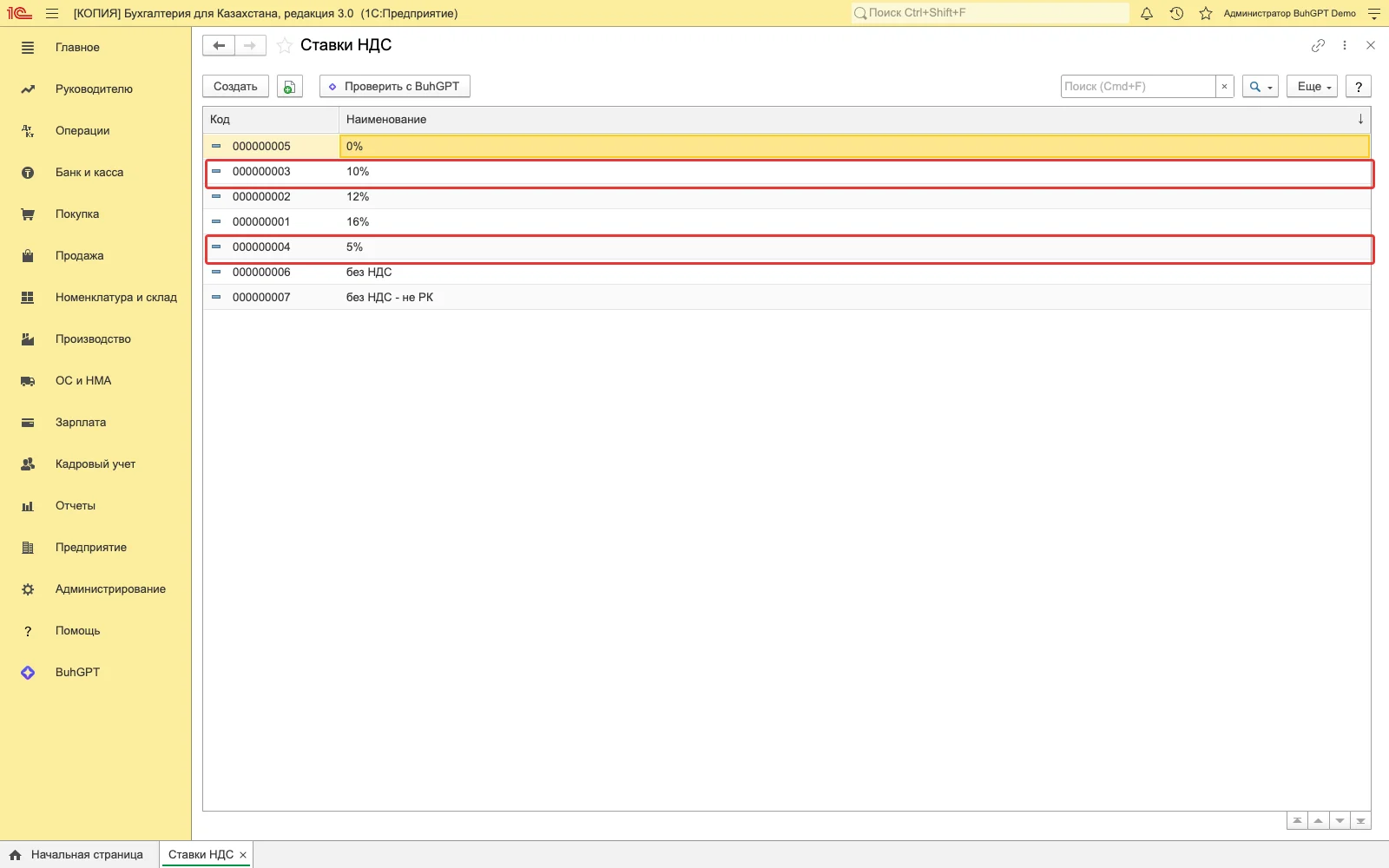
- In 1C:Accounting for Kazakhstan 3.0.75.1, the VAT Rates directory already contains a 10% entry. The rate in the item record is independent of the date, so change it manually after posting all December 2026 documents and before entering the first 2027 document.
The turnover date determines the rate, regardless of when the buyer pays. A shipment on 30 December is taxed at 5%, while a shipment on 4 January is taxed at 10%, even if the buyer paid in December.
What the Tax Code says
The standard VAT rate is 16% (Article 503, paragraph 1). Paragraph 2 of the same article sets a reduced rate of 5% from 1 January 2026 and 10% from 1 January 2027. It applies to two categories of transactions:
- The sale and import of medicines, medical devices and their components, as well as assistive (compensatory) devices. The Government approves the list (Article 503, paragraph 2, subparagraph 1).
- The provision of medical services, including bundled services, by a healthcare provider licensed to carry out medical activities (Article 503, paragraph 2, subparagraph 2).
What is exempt from the 10% rate
Both categories exclude VAT-exempt medicines and medical services covered by the guaranteed volume of free medical care or CSHI, as well as those used to treat rare and socially significant diseases (Article 474, subparagraph 28).
Imports of these medicines are exempt under subparagraph 17 of paragraph 1 of Article 479.
No special transitional rules
The Code contains no special transitional rules for the change from 5% to 10%. The transitional provisions are in Section 22 (Articles 828–847), which does not address the rate for medicines and medical services.
The general rules on turnover dates, turnover adjustments and invoice issuance therefore apply at year-end.
| What you sell | 2026 | From 1 January 2027 |
|---|---|---|
| Medicines and medical devices on the list under Resolution No. 1204 | 5% | 10% |
| Medical services provided by a licensee, excluding exempt services | 5% | 10% |
| Medicines and medical services on the lists under Resolution No. 1203 (GVFMC, CSHI, rare and socially significant diseases) | Exempt | Exempt |
| Pharmacy goods outside the list under Resolution No. 1204, such as cosmetics and household goods | 16% | 16% |
Legal basis:
- Medicines and medical devices — Tax Code of Kazakhstan, Article 503, paragraph 2, subparagraph 1, and Government Resolution No. 1204
- Medical services — Tax Code of Kazakhstan, Article 503, paragraph 2, subparagraph 2
- Exemption — Tax Code of Kazakhstan, Article 474, subparagraph 28
- Other goods — Tax Code of Kazakhstan, Article 503, paragraph 1
Which lists apply
List for the 5%/10% rate
The list for the 5%/10% rate was approved by Resolution No. 1204 of the Government of Kazakhstan dated 31 December 2025 and amended by Resolution No. 542 dated 24 June 2026. It contains 243 entries with Eurasian Economic Union Commodity Nomenclature (EAEU CN) codes. The list includes:
- Pharmaceutical products in Chapter 30.
- Medical devices, such as contact lenses and spectacle lenses for vision correction in Chapter 90.
- Raw materials and other materials used to manufacture pharmaceutical products and medical devices.
The note to the list expressly restates the rates as “5 percent from 1 January 2026 and 10 percent from 1 January 2027.” Importers need a licence or notification and a registration certificate (or an authorisation document). The list does not apply to veterinary medicines.
Exemption lists
The exemption lists were approved by Resolution No. 1203 of the Government of Kazakhstan dated 31 December 2025, which was also amended by Resolution No. 542. It contains three lists:
- Medical services
- Medicines exempt upon sale
- Medicines exempt upon import
The rules governing the import exemption were approved separately.
Important: The reduced rate for medical services is determined directly by two conditions in the Tax Code, so there is no separate list of services subject to 10%:
- The service is a medical service
- The provider holds a licence to carry out medical activities
The list under Resolution No. 1203 serves only to identify exempt services covered by the GVFMC and CSHI.
Who is affected
- VAT-registered distributors and pharmacies.
- Importers of medicines and medical devices.
- Licensed clinics and laboratories that provide paid services outside the GVFMC and CSHI.
A pharmacy under a special tax regime does not pay VAT because its turnover under that regime is classified as non-taxable (Article 450, subparagraph 5).
The turnover date determines the rate
The VAT rate applies to taxable turnover (Articles 502 and 503). Article 460 determines the turnover date:
- Goods delivered by the supplier — the date the goods are handed over to the carrier or loaded onto the supplier’s vehicle (paragraph 1, subparagraph 1). If the goods left the warehouse on 30 December and reached the pharmacy on 3 January, the turnover falls in December and the rate is 5%.
- Goods supplied without delivery — the date both parties sign the transfer document (paragraph 1, subparagraph 2).
- Services — the date the certificate of completed work or services rendered is signed. If there is no certificate, use the signature date of another primary accounting document, excluding the invoice (paragraph 3). If the document contains several dates, use the latest one (paragraph 15).
Important: An advance payment does not constitute sales turnover. It appears neither in Article 452 nor among the turnover dates in Article 460.
Issue the invoice on or after the turnover date and within 15 calendar days after that date (Article 493, paragraph 1).
Year-end scenarios using the same example
A distributor sells medicines from the list under Resolution No. 1204 to a pharmacy chain. The batch costs 1 000 000 tenge excluding VAT. Both the distributor and the buyer are VAT payers.
Scenario 1. Shipment in December and payment in January
Example: The goods were transferred to the buyer under a delivery note on 28.12.2026, and payment arrived on 15.01.2027. The turnover occurred in December and the rate is 5%.
- VAT: 1 000 000 × 5% = 50 000 tenge.
- Amount payable: 1 000 000 + 50 000 = 1 050 000 tenge.
The electronic invoice (e-invoice) can be issued through 12.01.2027 inclusive (28 December + 15 days). Enter 28.12.2026 in the “Turnover Date” field and use the 5% rate, even though the e-invoice is issued in January.
Report the turnover in the VAT return for Q4 2026. The VAT tax period is one quarter (Article 504).
Scenario 2. Advance payment in December and shipment in January
The pharmacy paid 1 050 000 tenge on 20.12.2026 against a bill marked “including VAT at 5%” and received the goods on 11.01.2027. The turnover occurred in January, so the rate is 10%. The amount the seller receives depends on the contract’s pricing terms.
Example: A price of 1 000 000 “plus VAT”.
- Turnover: 1 000 000,00.
- VAT at 10%: 1 000 000 × 10% = 100 000,00.
- Total: 1 100 000,00 (additional payment of 50 000).
Example: A fixed price of 1 050 000 “including VAT”.
- VAT at 10%: 1 050 000 × 10 / 110 = 95 454,55.
- Turnover: 954 545,45.
- Check: 954 545,45 × 10% = 95 454,545, which rounds to 95 454,55. The sum is 954 545,45 + 95 454,55 = 1 050 000,00.
- Total: 1 050 000,00.
Important: If the contract makes no provision for an additional payment, the difference of 45 454,55 tenge (1 000 000 − 954 545,45) reduces the seller’s revenue. For these contracts, it is best to agree on the pricing terms by the end of December.
Scenario 3. Goods shipped in 2026 and returned in 2027
In February 2027, the pharmacy returned 20% of the December batch from the first scenario. A return requires an adjustment to the amount of turnover (Article 464, paragraph 2, subparagraph 1).
Include the adjustment in turnover for the period in which the return occurred (paragraph 5), which is Q1 2027. The reduction cannot exceed the turnover previously reported (paragraph 6).
Example: The original 1 000 000 was taxed at 5%, so:
- Turnover decreases by 1 000 000 × 20% = 200 000 tenge
- VAT decreases by 200 000 × 5% = 10 000 tenge, not by 20 000
The supplier issues a supplementary e-invoice to the December e-invoice (Article 500, paragraph 1, subparagraph 1) showing the turnover and VAT adjustments and the turnover date for the adjustment amount.
The VAT-paying buyer reduces its input VAT credit by exactly the VAT amount shown on the supplementary e-invoice (Article 484, paragraph 3). The return itself does not constitute sales turnover for the buyer (Article 453, subparagraph 6).
Scenario 3a. The price of a December shipment increases in 2027
The Code expressly provides that when turnover is adjusted upwards, VAT is calculated at the rate in effect on the adjustment date (Article 464, paragraph 7).
Example: An additional payment of 50 000 tenge excluding VAT is agreed in March 2027 and taxed at 10%.
- VAT: 50 000 × 10% = 5 000 tenge.
Scenario 4. Adjusting an e-invoice
The type of e-invoice to issue depends on the reason:
| Reason | Type of e-invoice | Rate |
|---|---|---|
| Return, discount, or change in price or transaction terms | Supplementary (Article 500), within 15 days of the adjustment date (Article 493, paragraph 7) | Reduction capped at the amount calculated at 5%. Increase taxed at 10%. |
| Error: a January shipment was invoiced at 5% | Corrected (Article 499). The original e-invoice is cancelled. | 10% based on the turnover date |
| Error: a December shipment was invoiced in January at 10% | Corrected (Article 499) | 5% based on the turnover date |
Turnover adjustments under Article 464 do not apply to errors (paragraph 3). The VAT-paying buyer must confirm or reject a corrected or supplementary e-invoice (Article 499, paragraph 4, and Article 500, paragraph 4).
Medical services at year-end
A clinic provided a course of procedures in December, and the acceptance certificate with the corporate client was signed on 05.01.2027. The turnover date is the date the certificate was signed (Article 460, paragraph 3), so the rate is 10%. To apply 5%, sign the certificate for December services in December.
How the VAT change affects pharmacy retail prices
If the shelf price includes VAT and stays the same in January, revenue excluding VAT falls.
Example: Take a pack priced at 1 050 tenge.
- 2026: 1 050 × 5 / 105 = 50,00 in VAT, with revenue of 1 000,00.
- 2027: 1 050 × 10 / 110 = 95,45 in VAT, with revenue of 954,55 (954,55 + 95,45 = 1 050,00).
- To maintain revenue of 1 000 tenge, the price must rise to 1 000 × 1,10 = 1 100 tenge.
Management sets the price. The accountant’s role is to ensure that the VAT rate in the item records and at the cash register changes at the same time on 1 January.
Stock purchased in 2026 at 5% is sold in 2027 at 10%. The input VAT credit is based on the VAT shown on the supplier’s e-invoice (Article 480), which is 5%. Output VAT will therefore exceed the input VAT credit.
What is available in 1C:Accounting for Kazakhstan 3.0.75.1
The configuration export confirms the following:
- The VAT rate is stored in the “VAT Rates” directory rather than in an enumeration. The fields are “VAT Rate, %”, “For Exempt Turnover” and “Place of Supply Outside Kazakhstan”.
- The directory already contains a “10%” entry. The version 3.0.69.1 update handler “ДобавитьЗаполнитьНовыеСтавкиНДС2026” creates it. The 10% rate also applies to domestic printed periodicals (Article 503, paragraph 3), so the entry is already available for use.
- The rate for a product is stored in the “VAT %” field of its item record as a single value with no date history. Selecting the item in a document copies the rate from the record, regardless of the document date.
- A “Customer Inventory Return” created from a sales document takes the VAT rate and amount from the source document.
- “Sales Adjustment” has the columns “VAT %”, “VAT Amount Before Adjustment” and “VAT Amount”.
How to switch items to 10% VAT
- Before 31 December, open Enterprise → Taxes → Value Added Tax → VAT Rates and check that the “10%” entry exists. The “VAT Rate, %” field should show 10.
- Open Items and Inventory → Directories and Settings → Items and filter the “VAT %” column to “5%”. This gives you the items to update.
- Check the items against the list under Resolution No. 1204 using the “Commodity Nomenclature Code” field in each item record.
- Check that exempt items on the lists under Resolution No. 1203 use the “No VAT” rate.
- Post all December documents, including sales with a turnover date through 31.12.2026, retail sales reports for 31 December and service acceptance certificates signed in December.
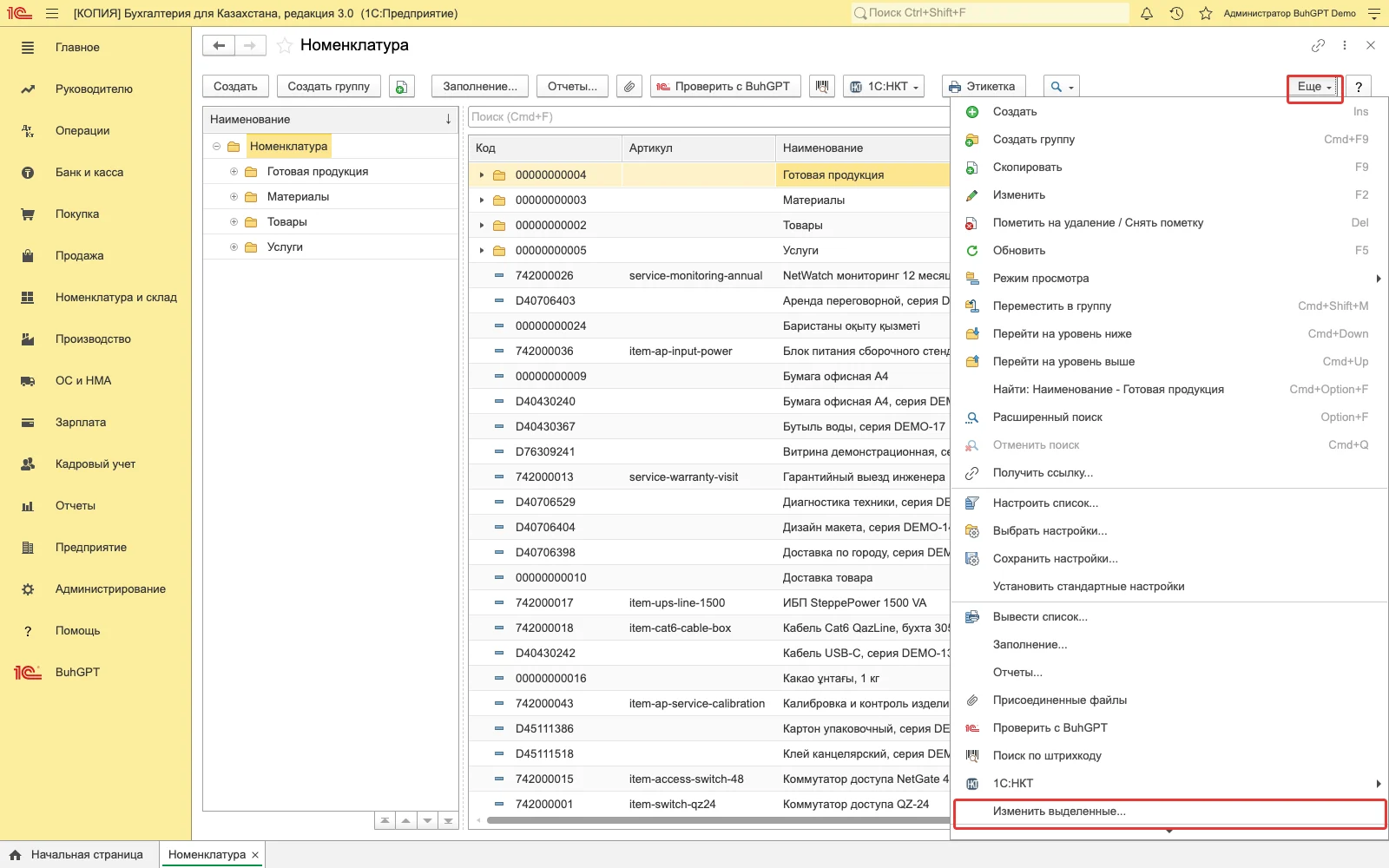
- After posting all December 2026 documents and before entering the first 2027 document, select the items in the list.
- Choose “Edit Selected” and set “VAT %” to “10%”. For a large directory, use Administration → Bulk Edit Fields with the same filter.
- Create a test “Sale of Inventory and Services” document (Sales → Sales) dated 01.01.2027.
- Check that the “VAT %” column shows 10% and that the “VAT Amount” has been recalculated.
- Check the rate on the pharmacy’s cash register, which generates the retail receipt.
Important: If you enter a late December document after updating the item records, 1C will insert 10%. Manually change the rate on the line to 5%. A January document copied from a December document will retain the 5% rate.
How to process returns and adjustments in 2027
Return of a December shipment
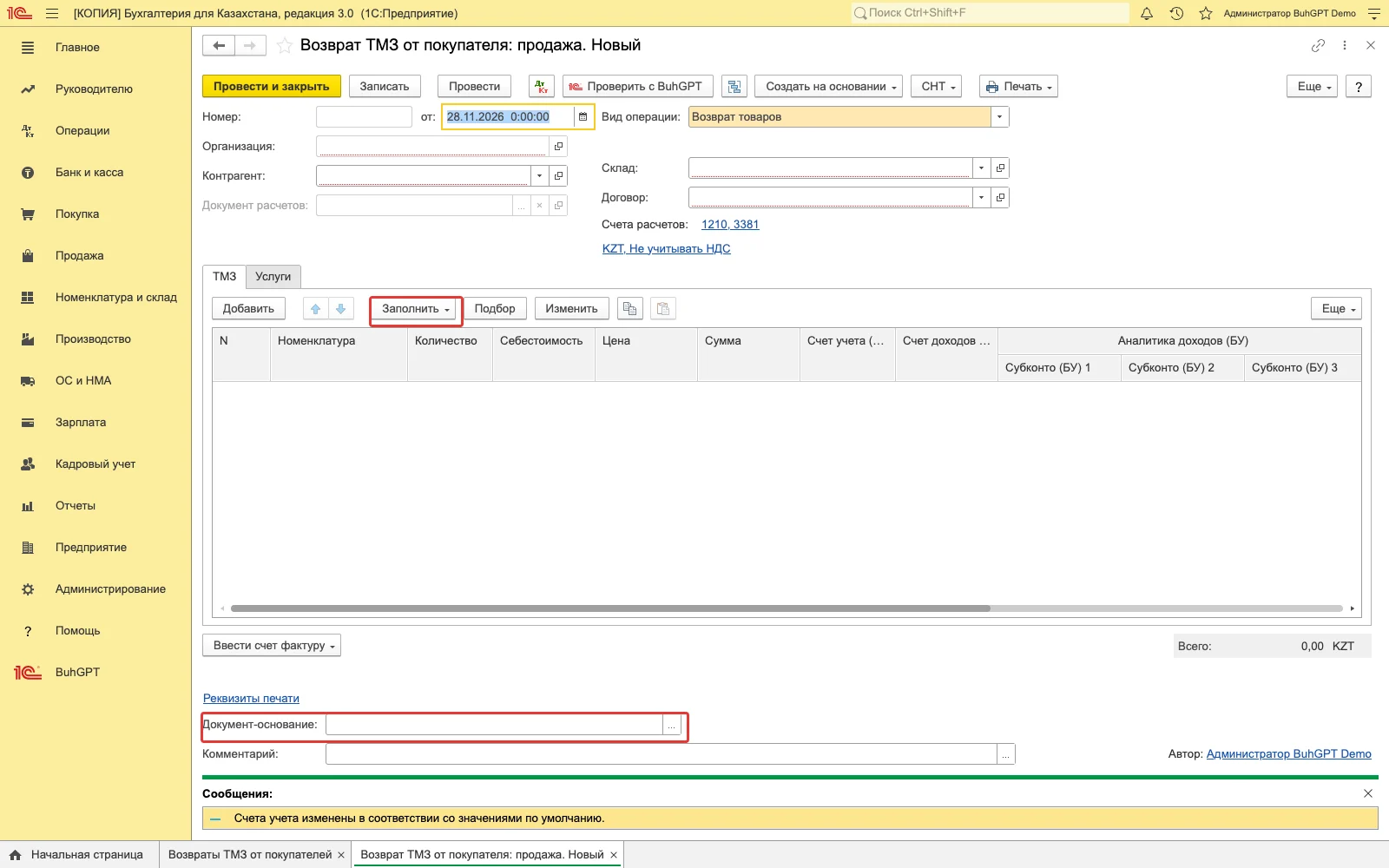
- Open Sales → Sales → Customer Inventory Return.
- Click “Fill” or create the return from the sales document.
- Keep “VAT %” at 5%, as shown in the source document.
Price change for a December shipment
- Open Sales → Sales → Sales Adjustment.
- Select “Adjustment by Agreement of the Parties” as the transaction type.
- Check the “VAT Amount” column before posting. For a price increase, calculate VAT at 10% on the amount of the increase (Article 464, paragraph 7). The document calculates VAT using the rate on the line, so check the result against a manual calculation.
Supplementary e-invoice
- Issue the supplementary e-invoice from the adjustment or return document.
- Check that the “Turnover Date” field shows the return or adjustment date.
December and January checklist
December 2026
- Check item codes against the list under Resolution No. 1204 and group the items by rate: 5%→10%, “No VAT” and 16%.
- Review contracts with advance payment and shipment after 1 January to see whether the price is “plus VAT” or “including VAT”.
- Clinics should sign acceptance certificates for December services in December.
- Distributors should record the handover or loading date for shipments in the final days of the year.
- Issue e-invoices for December shipments. For a shipment on 31 December, the deadline is 15 January 2027 and the rate is 5%.
January 2027
- Change “VAT %” in the item records to 10% after posting all December 2026 documents and before entering the first 2027 document.
- Check that the first January sales, retail sales reports and e-invoices use the 10% rate.
- Process returns of goods sold in 2026 using the source document with the 5% rate.
- Reconcile supplementary e-invoices with buyers. Each buyer reduces its input VAT credit by the amount shown on the supplementary e-invoice.
Frequently asked questions
The buyer paid in December. Can I apply 5%? — No. An advance payment does not constitute turnover. The rate is determined by the date the goods are transferred or the acceptance certificate is signed (Articles 452 and 460). A January shipment is taxed at 10%.
I am issuing an e-invoice for a December shipment on 10 January. Which rate applies? — 5%. Enter the 2026 turnover date on the e-invoice and issue it within 15 calendar days after that date (Article 493, paragraph 1).
The buyer returned goods from a November batch in March 2027. Which rate should I use to reduce VAT? — Use 5%, the rate applied to the shipment. The reduction cannot exceed the turnover previously reported (Article 464, paragraph 6). Report the adjustment in Q1 2027 (Article 464, paragraph 5).
Are all medicines taxed at 10%? — No. Medicines covered by the GVFMC or CSHI or used to treat rare and socially significant diseases are exempt (Article 474, subparagraph 28, and the list under Resolution No. 1203). Goods outside the list under Resolution No. 1204 are taxed at 16%.
Are paid clinic services taxed at 10%? — Yes, if the provider is a healthcare entity licensed to carry out medical activities and the service is a medical service that falls outside the GVFMC or CSHI exemption (Article 503, paragraph 2, subparagraph 2).
Do I need to wait for a 1C update to use the 10% rate? — The “10%” entry is already available in the “VAT Rates” directory in release 3.0.75.1. Update the item records manually or use bulk editing.
Will import rates change? — Yes. Article 503, paragraph 2 also applies to imports of goods on the list under Resolution No. 1204. The rate is 10% from 1 January 2027.
Sources
- Tax Code of Kazakhstan, Article 503 — VAT rates
- Tax Code of Kazakhstan, Article 460 — turnover date
- Tax Code of Kazakhstan, Article 464 — adjustment of the amount of turnover
- Tax Code of Kazakhstan, Article 474 — exempt turnover (subparagraph 28)
- Tax Code of Kazakhstan, Article 484 — adjustment of creditable input VAT
- Tax Code of Kazakhstan, Article 493 — invoice issuance deadlines
- Tax Code of Kazakhstan, Article 499 — corrected invoice
- Tax Code of Kazakhstan, Article 500 — supplementary invoice
- Tax Code of Kazakhstan dated 18.07.2025 No. 214-VIII (full text)
- Resolution No. 1204 of the Government of Kazakhstan dated 31.12.2025 — list of medicines and medical devices subject to the 5%/10% rate
- Resolution No. 1203 of the Government of Kazakhstan dated 31.12.2025 — healthcare VAT exemptions
- Resolution No. 542 of the Government of Kazakhstan dated 24.06.2026 — amendments to Resolutions No. 1203 and No. 1204