
In 2026, individual income tax (PIT) on an individual’s ordinary taxable income is calculated at 10% on annual taxable income up to and including 8 500 monthly calculation indices (MCIs) and at 15% on the excess. With an MCI of 4 325 tenge, the threshold is 36 762 500 tenge per calendar year. In the month when cumulative taxable income crosses this threshold, part of the income may be taxed at 10% and part at 15% (Article 363 of the Tax Code of the Republic of Kazakhstan).
PIT withholding is the deduction of individual income tax from an individual’s income by a tax agent. The tax agent calculates PIT when taxable income is accrued and withholds it by the date the income is paid (Article 440 of the Tax Code of the Republic of Kazakhstan). When checking the calculation, distinguish accrued salary from taxable income. The progressive tax schedule applies to taxable income for the calendar year (Article 363 of the Tax Code of the Republic of Kazakhstan).
If the software has split the income between the 10% and 15% rates, the accountant should check year-to-date taxable income, the amount remaining before the 36 762 500 tenge threshold, and the amount above it. Total tax should equal 10% of the portion within the threshold plus 15% of the excess alone (Article 363 of the Tax Code of the Republic of Kazakhstan).
Why PIT was withheld at two rates
Two rates apply in the same month when an employee is below the annual threshold before income is accrued and exceeds it after the accrual. The portion of the current month’s taxable income that falls within the 8 500 MCI threshold is taxed at 10%, and the rest is taxed at 15% (Article 363 of the Tax Code of the Republic of Kazakhstan).
For example, August itself does not trigger the higher rate. The rate depends on the individual employee’s cumulative taxable income for the calendar year. One employee may cross the threshold in August, while another may cross it later or never reach it, even if their base salaries are identical in a given month.
Two PIT line items alone do not indicate a calculation error. Verify the automated calculation by checking the period, taxable income, deductions applied, and how the tax base was split between the rates.
How the higher PIT bracket works in 2026
The calculation below gives the threshold for 2026.
8 500 × 4 325 tenge = 36 762 500 tenge.
Once income reaches the threshold, the 10% rate still applies to income up to 36 762 500 tenge. The 15% rate applies only to the excess. Use the following formula to check annual PIT once income exceeds the threshold.
3 676 250 tenge + 15% × the amount above the threshold.
Here, 3 676 250 tenge is 10% of the 36 762 500 tenge threshold. This calculation follows the progressive tax schedule for an individual’s ordinary taxable income for the calendar year (Article 363 of the Tax Code of the Republic of Kazakhstan).
In the month when income crosses the threshold, the calculation has two parts.
The portion of taxable income still within the annual threshold is taxed at 10%.
Taxable income above the annual threshold is taxed at 15% (Article 363 of the Tax Code of the Republic of Kazakhstan).
Use annual taxable income for the threshold comparison in place of base salary or total accruals. The tax deductions applied affect that amount. The basic tax deduction in 2026 is 30 MCIs, or 129 750 tenge, per month, up to a maximum of 360 MCIs per calendar year (Article 403 of the Tax Code of the Republic of Kazakhstan).
Example of calculating PIT in the month the threshold is exceeded
Suppose an employee’s cumulative taxable income before the current month is 36 000 000 tenge and their taxable income for the current month is 1 500 000 tenge.
Find the amount remaining before the threshold by subtracting 36 000 000 from 36 762 500. The result is 762 500 tenge.
Calculate PIT on the portion within the threshold using 762 500 × 10% = 76 250 tenge.
Find the excess for the current month using 1 500 000 − 762 500 = 737 500 tenge.
Calculate PIT on the excess using 737 500 × 15% = 110 625 tenge.
Add the two amounts to get 76 250 + 110 625 = 186 875 tenge.
In this example, PIT on the current month’s taxable income is 186 875 tenge. Applying the 15% rate to the entire month’s income would overstate the tax because the higher rate applies only to the amount above 36 762 500 tenge (Article 363 of the Tax Code of the Republic of Kazakhstan).
Portion of income | Amount | Rate | PIT |
|---|---|---|---|
Within the threshold | 762 500 tenge | 10% | 76 250 tenge |
Above the threshold | 737 500 tenge | 15% | 110 625 tenge |
Monthly total | 1 500 000 tenge | — | 186 875 tenge |
Who is subject to PIT withholding at the higher rate
The progressive tax schedule applies to an individual’s ordinary taxable income for the calendar year, with a 10% rate up to and including 8 500 MCIs and a 15% rate on the excess (Article 363 of the Tax Code of the Republic of Kazakhstan). Employees with substantial cumulative taxable income or a large one-off accrual may be taxed at two rates in the same month.
Take particular care when calculating tax for the following employees.
Employees with high regular income who are approaching the annual threshold.
Employees with a one-off bonus or another large accrual that causes them to cross the threshold in a single month.
Employees with several types of payments that the tax agent includes in taxable income.
Employees whose accruals or deductions have been corrected, because recalculation changes cumulative taxable income.
Two employees with the same base salary may cross the threshold in different months. Bonuses, employment start dates, the types of taxable payments, and the tax deductions applied all affect the calculation. Comparing current base salaries alone cannot establish whether PIT was calculated correctly.
Why PIT may go unwithheld
If the PIT line is missing or the software shows a zero amount, check taxable income first. A zero result can occur when the deductions applied reduce the tax base for the calculation period to zero. In 2026, the basic deduction is 30 MCIs per month, or 129 750 tenge, with a limit of 360 MCIs per calendar year (Article 403 of the Tax Code of the Republic of Kazakhstan).
Follow these steps in order.
Verify the employee’s accrued income for the month.
Review the taxable income amount.
Check which tax deductions were applied and make sure each was recorded only once.
Confirm that the accrual is assigned to the correct employee and calculation period.
Check the document date and the source data used in the calculation.
After correcting the data, rerun payroll and verify the breakdown.
A zero result alone does not warrant adding PIT manually. First identify the cause in the accruals, deductions, or taxable income, then recalculate.
How to check PIT withholding in 1C
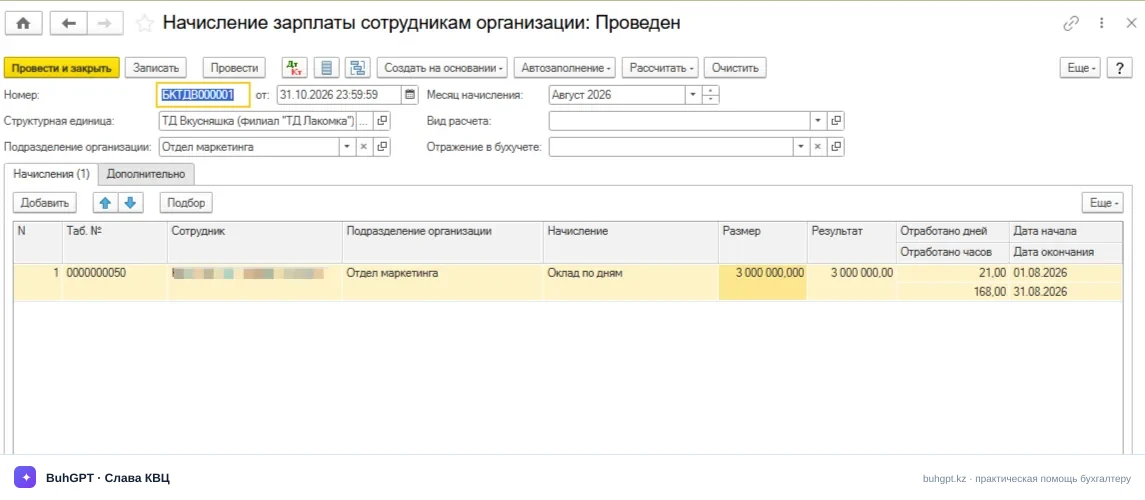
Go to “Payroll” → “Employee Payroll Accruals for Organizations”. Select the document for the relevant month, open the “Accruals” tab, and find the employee. Compare the accruals for the month with the underlying HR and payroll records.
Go to “Payroll” → “Employee Withholding Calculations”. Check the PIT calculated for the employee against their taxable income and tax deductions.
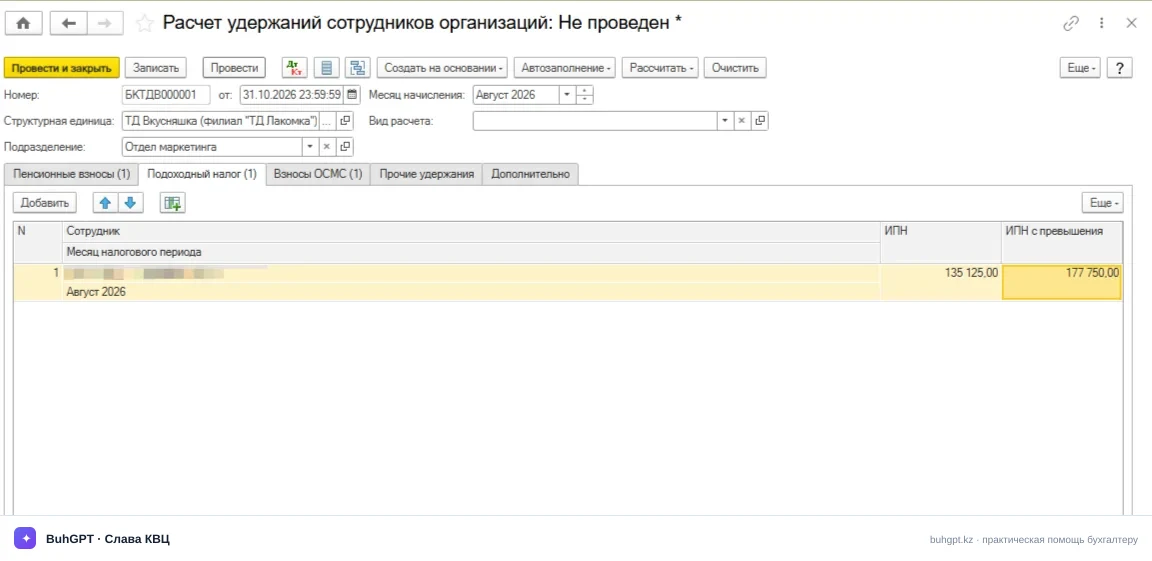
Check year-to-date taxable income. It should show why the 36 762 500 tenge threshold was crossed in this particular month.
Verify the tax deductions. An incorrectly entered, omitted, or duplicated deduction changes taxable income and the month when the 15% rate starts to apply.
After correcting the source data, repost the payroll accrual document. Then regenerate the payslip and verify the total PIT.
If cumulative taxable income, deductions, and the split between the rates match the calculation under the progressive tax schedule, the two rates alone do not warrant a separate recalculation (Article 363 of the Tax Code of the Republic of Kazakhstan).
What happens if PIT is not withheld
The tax agent must withhold PIT by the date the taxable income is paid (Article 440 of the Tax Code of the Republic of Kazakhstan). PIT withheld at source from salary must be remitted by the 25th day of the month following the month in which the income was paid (Article 560 of the Tax Code of the Republic of Kazakhstan). A calculation error therefore affects both the amount payable to the employee and the tax liability owed to the state budget.
If an error is found, the accountant should identify the employee and period, check the accruals and deductions, correct the source data, recalculate PIT, and compare the corrected amount with the amount remitted. Information on arrears and the taxpayer’s account can be checked in the Taxpayer Cabinet of the Integrated Tax Administration System.
What to explain to the employee
Show the employee how the higher rate applies to their income. Only the portion of ordinary annual taxable income above 8 500 MCIs is taxed at 15%. The amount within the threshold is taxed at 10% (Article 363 of the Tax Code of the Republic of Kazakhstan).
To illustrate the calculation, provide the payslip and a separate breakdown showing the following amounts.
Cumulative taxable income before the current month
Taxable income for the current month
Amount remaining before the 36 762 500 tenge threshold
Portion of income taxed at 10%
Excess taxed at 15%
Total PIT
If the source data and the split between the rates match the progressive tax schedule, the two rates alone do not require recalculation. If you find an incorrect accrual, an erroneous deduction, or an incorrect cumulative tax base, correct the data first and then rerun the calculation.
Frequently asked questions
Why was PIT withheld at two rates in the same month? — Annual taxable income crossed the threshold of 8 500 MCIs that month. The portion within the threshold is taxed at 10%, and the excess is taxed at 15% (Article 363 of the Tax Code of the Republic of Kazakhstan).
Why is 1C showing no PIT withholding? — Check taxable income, the deductions applied, the document period, and the source data used in the calculation. In 2026, the basic deduction is 30 MCIs, or 129 750 tenge, per month, so applying it may reduce the tax base for the period to zero (Article 403 of the Tax Code of the Republic of Kazakhstan).
Do I need to rerun payroll if PIT was withheld at two rates? — No, if cumulative taxable income and the split between the rates were calculated correctly. Recalculate if there is an error in the accruals, deductions, period, or cumulative taxable income.
What should I do if PIT was left unwithheld by mistake? — Correct the source data, recalculate the tax, and compare it with the amount remitted. The tax agent must withhold PIT by the date the income is paid (Article 440 of the Tax Code of the Republic of Kazakhstan), and PIT on salary must be remitted by the 25th day of the month following the month of payment (Article 560 of the Tax Code of the Republic of Kazakhstan).
How can I quickly show an employee that the withholding is correct? — Show the cumulative taxable income, the amount remaining before the threshold, the excess, and the tax calculated at each rate. The sum of the two amounts should match the total PIT on the payslip.