From 17 October 2026, tax deferrals and installment plans are processed using updated forms and Rules. Order No. 664 of the Minister of Finance of the Republic of Kazakhstan, dated 30 September 2026, No. 664, introduced them by replacing all four annexes to Order No. 651 (Order No. 664).
Article 133 of Kazakhstan’s 2026 Tax Code sets the maximum periods: up to 6 months for a deferral and up to 36 months for an installment plan. Under the Rules, taxpayers with debt of up to 1500 monthly calculation indices (MCI) can apply without collateral or a bank guarantee, with installment plans limited to 12 months in that case.
At a glance
- Order No. 664 was published on 6 October 2026 and takes effect after 10 calendar days have elapsed, on 17 October 2026.
- The application form, decision form, standard pledge agreement, and Rules have been replaced.
- Installment plans without collateral or a guarantee (for debt of up to 1500 MCI) are limited to 12 months.
- Applications with missing documents now go on a “digital waiting list,” and applicants are given time to correct the deficiencies before the application can be returned.
- For applications without collateral, only outstanding notices under subparagraphs 3), 5), and 7) of paragraph 1 of Article 83 of the Tax Code affect eligibility.
- Late-payment penalties continue to accrue on the deferred amount during the deferral period (Article 132 of Kazakhstan’s Tax Code).
What Order No. 664 changed
Order No. 664 keeps Order No. 651 of 31 October 2025 in force and replaces its preamble and all four annexes (Order No. 651).
| Item | Details |
|---|---|
| Document | Order No. 664 of the Minister of Finance of the Republic of Kazakhstan |
| Order date | 30 September 2026 |
| Registration with the Ministry of Justice | 1 October 2026, No. 40052 |
| Publication date | 6 October 2026 (Reference Control Bank of Regulatory Legal Acts) |
| Effective date | 17 October 2026, after 10 calendar days have elapsed following publication |
Replaced annexes
- Annex 1 — application form for a deferral or installment plan
- Annex 2 — decision form for granting or denying an application
- Annex 3 — standard property pledge agreement
- Annex 4 — Rules and conditions for granting deferrals and installment plans
Key changes for accountants
The table compares the version of Order No. 651 in force from 1 January 2026 with the version introduced by Order No. 664.
| Issue | Before 17.10.2026 | From 17.10.2026 |
|---|---|---|
| Installment period without collateral or a guarantee | No separate limit. Up to 36 months, or up to 12 months for horizontal monitoring participants | Up to 12 months, the same as for horizontal monitoring participants |
| Incomplete application package | Application rejected on submission. Public service centers issue a written notice of refusal | Application accepted via the “digital waiting list” with time to correct deficiencies |
| Notices that prevent approval without collateral | Outstanding notices “under Article 83 of the Tax Code” | Only notices under subparagraphs 3), 5), and 7) of paragraph 1 of Article 83 of the Tax Code |
| Service providers | State revenue authorities for districts, cities, and districts within cities | Regional state revenue authorities added |
The other changes are mainly terminological. “Digital systems” replaces “information systems,” and “digital government” replaces “electronic government.” A new note in the decision form states that a decision made by a state revenue authority’s automated digital system is authenticated with that system’s electronic digital signature (EDS). Under the standard pledge agreement, private business entities are exempt from using a seal.
Important The application form (Annex 1) is published as an image on Adilet, so the old and new form fields cannot be compared as text. Use the current form when applying.
- Download the current form from the Order No. 664 page.
- When applying after 17 October 2026, discard any previously saved template.
Who qualifies for a deferral or installment plan
Under the Tax Code, a deferral or installment plan is available to a taxpayer who cannot pay the tax by the original deadline but is likely to be able to pay within the deferral period. One of seven grounds must apply (paragraph 2 of Article 133 of Kazakhstan’s Tax Code):
- Loss caused by force majeure, such as an emergency or military action.
- Seasonal production or sales.
- An individual who is not an individual entrepreneur cannot pay the full amount immediately due to their financial circumstances.
- A court has ordered debt restructuring.
- The taxpayer’s main activity is in an industry of strategic importance under Kazakhstan’s laws.
- The taxpayer has filed supplementary tax returns.
- The taxpayer has accepted the additional assessments specified in an audit findings notice and has been registered for at least five years.
To apply on seasonal grounds, the Rules require the taxpayer to prepare a document showing that income from seasonal activities accounts for at least 50% of total sales income (paragraph 8 of the List, Order No. 664).
Which taxes can be deferred
Deferrals are available for taxes calculated in tax returns or additionally assessed following an audit, as well as land use fees and fees for negative environmental impact. A deferral may cover all or part of the amount due for one or more taxes (paragraph 3 of Article 133 of Kazakhstan’s Tax Code).
Important Paragraph 3 of Article 133 of the Tax Code expressly excludes the following taxes and payments from deferral.
- Taxes withheld at source, such as individual income tax (IIT) on wages and corporate income tax (CIT) on nonresident income.
- Excise duties and VAT on goods imported from Eurasian Economic Union (EAEU) member states.
- Signature bonus.
- Taxes paid into the National Fund.
Social payments, including mandatory pension contributions, mandatory employer pension contributions, social contributions, and mandatory social health insurance contributions, fall outside the categories of taxes and fees covered by Article 133 of the Tax Code. This procedure provides no deferral for those payments.
Payment periods, collateral, and guarantees
A deferral moves the due date for paying the full amount in a lump sum. An installment plan allows payment in equal monthly or quarterly installments (paragraph 1 of Article 133 of Kazakhstan’s Tax Code).
| Option | Deferral | Installment plan | Security |
|---|---|---|---|
| Standard taxpayer | Up to 6 months | Up to 36 months | Property pledged as collateral and/or a bank guarantee |
| Debt of up to 1500 MCI | Up to 6 months | Up to 12 months | No collateral or guarantee |
| Horizontal monitoring participant | Up to 12 months | Up to 12 months | No collateral or guarantee |
Five conditions for applying without collateral
To qualify for a deferral without collateral or a guarantee, the taxpayer must meet all five conditions (paragraph 9 of the List, Order No. 664):
- The debt does not exceed 1500 MCI, based on the MCI in effect on 1 January of the relevant year.
- The taxpayer has no existing deferral or installment plan in effect.
- The taxpayer has no outstanding notices to remedy violations, confirm their location, or confirm accounts receivable (subparagraphs 3), 5), and 7) of paragraph 1 of Article 83 of Kazakhstan’s Tax Code).
- At least two years have passed between the date of registration as a taxpayer and the application date.
- The taxpayer’s operations are active at the time of application.
For 2026, 1500 MCI equals 6 487 500 tenge (MCI of 4 325 tenge, Article 7 of Law No. 239-VIII). The threshold in tenge for 2027 applications will be known once the law on the national budget for 2027 is adopted. As of 28.11.2026, the law is unavailable on Adilet.
Applying with collateral or a guarantee
Collateral must be insured and readily saleable. Its market value must cover the deferred amount, late-payment penalties for the entire period, and the costs of sale (paragraph 6 of Article 133 of Kazakhstan’s Tax Code). The property may only be pledged once.
The following property is ineligible as collateral.
- Seized property and property subject to third-party rights.
- Property subject to restrictions imposed by government authorities, except for restrictions imposed by the tax authority.
- The sole residence of an individual, individual entrepreneur, or person in private practice.
- Essential utility facilities, energy, perishable raw materials, and food products.
A bank guarantee must be irrevocable, cover the entire amount, and remain valid for at least 6 months after the payment deadline (paragraph 5 of Article 133 of Kazakhstan’s Tax Code).
How to apply
Applications are accepted by state revenue authorities, through public service centers (“Government for Citizens”), and via the egov.kz portal. You can also apply online through the Taxpayer’s Cabinet if you have an EDS (paragraphs 2 and 10 of the List). The service is free.
- Determine where to file. For national taxes and taxes shared between budgets, apply to the state revenue authority for your registered location. For taxes paid entirely into a local budget, apply where the taxes are paid.
- Complete the tax application using the form in Annex 1 to Order No. 651, as amended by Order No. 664.
- Attach the proposed schedule for meeting the tax obligation.
- Attach a list of debtors showing the amounts and contract terms, along with copies of the contracts. This list is not required for debt of up to 1500 MCI, for individuals who are neither individual entrepreneurs nor private practitioners, or for horizontal monitoring participants.
- Attach documents supporting the grounds for the application, such as a statement from the competent authority confirming force majeure or a calculation of the share of seasonal income.
- If applying with collateral, attach the property documents and the appraiser’s report. The report must have been prepared no more than 10 working days before the application is filed.
- If applying with a guarantee, attach the agreement with the bank and the bank guarantee itself.
- The state revenue authority issues a decision within 10 working days. The pledge agreement is signed within 5 working days of filing the application.
- If the pledge agreement requires state registration, submit proof of registration to the state revenue authority within 5 working days of signing the agreement.
Important If the application package contains errors or is missing documents, the application is accepted via the “digital waiting list” and you are given time to correct the deficiencies.
- The correction period is excluded from the 10 working days. If you correct the deficiencies in time, the date you first submitted the application counts as the filing date.
- Failure to correct deficiencies by the deadline is a separate ground for refusal (subparagraph 8) of paragraph 9 of the List).
Worked example of an installment plan without collateral
Example An LLP registered in 2019 filed a supplementary CIT return in November 2026, resulting in an additional payment of 3 600 000 tenge. It has no installment plan in effect and no outstanding notices under subparagraphs 3), 5), and 7) of paragraph 1 of Article 83 of the Tax Code.
- Check the threshold. 1500 MCI × 4 325 tenge = 6 487 500 tenge. The debt of 3 600 000 tenge is below the threshold, so collateral and a guarantee are unnecessary.
- Filing a supplementary return is a qualifying ground (subparagraph 6) of paragraph 2 of Article 133 of the Tax Code).
- An installment plan without collateral can run for up to 12 months. Request the maximum period with monthly payments.
- Monthly installment: 3 600 000 ÷ 12 = 300 000 tenge.
- Check the total: 300 000 × 12 = 3 600 000 tenge.
- Late-payment penalties continue to accrue on the deferred amount (paragraph 3 of Article 132 of the Tax Code). Budget for them separately from the tax installments.
The plan consists of 12 tax payments of 300 000 tenge each, plus late-payment penalties.
When an installment plan can end early
A deferral or installment plan ends early in three cases (paragraph 8 of Article 133 of Kazakhstan’s Tax Code):
- The taxpayer pays the full amount ahead of schedule.
- A court ruling takes effect.
- The taxpayer is more than five working days late with a scheduled payment.
Important When a late payment triggers termination, the following steps apply.
- The state revenue authority gives notice of termination. The guarantor bank receives a demand for payment and pays within three working days.
- If the debt remains unpaid three working days after receipt of the notice, the authority enforces collection against the pledged property (paragraph 10 of Article 133 of Kazakhstan’s Tax Code).
- Early termination on this ground bars the taxpayer from obtaining a new deferral for two years (paragraph 7 of Article 133 of the Tax Code).
How to manage the payment schedule in 1C
The Tax Code and Order No. 664 require no special journal entry when a deferral is granted. The liability remains in the relevant tax account (3110 for CIT, 3150 for social tax, 3190 for other taxes, and so on) and is cleared by payments made according to the schedule. “1C: Accounting for Kazakhstan” 3.0.75.1 has standard documents for this.
Check the outstanding balance before applying
- Open Reports → Trial Balance by Account (Accounting).
- Select the tax account, such as 3110, and set the period to end on the application date.
- Reconcile the closing balance with your tax account in the Taxpayer’s Cabinet. Enter the amount shown in the tax account on the application.
Make the next scheduled payment
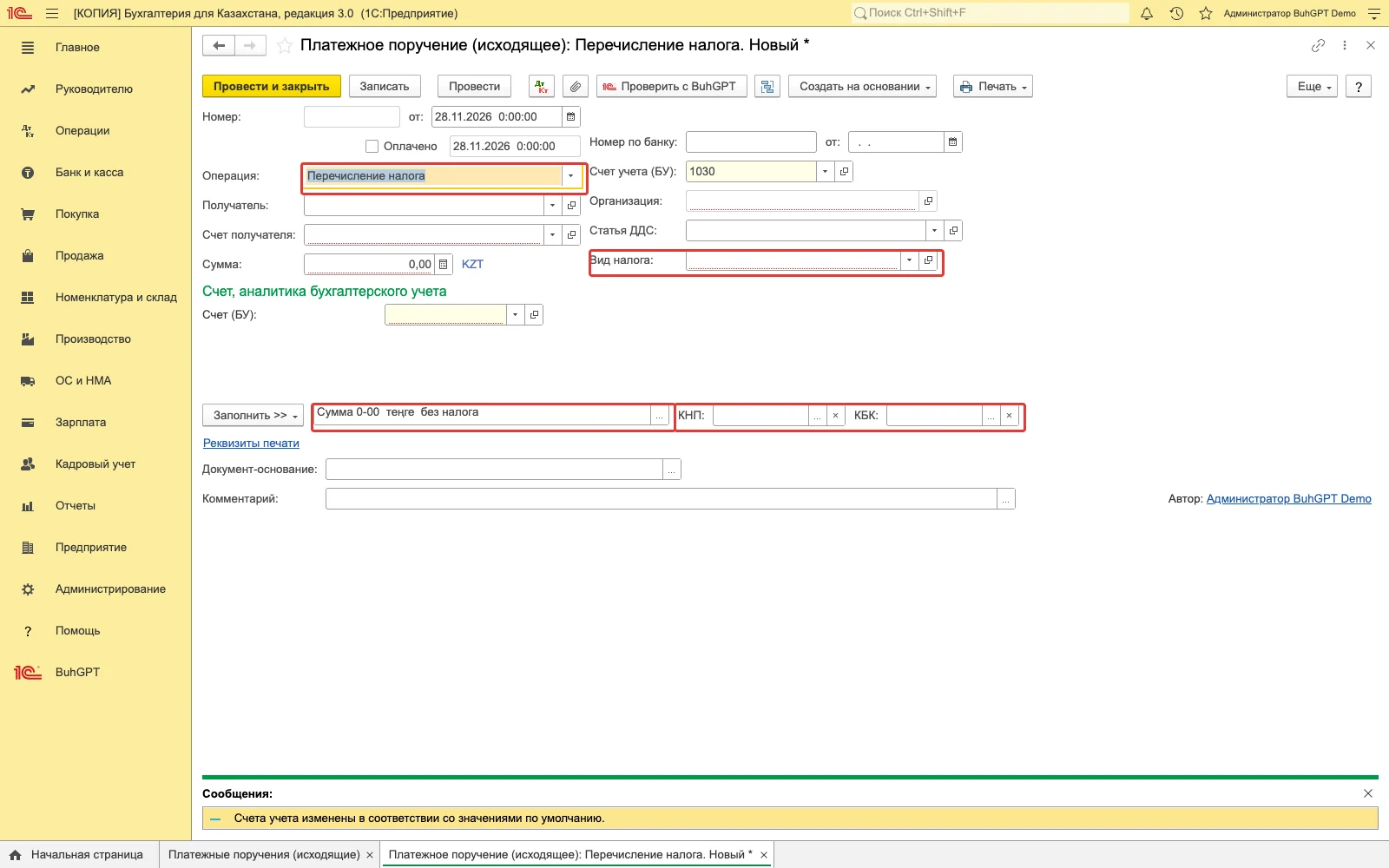
- Open Bank and Cash → Payment Orders and create an “Outgoing Payment Order.”
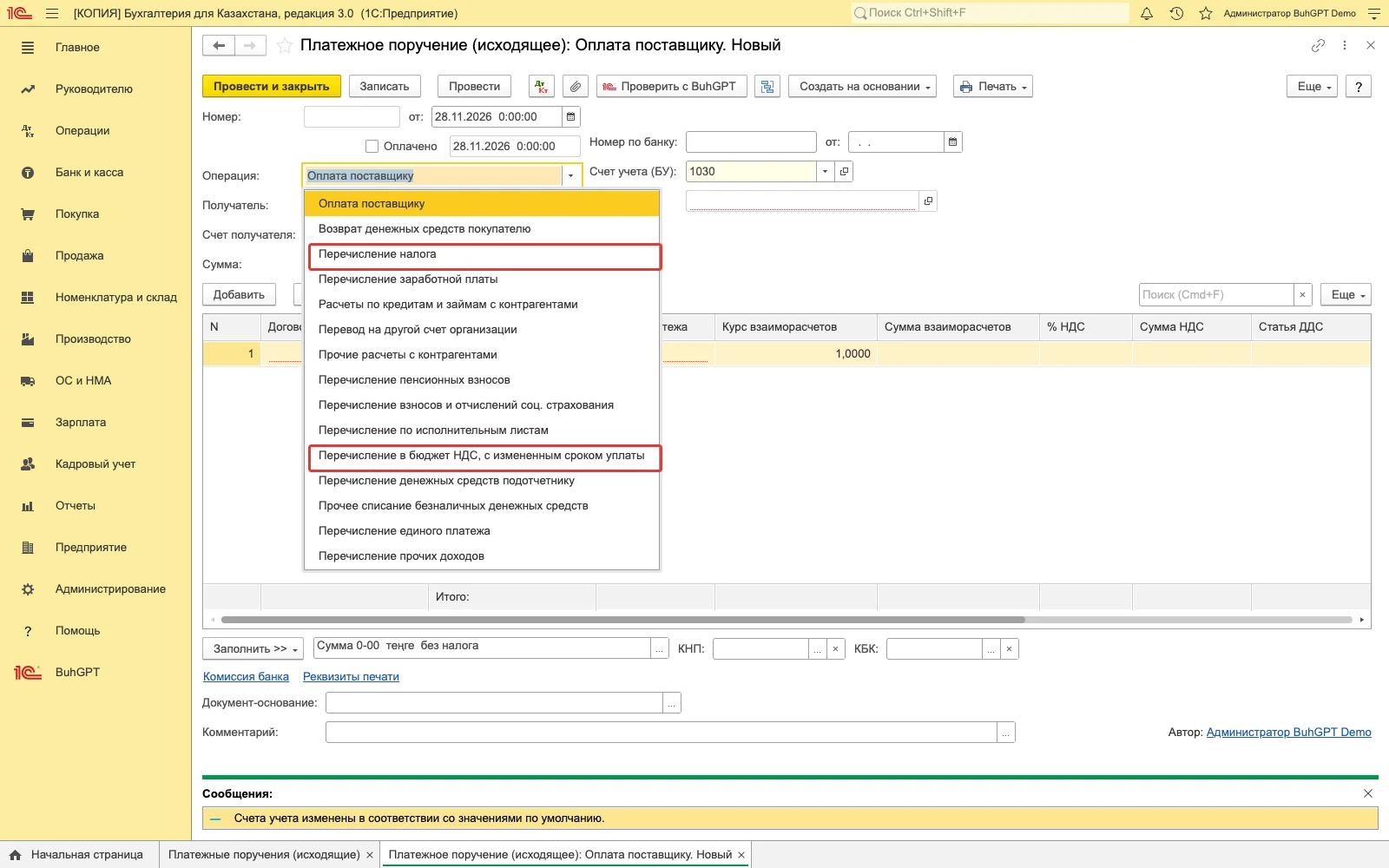
- In the “Transaction Type” field, select Tax Payment.
- Enter the “Tax Type” and “Budget Classification Code” as shown in the deferral decision.
- For the tax amount, select “Tax (Contributions): Assessed / Paid” in the “Payment Type” field.
- Use a separate payment order for late-payment penalties. In release 3.0.75.1, the “Payment Type” field has two options: “Late-Payment Penalties: Additionally Assessed / Paid (Self-Assessed)” and “Late-Payment Penalties: Assessed / Paid (Based on Audit Report).” Check the budget classification code against the deferral decision.
- Use the “Amount” and “Payment Purpose” fields to specify the scheduled installment amount and date, for example, “CIT installment payment under Decision No. … dated …, payment 1 of 12.”
Important The transaction type “VAT Payment to the Budget with a Revised Due Date” applies to the separate procedure for changing the due date for import VAT (Article 134 of Kazakhstan’s Tax Code). For tax installment plans under Article 133, use “Tax Payment.”
Frequently asked questions
When do the new forms take effect? — On 17 October 2026. Order No. 664 was published on 6 October 2026 and takes effect after 10 calendar days have elapsed following publication.
Can I get an installment plan for individual income tax on wages? — No. Paragraph 3 of Article 133 of Kazakhstan’s Tax Code excludes taxes withheld at source.
How long can an installment plan run without collateral? — Up to 12 months. This limit applies to debt of up to 1500 MCI under paragraph 5 of the List, as amended by Order No. 664.
Do late-payment penalties accrue during a deferral? — Yes. Late-payment penalties continue to accrue when the due date changes (paragraph 3 of Article 132 of Kazakhstan’s Tax Code). The exceptions are import VAT for manufacturers and restructuring under the Law on Rehabilitation and Bankruptcy.
How long does it take to get a decision? — 10 working days from receipt of the application. Any time spent correcting deficiencies is excluded.
Will a company registered less than two years ago be denied? — An application without collateral or a guarantee will be denied because the company must have been registered for at least two years. The Rules impose no minimum registration period for applications backed by collateral or a bank guarantee.
What happens if I miss a scheduled payment? — The installment plan ends if the payment is more than five working days late. The authority enforces the pledge or calls on the guarantee, and any application for a new deferral will be denied for the next two years (paragraphs 7–10 of Article 133 of Kazakhstan’s Tax Code).
Sources
- Order No. 664 of the Minister of Finance of the Republic of Kazakhstan dated 30.09.2026, “On Amendments to Order … No. 651 of 31 October 2025”
- Order No. 651 of the Acting Minister of Finance of the Republic of Kazakhstan dated 31.10.2025, “On Certain Matters Relating to Deferrals and Installment Plans for the Payment of Taxes, Fees, and/or Late-Payment Penalties”
- Article 132 of Kazakhstan’s 2026 Tax Code, Article 133 of Kazakhstan’s 2026 Tax Code, Article 83 of Kazakhstan’s 2026 Tax Code (K2500000214)
- Law No. 239-VIII of the Republic of Kazakhstan, “On the National Budget for 2026–2028,” Article 7
- “1C: Accounting for Kazakhstan” configuration 3.0.75.1, including the “Outgoing Payment Order” document, the “Outgoing Payment Order Transaction Types” enumeration, and the “Trial Balance by Account (Accounting)” report