The Ministry of Finance Order No. 688 of 12 October 2026 has been in force since 25 October 2026, but it has little effect on most businesses importing from the EAEU. It updated two undertaking forms annexed to the VAT Exemption Rules that the National Bank and diplomatic missions submit. A separate order, No. 734 of 2 November 2026, amended Form 328.00 itself. The new Annex 2 applies from 20 November 2026.
At a glance
- Order No. 688 revised only Annexes 1 and 2 to the Rules for VAT Exemption on Imports from the EAEU (Order No. 662). These are forms for undertakings to use goods for their designated purpose.
- The changes are technical. The spelling «тенге» changed to «теңге», and the reference to Article 530 of the Tax Code of Kazakhstan was clarified.
- From 20.11.2026, Form 328.00 must be filed with the new Annex 2, which covers the foreign exchange contract registration number, VAT payment in digital tenge, and the NTIN and gross weight of each item.
- The deadline remains the same. The application and VAT payment are due by the 20th day of the month following the month in which the goods were recorded in the accounts (Article 530 of the Tax Code of Kazakhstan).
- The import VAT rate remains 16% in 2027 (Article 503 of the Tax Code of Kazakhstan), with a 10% rate for medicines and medical devices on the government list.
- In 1C, the “Application for Import of Goods and Payment of Indirect Taxes” document is under Purchases → Import.
What Order No. 688 changed
The Ministry of Justice registered Order No. 688 on 13 October 2026 under No. 40147, and the order was published on 14 October 2026. It takes effect “upon expiry of ten calendar days after the date of its first official publication,” which is 25 October 2026 (Order No. 688).
Paragraph 1 of the order makes a single change. It replaces Annexes 1 and 2 to the Rules for VAT Exemption on Imports of Goods within the EAEU. The Acting Minister of Finance approved the Rules by Order No. 662 of 3 November 2025, and they have applied since 1 January 2026 (Order No. 662).
| Annex to the Rules | Who files it | What changed |
|---|---|---|
| 1. Undertaking to use raw materials for their designated purpose of producing banknotes and coins | National Bank of Kazakhstan and its organisations (paragraph 5 of the Rules) | «тенге» → «теңге», “under 530” → “under Article 530” |
| 2. Recipient’s undertaking to use imported goods exclusively for personal use | Diplomatic and consular missions and their staff (paragraph 8 of the Rules) | The same technical changes |
Order No. 688 leaves the exemption procedure, the list of documents and the provisions of the Rules unchanged. If you are an LLP or an individual entrepreneur importing goods for resale or production, the order requires no action on your part.
Important: Both forms include the wording “if I use the specified goods for other purposes, I undertake to pay value added tax … and late-payment interest.” This follows directly from the Rules and the Tax Code.
- Goods imported under an exemption may be used only for the purposes for which the exemption was granted (paragraph 20 of the Rules).
- If the goods are used for another purpose, VAT is payable under Article 530 of the Tax Code of Kazakhstan. Under paragraph 3 of Article 525, it is payable as of the last day of the prescribed period for paying import VAT.
When imports from the EAEU are exempt from VAT
Paragraph 2 of Article 525 of the Tax Code of Kazakhstan lists VAT-exempt imports from the EAEU. It refers to subparagraphs 1), 2), 4)–8) and 10)–18) of paragraph 1 of Article 479. Order No. 662 sets out the applicable procedure (Article 525 of the Tax Code of Kazakhstan).
Businesses most commonly encounter three cases from this list.
- Warranty service requires a contract with a warranty clause, documents accompanying the goods, a claim and a defect report (subparagraph 2 of paragraph 2 of Article 525).
- Goods of Astana Hub participants qualify subject to the conditions in subparagraph 11) of paragraph 1 of Article 479. This exemption applies until 01.01.2029.
- Humanitarian aid, charitable aid and grants require the documents specified in paragraphs 6, 7 and 17 of the Rules.
The standard rules for calculating and paying VAT apply to ordinary purchases of goods for resale.
What changed in Form 328.00 from 20 November 2026
Ministry of Finance Order No. 628 of 28 October 2025 approves Form 328.00 and its filing rules. Order No. 734 of 2 November 2026, issued by the Acting Minister of Finance, revised the form itself, the filing rules, the withdrawal rules, the withdrawal application form and the rules for confirming payment (Order No. 734).
Order No. 734 was published on 9 November 2026 and takes effect after ten calendar days, on 20 November 2026. The separate Rules for the Provision of the Public Service (formerly Annex 3) were removed. The filing rules now set out how applications are accepted.
New Annex 2 to the application
Accountants should focus on Annex 2, “Details of Goods Imported from EAEU Countries.” The buyer completes it (paragraph 13 of the notes to the form).
| Line or column | What to enter |
|---|---|
| Whether a registration number was assigned to the contract on line 05 | “Yes” or “No” under the Law on Currency Regulation and Currency Control |
| Registration number and date assigned | The foreign exchange contract identification number and the date it was assigned |
| VAT payment in digital tenge | “Yes” if VAT was paid in digital tenge under budget classification code 105 115. Otherwise, “No” |
| Columns 2, 3, 5 | Item name, 10-digit EAEU commodity code and quantity, as shown in the table in Section 1 |
| Column 4 — NTIN | The National Catalogue of Goods code, if required under the Law on Regulation of Trading Activities |
| Column 6 | Gross weight of the goods in kilograms |
Important: Annex 2 is checked against Section 1 line by line. Common discrepancies include the following.
- The item name or EAEU commodity code in Annex 2 differs from the entry in Section 1.
- The EAEU commodity code is incomplete. All 10 digits are required.
- Column 6 contains the net weight from the item record in place of the gross weight from the transport documents.
What stayed the same
- The application consists of three sections and annexes. The taxpayer completes the first and third sections and the annexes. The tax authority completes the second section.
- You can file with the tax authority for your location or through the Taxpayer’s Cabinet or a mobile banking app.
- For electronic-only applications, the tax authority confirms payment or issues a refusal within 3 working days. For applications filed both on paper and electronically, it does so within 10 working days (paragraph 7 of Article 530 of the Tax Code of Kazakhstan).
Deadlines and documents required by the Tax Code of Kazakhstan
The VAT period for imports from the EAEU is the calendar month in which the goods were recorded in the accounts (paragraph 6 of Article 530). The application and VAT payment are due by the 20th day of the following month (Article 530 of the Tax Code of Kazakhstan).
| Scenario | How to file Form 328.00 | Documents |
|---|---|---|
| Ordinary taxable imports | Electronic-only filing is permitted | No supporting documents are filed (paragraph 4 of Article 530) |
| Imports exempt under paragraph 2 of Article 525 | In 4 paper copies and electronically | Documents under paragraph 2 of Article 530 and evidence of eligibility for the exemption |
| VAT payment by offset (Article 509) | In 4 paper copies and electronically | Documents under paragraph 2 of Article 530 |
| Correction of an application under paragraph 2 of Article 533 | In 4 paper copies and electronically | Documents evidencing the return of the goods |
The documents under paragraph 2 of Article 530 include a bank statement confirming payment or evidence of eligibility for an exemption, documents accompanying the goods, supplier invoices (if their issuance is provided for in the supplier’s country) and the contract. In some cases, an information notice and commission agreements are also required.
Important: If you receive a refusal stating the reasons, submit a corrected application within 15 calendar days of receiving it (paragraph 9 of Article 530). You can withdraw the application yourself if the error does not affect the tax base. If it does, withdraw the application by filing a tax request (Article 532).
Example of a VAT calculation
The taxable import amount is based on the value of the purchased goods at the transaction price stated in the contract. If delivery and other expenses are listed separately in the contract, only the value of the goods is included in the tax base. Otherwise, the full transaction price is included (paragraph 2 of Article 518 of the Tax Code of Kazakhstan). The rate is 16% (Article 503 of the Tax Code of Kazakhstan).
Example: A VAT-registered LLP under the standard tax regime bought equipment for resale from a Russian supplier. The contract is denominated in tenge. The goods cost 2 500 000 tenge, and delivery of 150 000 tenge is listed separately. The goods were recorded in the accounts on 14 December 2026.
- The tax period is December 2026.
- The contract lists delivery separately, so the tax base is 2 500 000 tenge.
- VAT is 2 500 000 × 16% = 400 000 tenge.
- If delivery had been included in the contract price without a separate line item, the tax base would have been 2 650 000 tenge and VAT would have been 2 650 000 × 16% = 424 000 tenge, an increase of 24 000 tenge.
- The deadline to file Form 328.00 (with Annex 2) and pay VAT is 20 January 2027.
VAT of 400 000 tenge is due by 20.01.2027. Once paid, the amount is eligible for an input VAT credit up to the amount actually paid (Article 526 of the Tax Code of Kazakhstan).
How to record EAEU imports in 1C:Accounting for Kazakhstan
The steps below apply to version 3.0.75.1. Section and document names were checked against this configuration.
Step 1. Record receipt of the goods
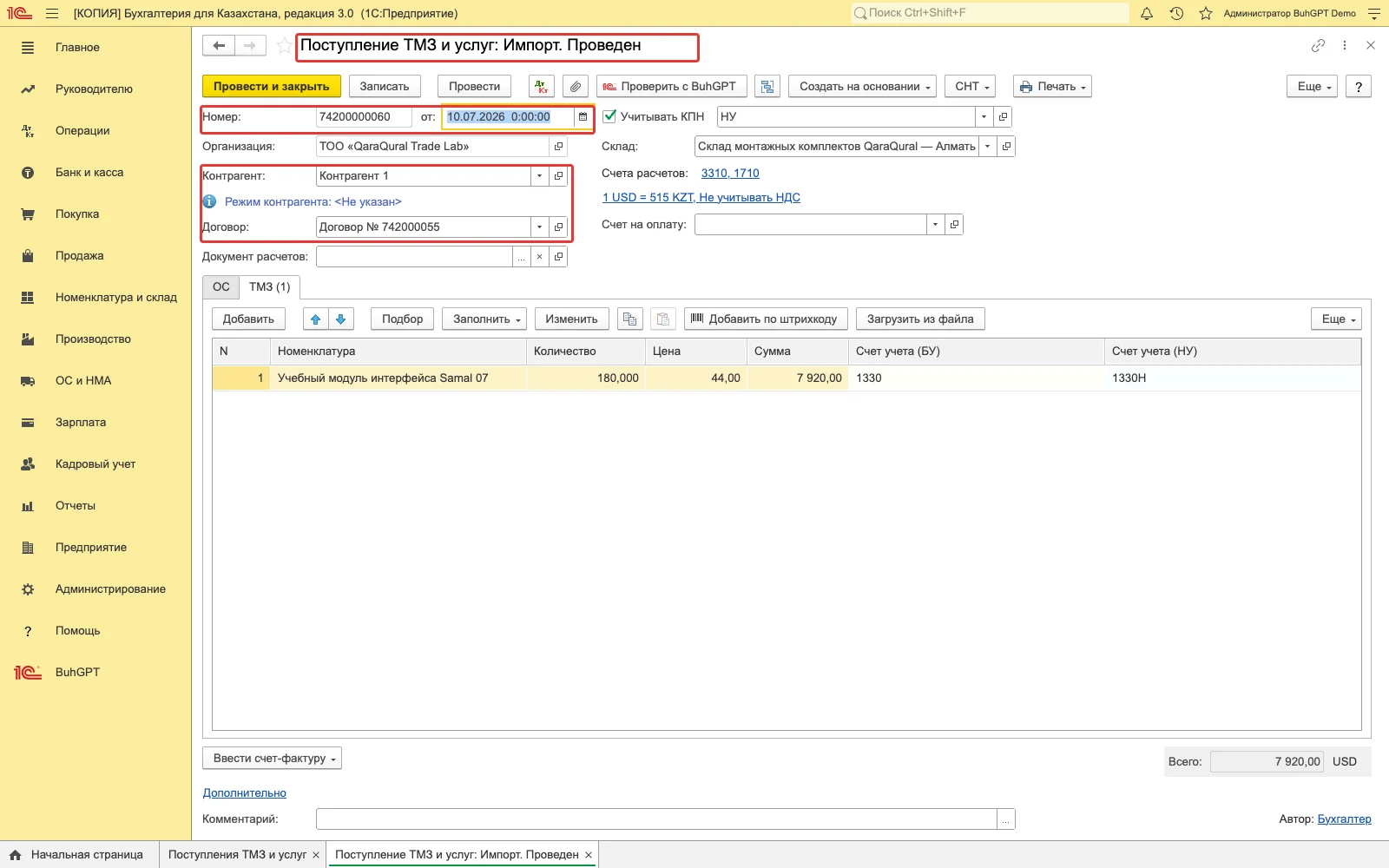
- Open Purchases → Receipt of Inventory and Services and create a document.
- Select “Import” as the operation type.
- Enter the supplier, contract, currency, and the number and date of the incoming document (consignment note).
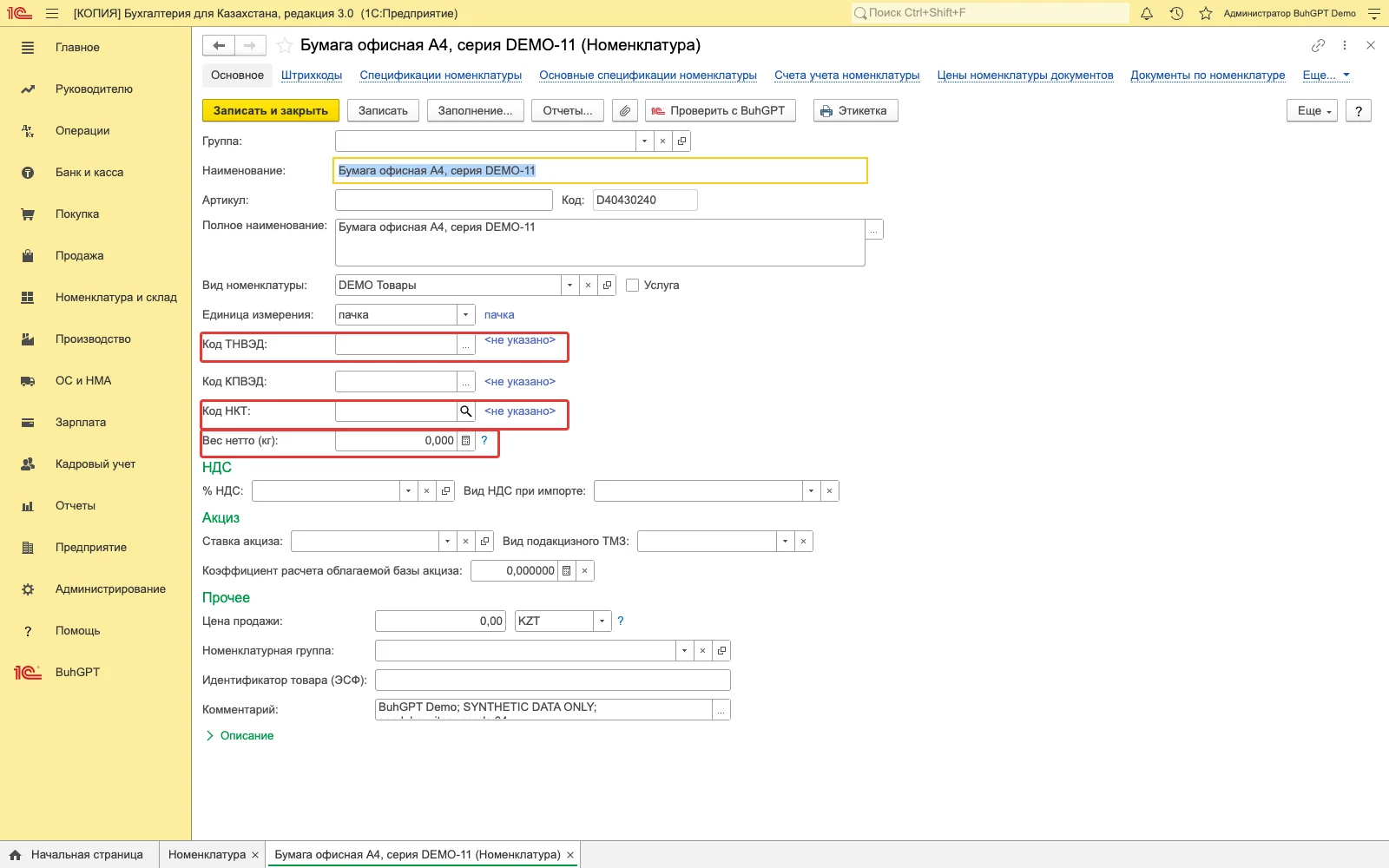
- Check that each item record has an “EAEU Commodity Code” and, if the item appears in the National Catalogue of Goods, a “National Catalogue Code”.
- Post the document.
Step 2. Create the import application
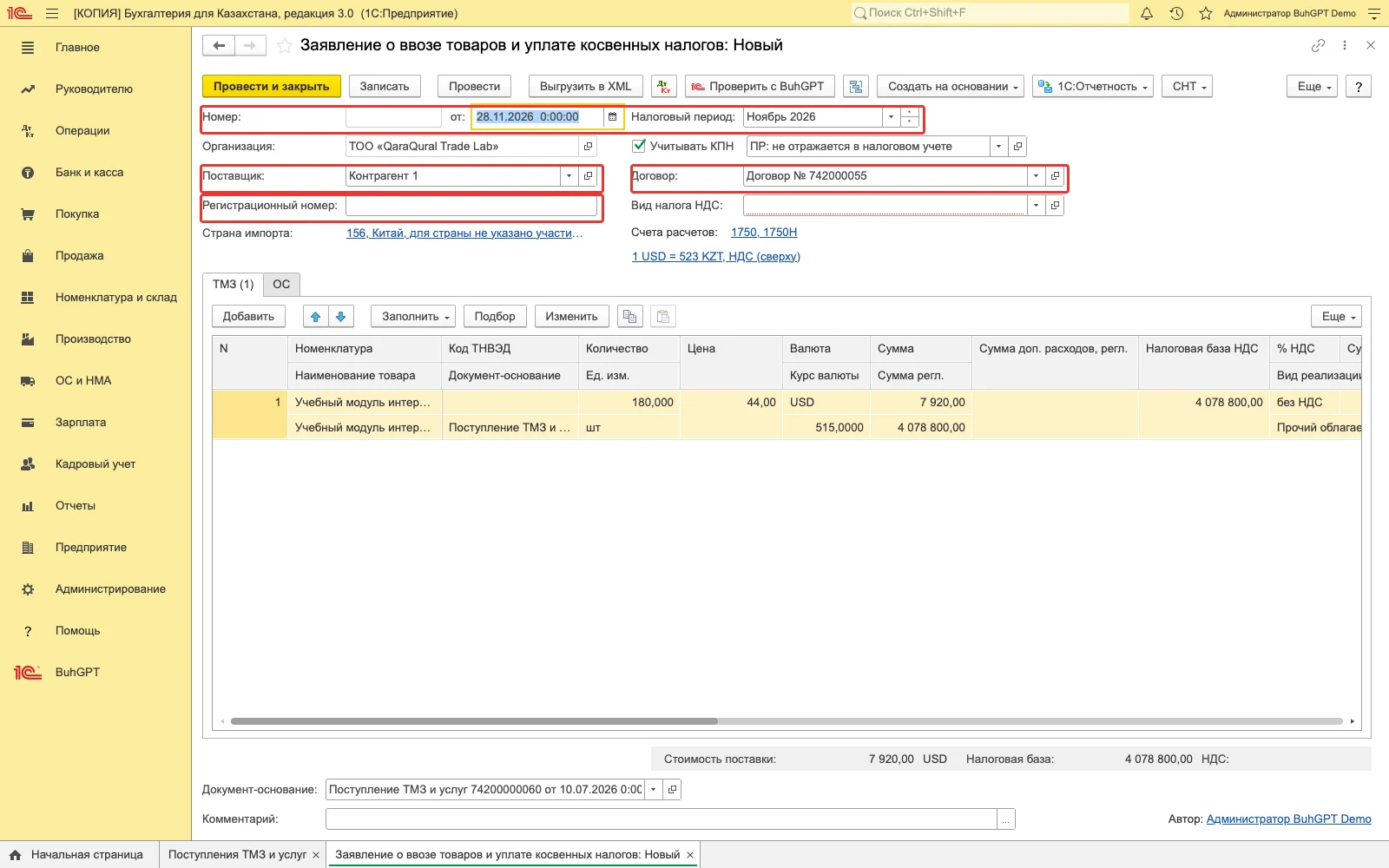
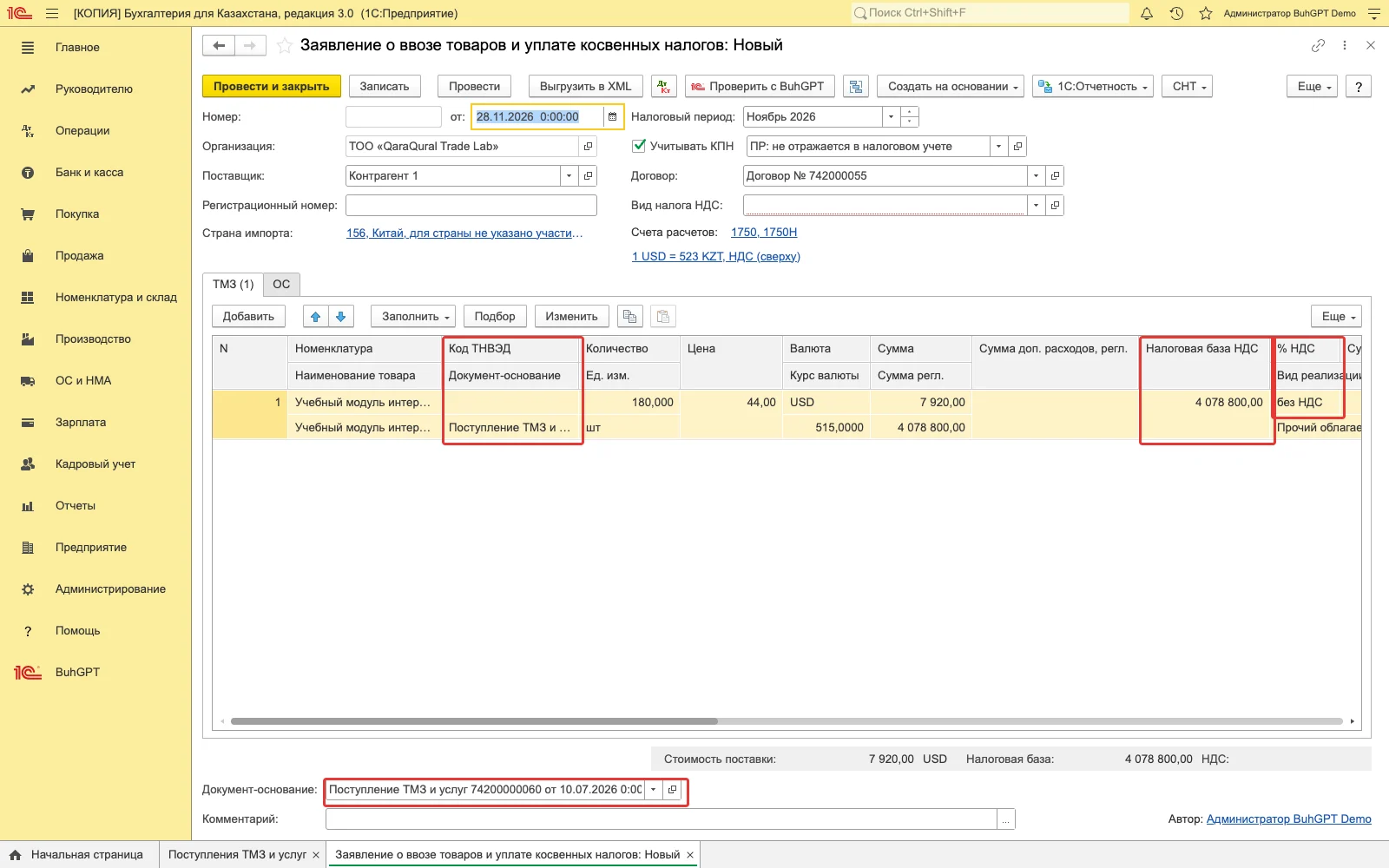
- From the posted receipt, select Create Based On → Application for Import of Goods and Payment of Indirect Taxes. You can also open the list of these documents via Purchases → Import → Applications for Import of Goods and Payment of Indirect Taxes.
- In “Tax Period”, enter the month in which the goods were recorded in the accounts.
- To combine multiple shipments under one contract, click Fill → Add from Receipt.
- Check the “Invoice No.” and “Invoice Date” columns. If they are blank, use the “Edit” button to fill them in for all rows at once.
- Enter any expenses included in the tax base in the “Additional Expenses, Statutory Accounting” column.
- Check the “VAT Tax Base”, “VAT %” and “VAT Amount” columns. If paying by offset, select “VAT Paid by Offset” in the “VAT Type” column.
- Post the document. By default, accrued VAT is credited to account 3131 “VAT (Accrued)”.
Step 3. Print or export Form 328.00
- Click Print in the application and open Form 328.00.
- Check that the form includes Annex 2 with columns for NTIN and “Gross Weight of Goods in Kilograms”.
- To file electronically, use Purchases → Import → Export Import Application to XML, then upload the file to the Taxpayer’s Cabinet.
- Once the application has been accepted, enter its “Registration Number” in the document.
Important: The standard 3.0.75.1 release prints an older version of the form without the NTIN and gross weight columns. Complete the following steps before filing.
- Install the patch with the updated form. Our knowledge base identifies it as EF_00_00064813 for 1C:Accounting for Kazakhstan 3.0.75.1.
- Check the gross weight against the transport documents. The item record stores the net weight.
Step 4. Pay VAT and claim the credit
- From the application, create a Payment Order (Outgoing) with “Tax Payment” as the operation type. The amount is filled in automatically, along with the budget classification code and payment purpose code if they are set for the tax type.
- After payment, use the application to create a “Record Other Transactions for Purchased Goods (Work, Services) for VAT Purposes” document in the period in which the tax was paid.
- Post the document. The VAT credit will be recorded in account 1421 “VAT Recoverable”.
The account numbers follow the Standard Chart of Accounts in force in 2026 and built into 1C 3.0.75.1. A revised chart of accounts applies from 1 January 2027 under Order No. 533. There is no need to rename the accounts manually before the configuration is updated.
Frequently asked questions
Does our LLP need to make any changes under Order No. 688 if we are a regular importer? — No. Order No. 688 only made technical changes to the undertaking forms for the National Bank and diplomatic missions. For a regular importer, Order No. 734 and the new Annex 2 to Form 328.00 are more relevant.
When do we start filing the new Form 328.00? — From 20 November 2026. Order No. 734 was published on 9 November and takes effect after ten calendar days.
Where can I find the gross weight if the supplier gave only the net weight? — Column 6 of Annex 2 requires the gross weight in kilograms, including packaging. Ask the supplier or use the transport documents. The net weight in the item record is unsuitable for this column.
Is an NTIN required for every item? — No. Complete column 4 in the cases specified by the Law on Regulation of Trading Activities. In 1C, the code is stored in the “National Catalogue Code” field of the item record.
What is the deadline for filing the application and paying VAT on EAEU imports? — Both are due by the 20th day of the month following the month in which the goods were recorded in the accounts (paragraphs 2 and 5 of Article 530 of the Tax Code of Kazakhstan). For December 2026, the deadline is 20 January 2027.
Will the import VAT rate change in 2027? — The standard rate remains 16%. For medicines and medical devices on the government list, the rate rises from 5% to 10% on 1 January 2027 (paragraph 2 of Article 503 of the Tax Code of Kazakhstan).
We returned defective goods to the supplier. What should we do with the application? — Omit the goods from the application if you returned them before the end of the month of import. For a partial return after that month, file a replacement for the withdrawn application. For a full return, withdraw the application by deletion (Article 533 of the Tax Code of Kazakhstan).
Sources
- Order No. 688 of the Minister of Finance of Kazakhstan, dated 12.10.2026 — amendments to Order No. 662.
- Order No. 662 of the Acting Minister of Finance of Kazakhstan, dated 03.11.2025 — Rules for VAT Exemption on Imports of Goods within the EAEU.
- Order No. 628 of the Minister of Finance of Kazakhstan, dated 28.10.2025 — Form 328.00 and its filing rules.
- Order No. 734 of the Acting Minister of Finance of Kazakhstan, dated 02.11.2026 — revised Form 328.00.
- Article 530 of the Tax Code of Kazakhstan — procedure for calculating and paying VAT on imports from the EAEU.
- Article 525 of the Tax Code of Kazakhstan — VAT-exempt imports within the EAEU.
- Article 518 of the Tax Code of Kazakhstan — taxable import amount.
- Article 503 of the Tax Code of Kazakhstan — VAT rates.
- Article 532 and Article 533 of the Tax Code of Kazakhstan — withdrawing and correcting applications.
- “1C:Accounting for Kazakhstan” configuration 3.0.75.1, “Application for Import of Goods and Payment of Indirect Taxes” document under “Purchases → Import”.