You can adjust your CIT advance payments for 2026 only until 31 December 2026 by filing a supplementary calculation on Form 101.02 (paragraph 4 of Article 350 of the Tax Code of Kazakhstan). The tax authority calculates the advance payments for Q1 2027 at 1/12 of the total advance payments reported in the calculations for 2026 (Article 349 of the Tax Code of Kazakhstan). The payment deadlines are 25 January, 25 February and 25 March 2027.
At a glance
- You may file a supplementary calculation of advance payments for Q2–Q4 2026 no later than 31.12.2026 (Thursday). Filing is optional.
- The tax authority assesses the advance payments for January, February and March 2027. You do not file a calculation for Q1.
- Companies with aggregate annual income for 2025 of no more than 600 000 times the 2025 monthly calculation index (MCI), or 2 359 200 000 ₸, are exempt from advance payments in 2027.
- Avoid setting advance payments too low. If CIT for the year exceeds advance payments by more than 20%, the fine is 20% of the excess (part 3 of Article 278 of the Code of Administrative Offences).
- In 1C 3.0.75.1, record advance payments in account 1410. In December, the “Month-End Closing” process offsets them against CIT in account 3110.
Who pays CIT advances in 2027
All CIT payers make CIT advance payments except those listed in paragraph 1 of Article 348 of the Tax Code of Kazakhstan. The main exemption applies to taxpayers with income below the threshold.
The threshold for 2027 is based on income for 2025, the period before the preceding period. The calculation also uses the 2025 MCI, which the budget law sets at 3 932 ₸ (Article 9 of Law No. 141-VIII).
Example. Calculating the 2027 exemption threshold for advance payments.
- The 2025 MCI is 3 932 ₸.
- The threshold is 600 000 × 3 932 = 2 359 200 000 ₸.
- The LLP’s aggregate annual income for 2025, after adjustments, is 1 900 000 000 ₸. This is below the threshold.
- The LLP is exempt from CIT advance payments in 2027.
Other exemptions from advance payments include the following.
- New companies are exempt in the year of registration and the following year. A different rule applies to reorganisations by division or spin-off (subparagraph 2 of paragraph 1 of Article 348).
- Non-profit organisations applying paragraph 1 of Article 329 and Article 330 of the Tax Code, and organisations of persons with disabilities that meet the conditions of Article 331 of the Tax Code.
- Astana Hub participants (until 01.01.2029).
These exemptions do not apply to companies dealing in digital assets (paragraph 2 of Article 348).
Important. You pay Q1 2027 advances only if you were also liable for advance payments in 2026 (paragraph 1 of Article 349). Both conditions must be met.
- You are liable for advance payments in 2027 under Article 348.
- You made advance payments in 2026.
Deadlines at the turn of 2026 and 2027
If a deadline falls on a non-working day, it moves to the next working day (paragraph 2 of Article 64 of the Tax Code of Kazakhstan). The dates below reflect this rule.
| Date | Action | Legal provision |
|---|---|---|
| 25.12.2026, Fri | Pay the December 2026 advance payment | Paragraph 5 of Article 350 |
| 31.12.2026, Thu | Last day to file a supplementary calculation on Form 101.02 for 2026 | Paragraph 4 of Article 350, subparagraph 4 of paragraph 3 of Article 116 |
| 25.01.2027, Mon | Pay the January advance assessed by the tax authority | Paragraph 3 of Article 349 |
| 25.02.2027, Thu | Pay the February advance | Paragraph 3 of Article 349 |
| 25.03.2027, Thu | Pay the March advance | Paragraph 3 of Article 349 |
| 31.03.2027, Wed | File the 2026 CIT return on Form 100.00 | Paragraph 1 of Article 359 |
| 12.04.2027, Mon | Pay the remaining CIT for 2026 (10.04 falls on a Saturday) | Paragraph 2 of Article 347 |
| 20.04.2027, Tue | File the calculation for Q2–Q4 2027 on Form 101.02 | Paragraph 3 of Article 350 |
| 26.04.2027, Mon | Pay the April 2027 advance (25.04 falls on a Sunday) | Paragraph 5 of Article 350 |
The Code specifies the deadline for a supplementary calculation in two places. Article 350 says “no later than 31 December” and Article 116 says “no later than the last working day of the current tax period” (subparagraph 4 of paragraph 3 of Article 116). In 2026, 31 December falls on a Thursday and is a working day, so the dates coincide.
Supplementary calculation by 31 December 2026
You calculated the advance payments for Q2–Q4 2026 on Form 101.02 by 20 April, using 1/12 of your 2025 CIT per month (subparagraph 1 of paragraph 2 of Article 350). If it becomes clear by year-end that your 2026 CIT will differ, you can adjust this amount.
Base the adjustment on your estimated CIT for the current year. The adjusted advance payments cannot be negative (paragraph 4 of Article 350).
How to complete Form 101.02
The Ministry of Finance approved the form and its instructions by Order No. 695 dated 12.11.2025 (Annex 3). The calculation section contains three lines.
- 101.02.001 — CIT calculated for the preceding year.
- 101.02.002 — estimated CIT for the current year. Complete this line in the supplementary calculation.
- 101.02.003 — monthly advance payment, calculated as 101.02.001 / 12 or 101.02.002 / 12.
In the supplementary filing, report the difference between the actual amount and the amount previously reported (subparagraph 1 of paragraph 1 of Article 116). The instructions for Form 101.02 likewise say to report the estimated amount “less the advance payments previously declared”.
When to file the calculation
- Your 2026 CIT will be lower than your 2025 CIT. You can reduce the advances to keep more cash available for operations. This also reduces the base for Q1 2027 advance payments.
- Your 2026 CIT will be significantly higher. Consider increasing the advance payments to avoid a fine under part 3 of Article 278 of the Code of Administrative Offences. Paying the additional amount under a supplementary filing does not give rise to liability for that amount (paragraph 1 of Article 116 of the Tax Code).
It is more convenient to file the calculation by 25 December so you can pay the revised amount for December straight away.
Example. An LLP reduces its advance payments in December 2026.
- CIT for 2025 was 24 000 000 ₸. The advance payment for each month from April through December 2026 is 24 000 000 / 12 = 2 000 000 ₸.
- In December, the accountant estimates 2026 CIT at 18 000 000 ₸. The revised monthly advance is 18 000 000 / 12 = 1 500 000 ₸.
- The difference to report in the supplementary calculation is 18 000 000 − 24 000 000 = −6 000 000 ₸, or −500 000 ₸ per month.
- The advances for April through November were already paid at the original amount of 8 × 2 000 000 = 16 000 000 ₸. The LLP files the calculation by 25 December, so it pays the revised December advance of 1 500 000 ₸.
- Advance payments for Q2–Q4 were originally 9 × 2 000 000 = 18 000 000 ₸. The revised total is 16 000 000 + 1 500 000 = 17 500 000 ₸.
- The amount due for December is 500 000 ₸ lower.
The Code does not expressly state how the tax authority will apply a reduction to months for which advances have already been paid. The example therefore reduces only the advance that has yet to fall due. Reconcile the remaining amount with your tax account in the Taxpayer Portal.
Important. Avoid reducing your advance payments “just in case”. Under part 3 of Article 278 of the Code of Administrative Offences, if CIT for the year exceeds advance payments by more than 20%, the fine is 20% of the excess.
- Continuing the example, suppose Q1 2026 advances came to 3 × 2 000 000 = 6 000 000 ₸. Total advance payments for the year are 6 000 000 + 17 500 000 = 23 500 000 ₸.
- The CIT return shows 2026 CIT of 30 000 000 ₸. The excess is 30 000 000 − 23 500 000 = 6 500 000 ₸. That is 27,7% of the advance payments and 21,7% of the tax, both above 20%.
- The fine is 6 500 000 × 20% = 1 300 000 ₸.
The tax authority assesses Q1 2027 advance payments
You do not file a calculation for January, February or March. The tax authority calculates the advance for each month at 1/12 of the total advance payments reported in the preceding year’s calculations, including supplementary calculations (paragraph 2 of Article 349). The amount is deemed to have been calculated as if you had reported it in your tax filing (subparagraph 3 of paragraph 1 of Article 119).
A supplementary calculation filed by 31.12.2026 therefore also affects Q1 2027 advance payments. If you find in January that the amount is too high, it will be too late to adjust it. The filing deadline for the 2026 calculation is the end of the year.
Example. Q1 2027 advance payments under paragraph 2 of Article 349.
- Advance payments reported in the 2026 calculations, including the supplementary calculation, total 17 500 000 ₸ (see the example above).
- The monthly advance is 17 500 000 / 12 = 1 458 333 ₸.
- Pay 1 458 333 ₸ by each of the following dates: 25.01, 25.02 and 25.03.2027.
- The Q1 total is 3 × 1 458 333 = 4 374 999 ₸.
Important. The Code refers to the “total amount of advance payments calculated in the calculations”. We found no official guidance specifying which amount the tax authority uses.
- Using annual CIT from line 101.02.002 would give 18 000 000 / 12 = 1 500 000 ₸ per month in this example.
- Pay the amount assessed by the tax authority. Check it against your tax account in the Taxpayer Portal by 25 January.
- An advance payment that is overdue becomes a tax arrear and accrues late-payment interest (Article 5 of the Tax Code of Kazakhstan).
What changes from April 2027
By 20.04.2027, file a new calculation on Form 101.02 for 2027. Use the 2026 CIT from your Form 100.00 return as the base (subparagraph 1 of paragraph 2 of Article 350). If CIT for 2026 is zero, calculate the advances using estimated CIT for 2027 (subparagraph 2 of paragraph 2 of Article 350).
How to record advance payments in 1C:Accounting for Kazakhstan 3.0.75.1
Under the Standard Chart of Accounts, CIT advance payments are recorded in account 1410, “Corporate Income Tax” (Order No. 185). Accrued tax is recorded in account 3110, “Corporate Income Tax Payable”. These account numbers stay the same in the 2027 chart of accounts under Order No. 533. CIT expenses move from 7710 to 7510.
Step 1. Check the tax settings
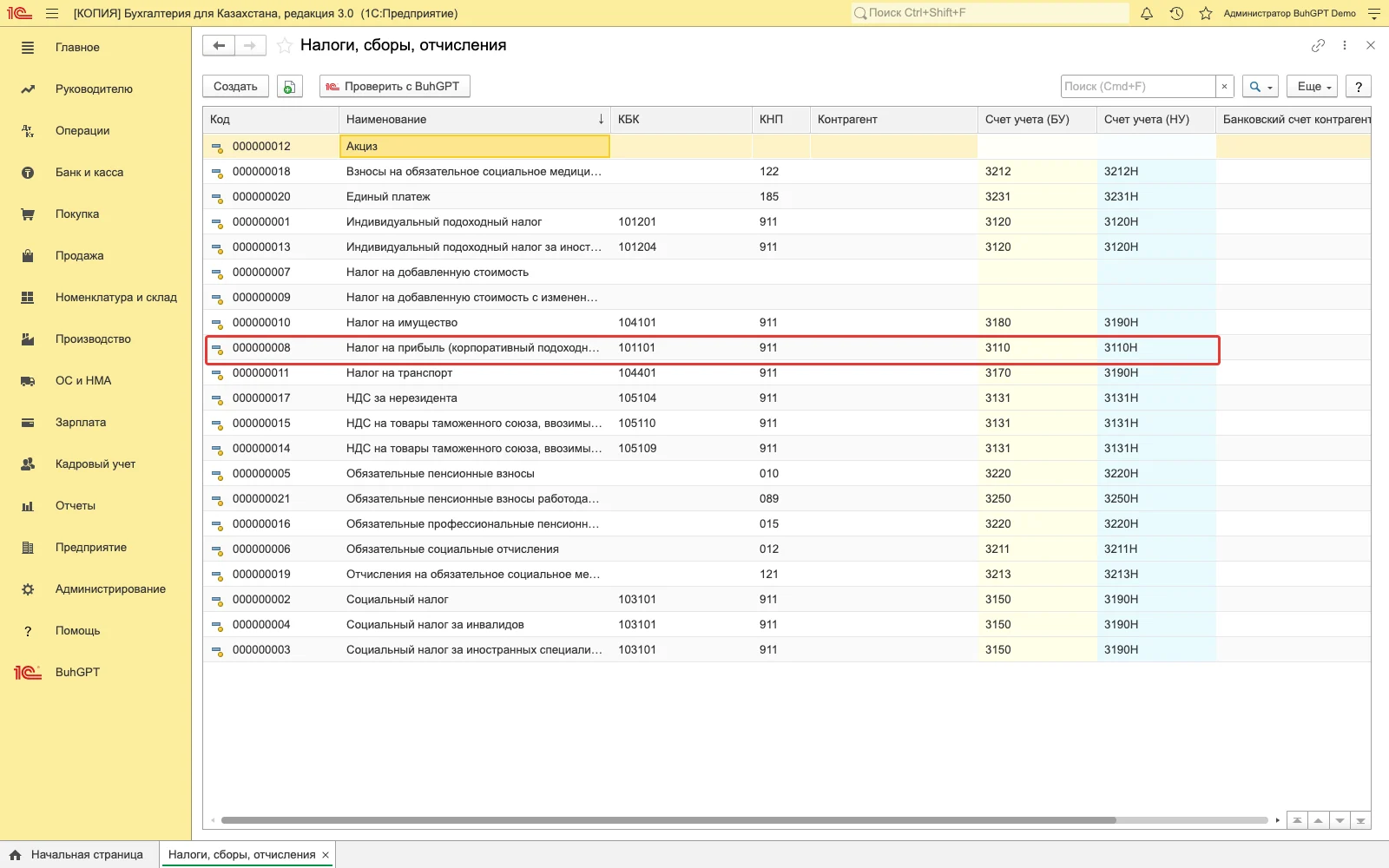
In the “Taxes, Fees and Contributions” directory, 1C defaults to account 3110, budget classification code (BCC) 101101 and payment purpose code (PPC) 911 for CIT. Paying an advance with these settings posts Dr 3110 Cr 1030 and leaves a debit balance in 3110 until year-end.
- Open Enterprise → Taxes → Taxes, Fees and Contributions.
- Open the “Profit Tax (Corporate Income Tax)” entry.
- Check the BCC and PPC against the budget classification in force on the payment date.
- Keep the “Ledger Account (Financial Accounting)” field as configured because it determines where annual CIT is posted. Select account 1410 for the advance directly in the payment order (step 2).
Step 2. Create a payment order for the advance
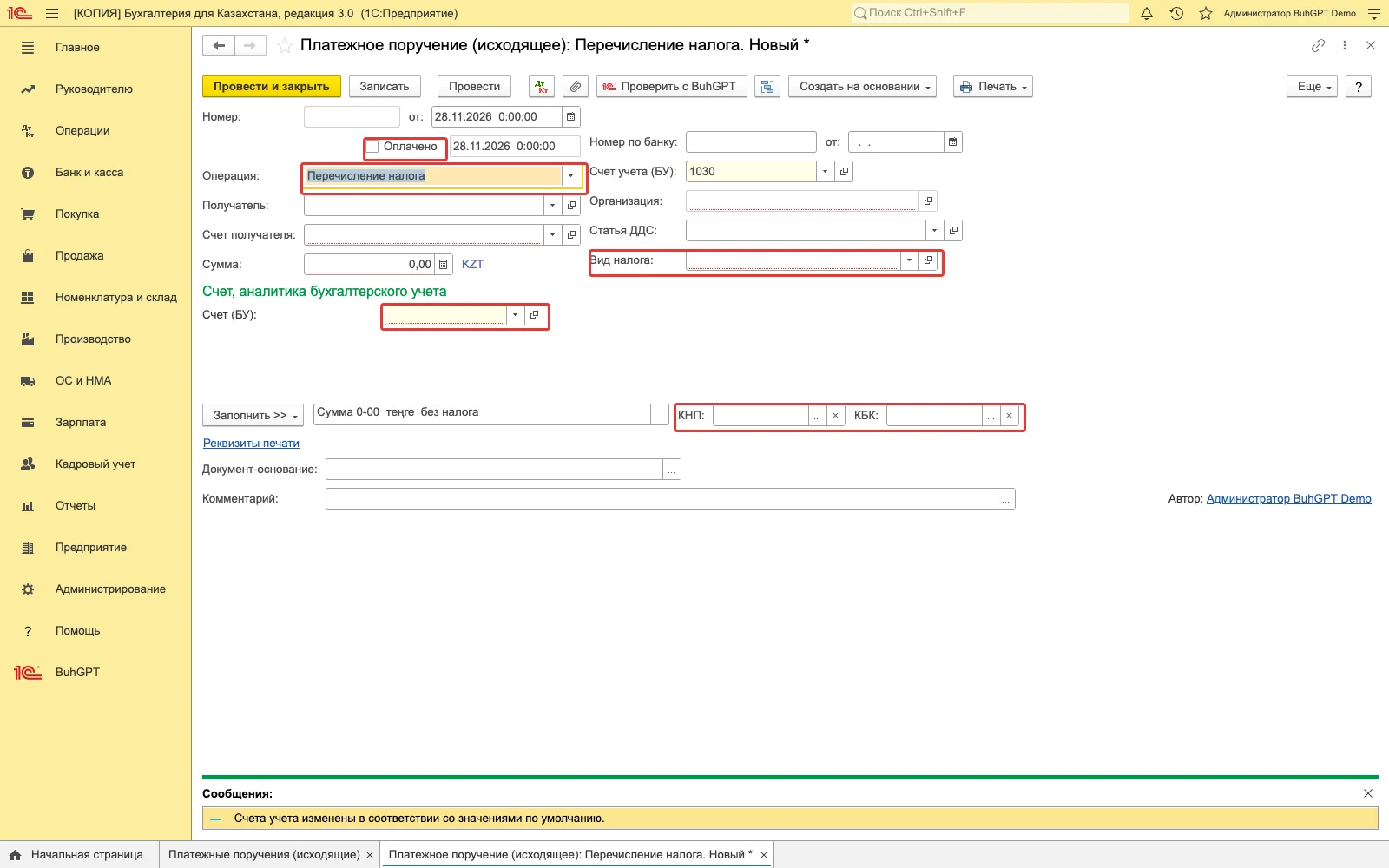
- Open Bank and Cash → Bank → Outgoing Payment Orders and click “Create”.
- In the “Transaction Type” field, select “Tax Payment”.
- In the “Tax Type” field, select “Profit Tax (Corporate Income Tax)”.
- In the “Payment Type” field, select “Tax (Contributions): Accrued / Paid”.
- Check the BCC, payment purpose code and recipient, which is the tax authority for your location.
- In the “Settlement Account (Financial Accounting)” field, enter 1410.
- Specify the month in the payment purpose, for example, “CIT advance payment for January 2027”.
- Once the bank statement shows the debit, select the “Paid” checkbox and post the document. 1C requires the checkbox to be selected before posting.
The journal entry is Dr 1410 Cr 1030, with the “Profit Tax” and “Tax (Contributions): Accrued / Paid” accounting dimensions.
Step 3. Reconcile advance payments with your tax account
- Open Reports → Standard Reports → Trial Balance by Account (Financial Accounting).
- Select account 1410 and the period “January – March 2027”.
- Compare debit turnover with the amount of advance payments assessed by the tax authority in your tax account.
Step 4. Offset advance payments at year-end
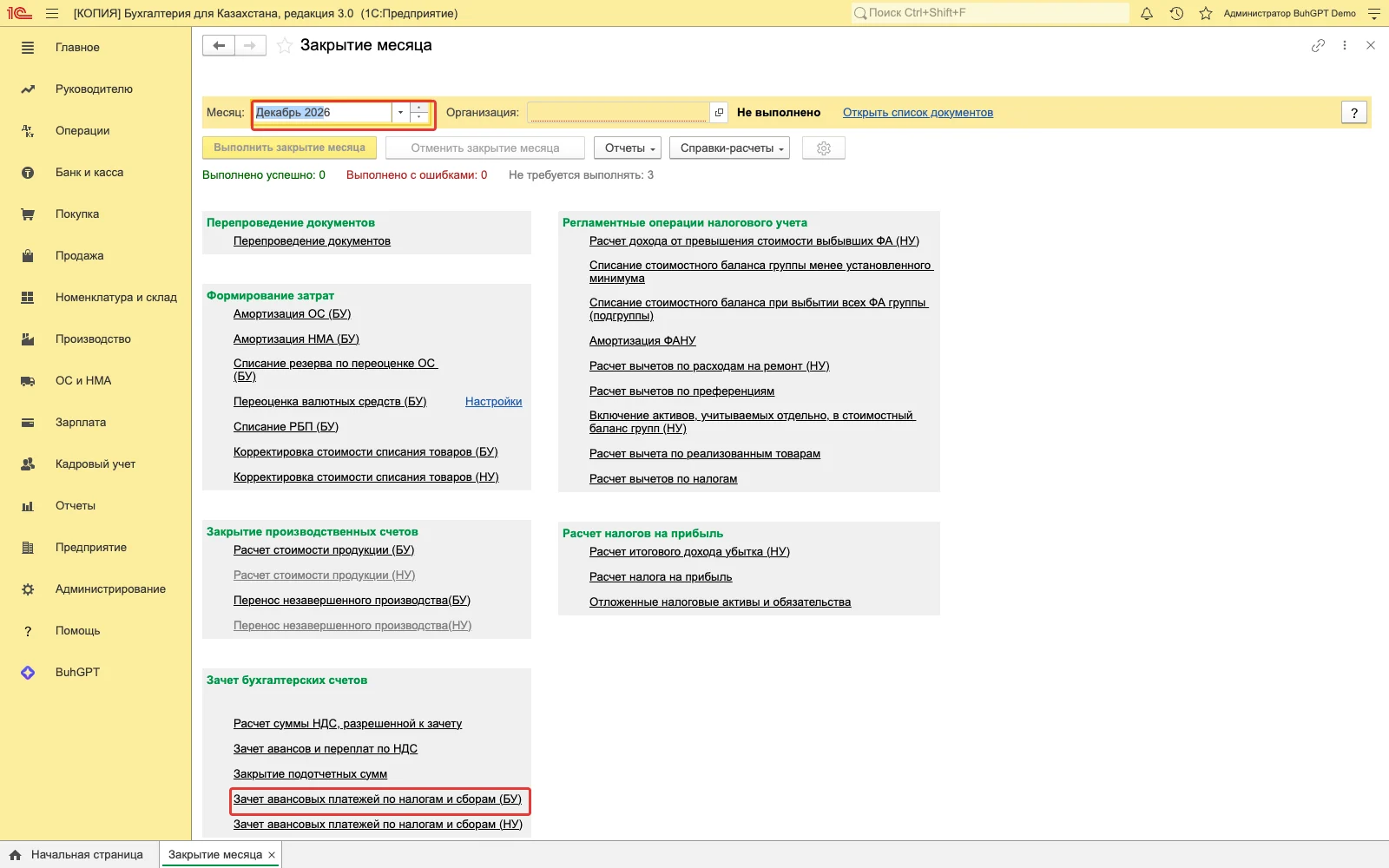
The month-end closing process offsets advance payments automatically. The “Offset Advance Payments for Taxes and Fees (Financial Accounting)” operation transfers debit balances from 1410 and 1430 to tax accounts 3110, 3120 and 3140–3190. The transfer is limited to the amount of tax accrued.
- Open Operations → Period-End Operations → Month-End Closing.
- Select the organisation and the month “December 2026”.
- Run month-end closing.
- Open the journal entries for the “Offset Advance Payments for Taxes and Fees (Financial Accounting)” operation. Look for Dr 3110 Cr 1410 with the description “Offset Advance Payments for Taxes and Fees”.
Important. The operation offsets an advance only if the accounting dimensions for 1410 and 3110 match for both tax type and payment type. If you paid the advance under the “Late-Payment Interest” payment type or under a different tax, it will remain in 1410.
We did not find Form 101.02 among the statutory reports in the 3.0.75.1 configuration export. File the calculation and any supplementary calculation through the Taxpayer Portal.
Frequently asked questions
Do I have to file a supplementary calculation by 31 December? — No. Taxpayers may choose to file one (paragraph 4 of Article 350 of the Tax Code of Kazakhstan). If you do not file one, your 2026 advance payments remain at the amount in the calculation filed by 20 April.
Can I file a supplementary calculation for 2026 in January 2027? — No. Supplementary calculations of advance payments for Q2–Q4 are accepted no later than the last working day of the current tax period (subparagraph 4 of paragraph 3 of Article 116 of the Tax Code of Kazakhstan), which is 31.12.2026.
Does the company have to calculate its own advance payments for January through March 2027? — No. The tax authority calculates them under paragraph 2 of Article 349 of the Tax Code of Kazakhstan. Check the assessment in your tax account and pay by the 25th of each month.
We did not make advance payments in 2026, but we are required to in 2027. What about Q1? — Only taxpayers who were also liable for advance payments in the preceding year pay advances for Q1 (paragraph 1 of Article 349). Start by filing Form 101.02 by 20.04.2027.
Which MCI applies to the 600 000 MCI threshold in 2027? — Use the 2025 MCI of 3 932 ₸. Compare your 2025 income with the threshold of 2 359 200 000 ₸ (subparagraph 1 of paragraph 1 of Article 348 of the Tax Code of Kazakhstan). The 2027 MCI does not apply to this calculation.
Will there be a fine if advance payments exceed CIT for the year? — No. A fine under part 3 of Article 278 of the Code of Administrative Offences applies only if CIT exceeds advance payments by more than 20%. Advance payments made during the year are offset against the CIT shown on the return (paragraph 2 of Article 347 of the Tax Code of Kazakhstan).
Which account should I use for an advance payment in 1C, 1410 or 3110? — Under the Standard Chart of Accounts, advance payments are recorded in 1410. Select 1410 in the 1C payment order so that month-end closing automatically offsets the advance against CIT in 3110 in December.
Sources
- Tax Code of the Republic of Kazakhstan No. 214-VIII dated 18.07.2025, Article 348, Article 349, Article 350, Article 347, Article 359, Article 116, Article 119, Article 64, Article 5
- Order No. 695 of the Minister of Finance of the Republic of Kazakhstan dated 12.11.2025 — Form 101.02 and its instructions (Annex 3)
- Code of Administrative Offences of the Republic of Kazakhstan, Article 278
- Law of the Republic of Kazakhstan No. 141-VIII dated 04.12.2024 “On the Republican Budget for 2025–2027”, Article 9
- Standard Chart of Accounts (Order No. 185 of the Ministry of Finance of the Republic of Kazakhstan) and Order No. 533 of the Ministry of Finance of the Republic of Kazakhstan
- “1C:Accounting for Kazakhstan”, version 3.0.75.1, including the “Outgoing Payment Order” document, the “Taxes, Fees and Contributions” directory and the “Month-End Closing” process