Charter capital is recorded in 1C through a series of transactions rather than as a single total. First, record the founder’s obligation to make a contribution, then record the actual receipt of cash or property separately. In Accounting for Kazakhstan, edition 3.0, verify the result in the equity accounts and the statement of changes in equity. The menu path below has been verified for release 3.0.74.2 (guide to the IFRS Equity report).
How to record charter capital in the accounts
First, distinguish between two events that accountants should record separately:
- the founder’s obligation to make the declared contribution;
- the settlement of that obligation with cash, a fixed asset, inventory, or another asset.
This approach shows both the amount of declared capital and each participant’s outstanding balance. If you record the receipt of an asset directly as an increase in capital without separately recording the amount due from the founder, it will be harder to verify whether the contribution was made in full.
Before entering the transaction, prepare the documents confirming the participants’ decision, the size of their shares, and the type of contribution. A bank or cash document supports the receipt of a cash contribution. For property, you need the transfer documents and the valuation adopted by the company. The article deliberately omits account numbers because the source material contains no verified excerpt from the standard chart of accounts. Select the accounts from the organization’s current working chart of accounts.
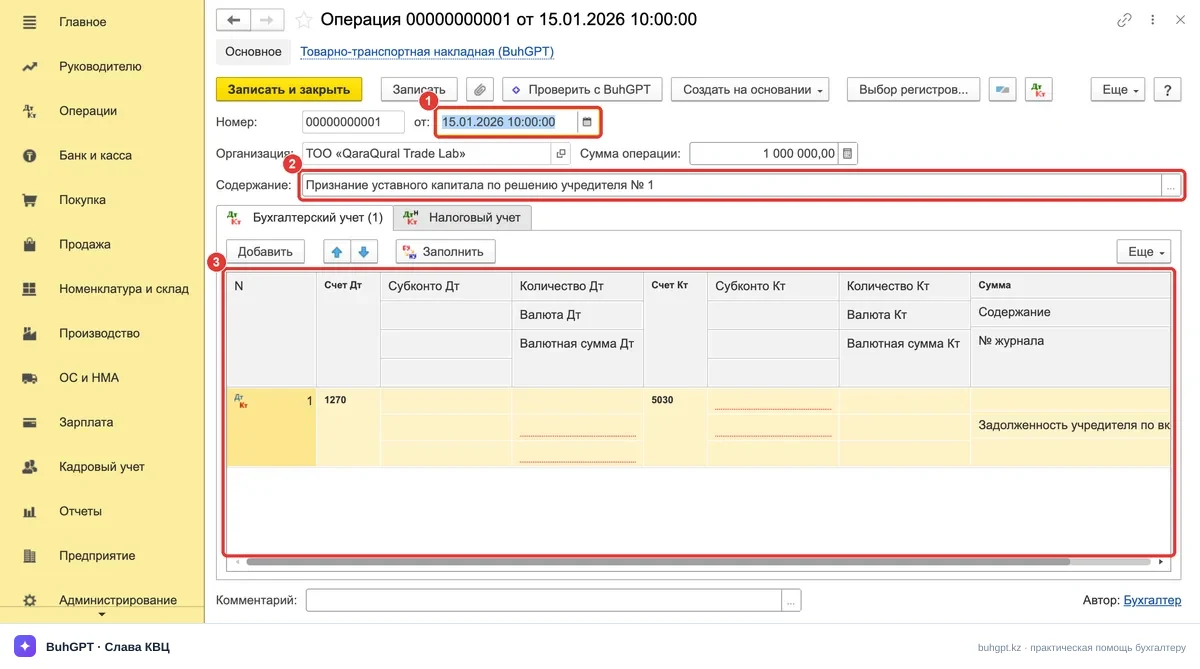
In 1C, enter the transaction recognizing charter capital based on the participants’ decision. Specify the organization, date, founder, entry description, equity account, and account for settlements with the founder. Enter the analytical details separately for each participant so you can compare the declared share with the actual contribution.
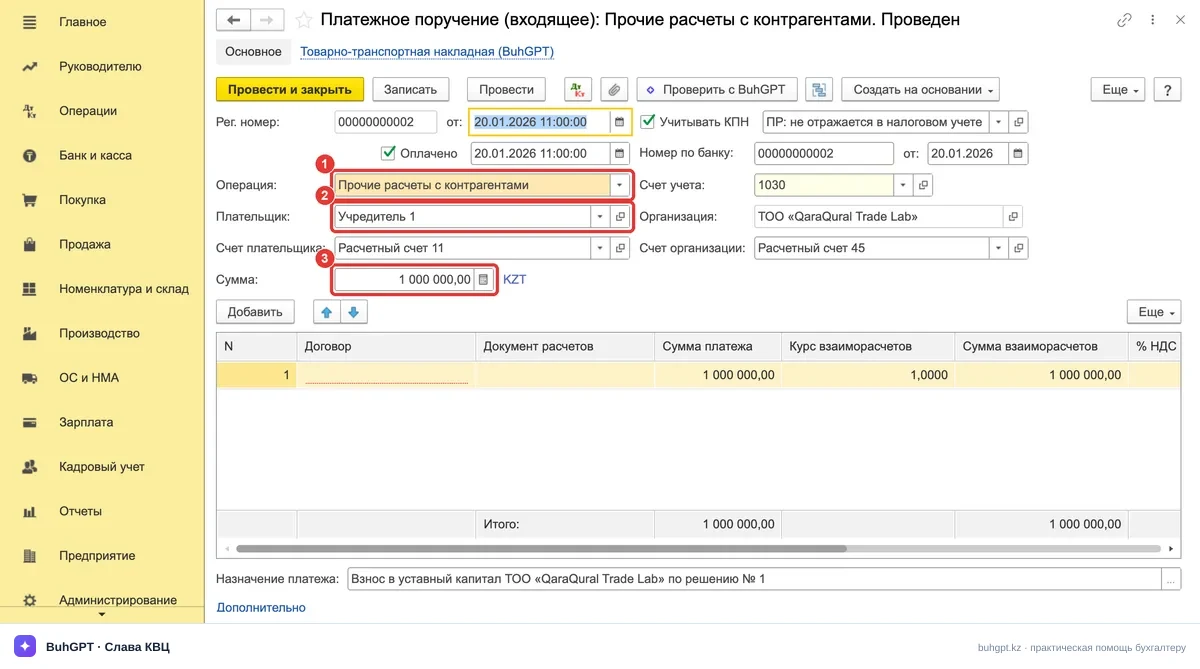
Then record receipt of the contribution using the appropriate document for the asset. For a cash contribution, use a cash receipt document. For a property contribution, use the document for recognizing that type of asset. The accounting entry should settle the selected founder’s obligation and avoid increasing capital a second time.
After posting, compare the amount recognized for each participant with the contribution received. An outstanding balance means either that the contribution was only partially recorded or that the documents were entered with different analytical details.
How cash and property contributions differ in 1C
For a cash contribution, the main check is the bank or cash document. Verify the payer, payment purpose, organization, and analytical details for the settlement. The founder’s name in the receipt document must match the analytical details in the original transaction.
A property contribution requires two accounting steps. First, settle the founder’s obligation. Second, recognize the asset itself with its name, characteristics, value, and how it will be used. Use the asset recognition document. A single manual equity entry may leave the asset out of the required 1C registers.
If the contribution is a fixed asset, check the transfer documents and verify that the asset was recorded in the fixed assets module. The knowledge base notes that a transfer without consideration and a contribution to charter capital differ in economic substance from an ordinary sale, although the transferor may use the same document to record the disposal (guide to the Fixed Asset Transfer document). This guidance applies to the transferor’s disposal. The recipient must record recognition of the asset in its own database.
The tax implications of a property contribution depend on the status of the parties, the type of property, and the nature of the transfer. The transaction name in 1C alone is insufficient to determine them. The source material contains no verified provision identifying a specific rate or Tax Code article that applies in all such cases, so a single tax entry cannot be used for every case. The current tax provisions are available in the Adilet Legal Information System.
How to verify capital and find discrepancies
In Accounting for Kazakhstan, edition 3.0, first check the release under Help → About. The Configuration field shows the edition and release number. The reporting procedure described here has been verified for version 3.0.74.2. If you use a different version, check which fields appear in the form for your installed release (guide for release 3.0.74.2).
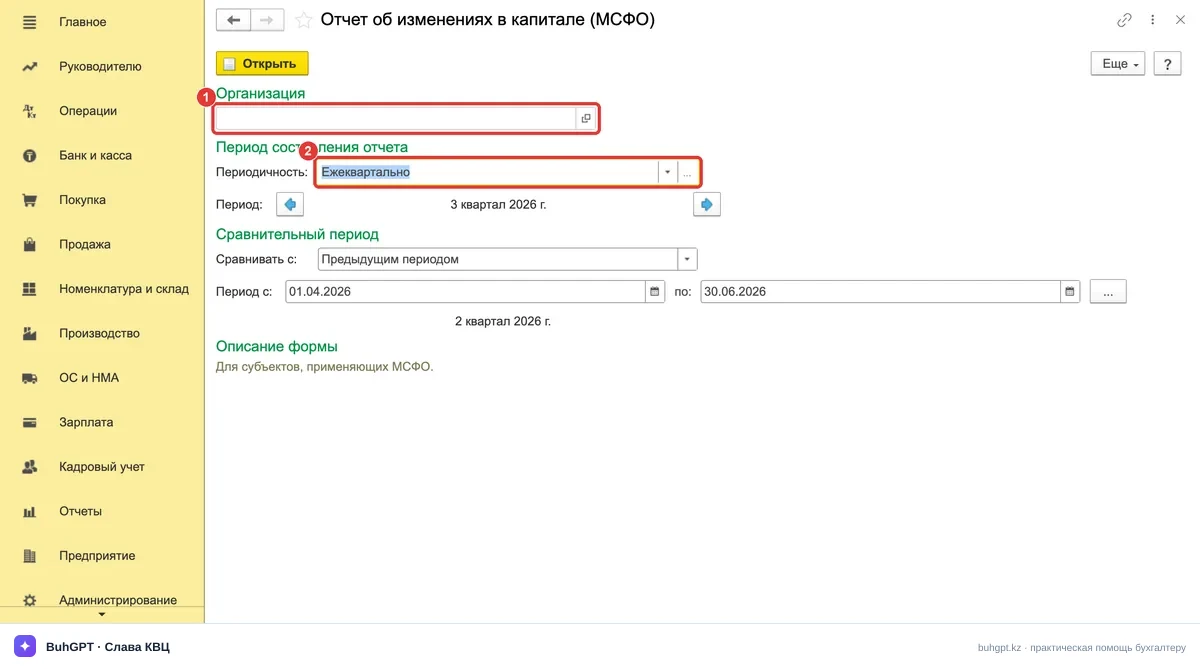
To check the IFRS report, go to Reports → Regulatory Reports → IFRS Financial Statements group → Statement of Changes in Equity (IFRS) → Create. Specify the organization and period, then populate the form. The report uses turnover and balances from the equity accounts and generates no accounting entries (description of the IFRS Equity report).
Organizations using the IFRS for SMEs form follow a different path. Go to Reports → Regulatory Reports → Create → Financial Statements (IFRS for SMEs) group → Statement of Changes in Equity. The form draws on account turnover and balances, so editing a total manually leaves the underlying accounting error in place (guide to the IFRS for SMEs report.
If the total does not reconcile, check the selected organization, period, analytical details for each founder, and underlying accounting transactions. Reconcile the declared capital, contributions actually received, and outstanding amounts due from participants. Then verify that changes in reserves and retained earnings were correctly classified and kept out of changes in charter capital.
Frequently asked questions
Which Russian term is correct for charter capital, «уставной капитал» or «уставный капитал»? — Accounting documents use the term «уставный капитал». The phrase «уставной капитал в 1С» is common in search queries. Use the official term in documents and transaction descriptions.
Can I record both charter capital and the receipt of cash in one transaction? — Recording them separately lets you track each founder’s obligation and its settlement. The receipt of cash must be supported by the appropriate bank or cash document.
Why is there still an amount due from the founder after the contribution was received? — The analytical details usually differ. A different founder, contract, business unit, or settlement account may have been selected. Compare every analytical field in the original transaction and the receipt document.
Does the statement of changes in equity generate journal entries? — No. It gathers turnover and balances from posted transactions and breaks them down by component of equity.
Where can I find the current rules for the transaction? — The Tax Code is available in the Adilet Legal Information System. For a specific property transfer, identify the applicable provision based on the type of asset and the circumstances of the transaction.