The easiest way to carry out the 2026 annual inventory is to take it as of 31 December 2026 and record the results in 1C before closing December. Paragraph 60 of Rules No. 241 requires assets and liabilities to be checked at least once a year. The accounting policy sets the date.
There is another reason to carry out the inventory in December this year. A new Standard Chart of Accounts takes effect on 1 January 2027 (Order No. 533). Verified balances as of 31.12.2026 are transferred to the new accounts, and any errors in unverified balances carry over into 2027 as well.
At a glance
- The Accounting Rules (Order No. 241 of the Ministry of Finance of the Republic of Kazakhstan dated 31.03.2015), Chapter 4, require an inventory at least once a year and a committee appointed by management order.
- Small businesses with up to 10 employees choose their own inventory period (para. 60).
- The results of the annual inventory are reflected in the annual financial statements (para. 72), so they are recorded in the 2026 accounts.
- 1C 3.0.75.1 has five inventory documents: “Warehouse Stock Count,” “Fixed Asset Inventory,” “Intangible Asset Inventory,” “Cash Inventory” and “Work-in-Progress Inventory.” Use the “Reconciliation Statement” to reconcile balances.
- The inventory documents themselves generate no journal entries. Record surpluses and shortages using “Inventory Receipt,” “Inventory Write-Off,” “Fixed Asset Write-Off” and cash vouchers.
- From 2027, accounts 6290 and 7410 have different purposes, and account 7480 is absent from the new chart. It is therefore best to post the inventory results as of 31.12.2026.
Legal basis and timing
Accounting in Kazakhstan is governed by the Law on Accounting and Financial Reporting. The reporting period for annual financial statements is the calendar year from 1 January to 31 December (Article 18 of the Law). Chapter 4 of Rules No. 241 sets out the inventory procedure.
Rules No. 241 were last amended by Order No. 206 dated 30.03.2026. The amendments affected the preamble and selected paragraphs of Chapters 1–3. Chapter 4 on inventory remained unchanged. This article quotes the version currently in force as published on Adilet.
Who must carry out an inventory and how often
Paragraph 60 of the Rules states that an inventory of assets and liabilities must be carried out “at least once a year.” Small businesses with no more than ten employees choose their own inventory period.
Management specifies the number, timing and scope of scheduled inventories in the accounting policy (para. 63 of Rules No. 241). Management approves the accounting policy (Article 8 of the Law).
Why use 31 December
Inventory results are recorded in the accounts for the month in which the inventory is completed. Annual inventory results are reflected in the annual financial statements (para. 72 of Rules No. 241). If the inventory is taken as of 31.12.2026, its results are included in the balance sheet for 2026.
You can start earlier, for example on 20–25 December, and then account for movements through year-end. The 1C document pulls book balances as of the document date. The simplest option is to date the document 31 December.
What to check
Check all property wherever it is located. This includes property belonging to others if it appears in the accounting records, such as property held for safekeeping, leased, held for processing or held on consignment. Check separately for unrecorded property and verify all types of liabilities (para. 61 of Rules No. 241).
Important: An unscheduled inventory is mandatory regardless of the accounting policy (para. 62 of Rules No. 241).
- When the person materially responsible for the assets changes, on the day of the handover.
- In the event of theft, misconduct or property damage.
- In the event of a natural disaster, fire or accident.
- In a reorganization, before preparing the separation balance sheet.
How to organize the inventory committee and carry out the count
- Management issues an order appointing the members of the inventory committee (para. 64).
- The committee reviews the records from the previous inventory, seals auxiliary rooms, checks the scales and obtains the latest receipt and issue documents (para. 65).
- Custodians sign statements confirming that all incoming property has been recorded, all outgoing property has been written off and all documents have been submitted to accounting (para. 66).
- The committee counts the property where it is located, in the custodian’s presence. Custodians may not serve on the committee for their own area (para. 67).
- Record the results on inventory sheets in at least two copies. All committee members and the custodian sign them (para. 68).
- Submit the inventory sheets, inventory reports and discrepancy statements to accounting (para. 70).
- The committee investigates the discrepancies and prepares minutes for management approval (para. 72).
Prepare separate inventory sheets for third-party property and damaged property (para. 69). If the count takes more than one day, seal the premises each evening (para. 68).
Which forms to print and where to find them in 1C
The inventory sheets, inventory reports and discrepancy statements were approved by Order No. 562 of the Ministry of Finance of the Republic of Kazakhstan dated 20.12.2012. Some are available as print forms in the corresponding documents in 1C:Accounting for Kazakhstan 3.0.75.1.
| What to check | Form under Order No. 562 | 1C document and menu |
|---|---|---|
| Goods, materials and other inventory | Inv-10 (stock count sheet), Inv-18 (discrepancy statement) | “Warehouse Stock Count” in Items and Warehouse → Inventory |
| Fixed assets | Inv-8 (long-term asset inventory sheet), Inv-16 (discrepancy statement) | “Fixed Asset Inventory” in Fixed and Intangible Assets → Fixed Asset Accounting |
| Intangible assets | Inv-8, Inv-16 | “Intangible Asset Inventory” in Fixed and Intangible Assets → Intangible Assets |
| Cash on hand | Inv-6 (cash and cash equivalents inventory report) | “Cash Inventory” in Bank and Cash → Cash Desk |
| Receivables and payables | Inv-4 (receivables and payables inventory report) + a reconciliation statement in any format | “Reconciliation Statement” in Sales (Purchases) → Counterparty Settlements |
We found no Inv-4 print form in the 3.0.75.1 export. Prepare the receivables and payables inventory report using the form approved by Order No. 562, with figures from the reconciliation statements and the trial balance.
What to do in 1C before closing December
The inventory is the first step in closing the year. The article “Closing 2026 and Opening 2027 in 1C” covers depreciation, foreign currency revaluation, year-end closing entries and reporting deadlines. The steps below cover the inventory.
- Post all December source documents and clear negative warehouse stock balances.
- Prepare the inventory documents dated 31.12.2026 and print the inventory sheets for the committee.
- After the count, enter the actual figures and print the discrepancy statements.
- Create receipt and write-off documents from the inventory documents and also date them 31.12.2026.
- Then run Operations → Month-End Close for December.
The sequence matters. “Inventory Write-Off” writes off goods at their cost on the document date. If you enter it after closing the month, you will have to rerun the close.
Stock count step by step
- Open Items and Warehouse → Inventory and create a “Warehouse Stock Count” document.
- In “Transaction Type,” select “Warehouse” to count one warehouse or “Organization” if stock is tracked at the organization level only.
- Fill in “Organization,” “Warehouse,” “Start Date” and “End Date.”
- On the “Inventory” tab, click “Fill from Warehouse Balances.” The “Book Quantity” and “Book Amount” columns are populated from the accounting records and are read-only.
- Click “Committee” to enter the chair and committee members. Enter the order details in “Basis,” “Number” and “Date.”
- Print Inv-10 and give it to the committee.
- After the count, enter the actual quantities in the “Quantity” column. The software calculates the variance automatically.
- Print and sign Inv-18 (the discrepancy statement).
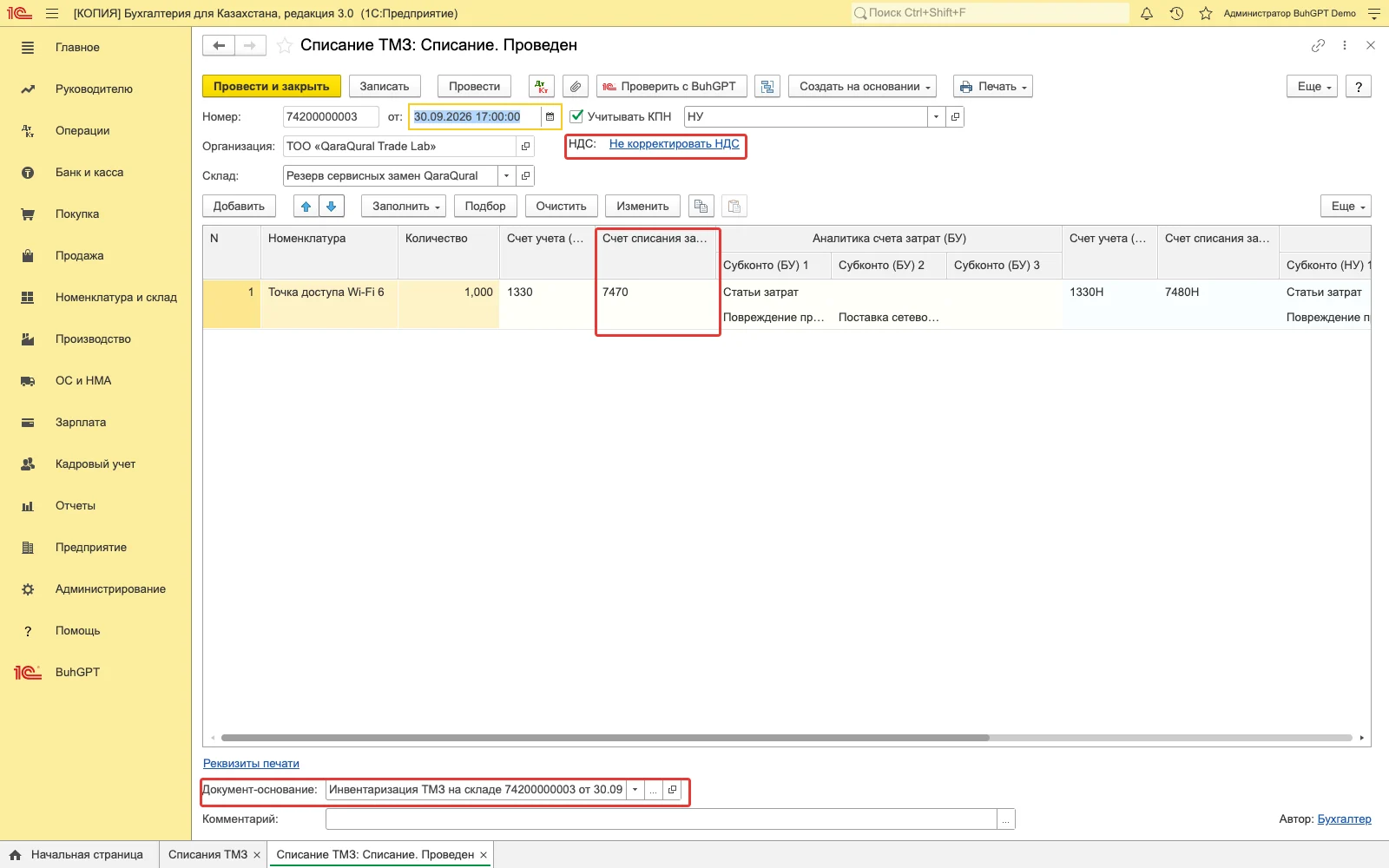
- For shortages, select Create Based On → Inventory Write-Off. For surpluses, select Create Based On → Inventory Receipt.
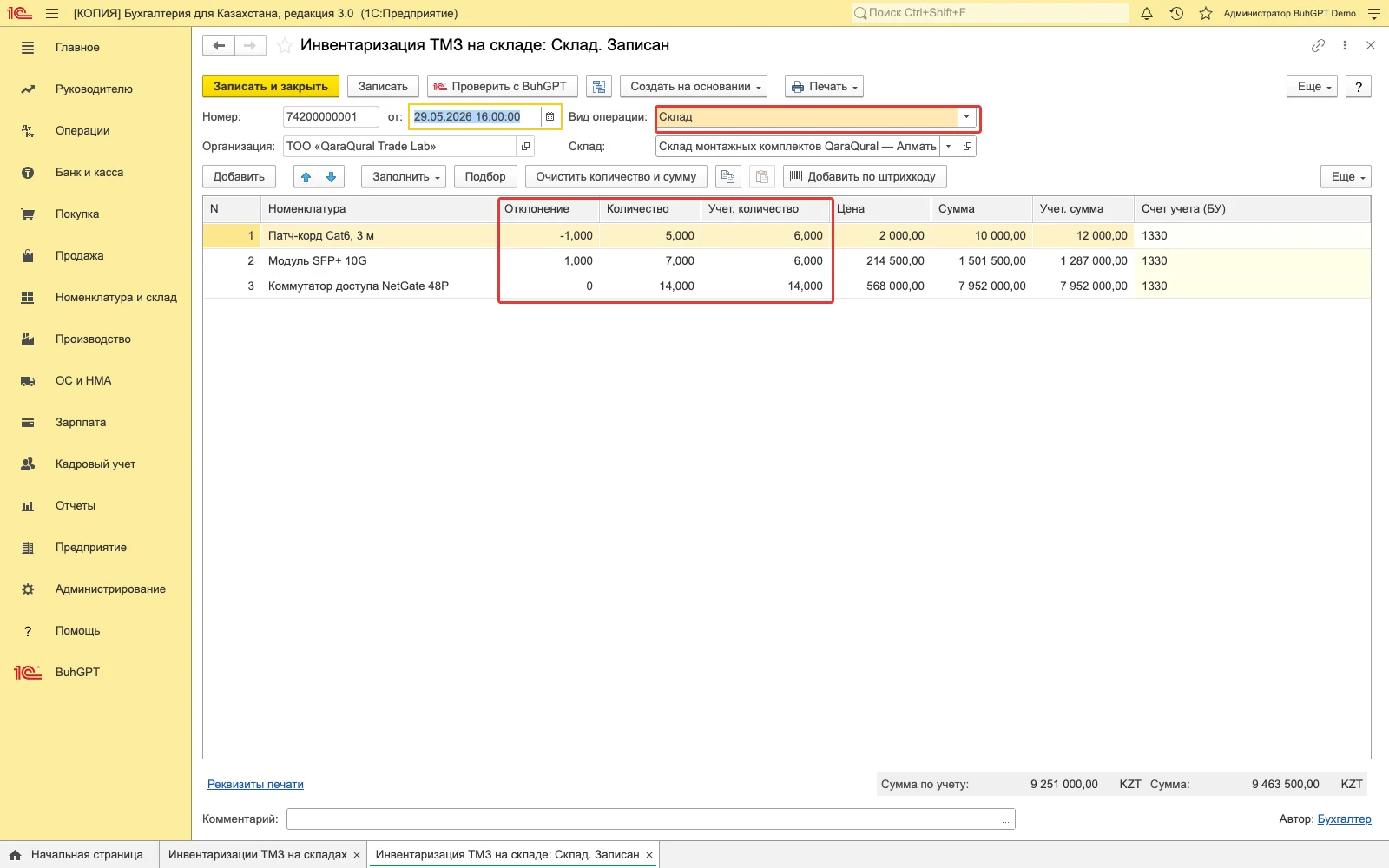
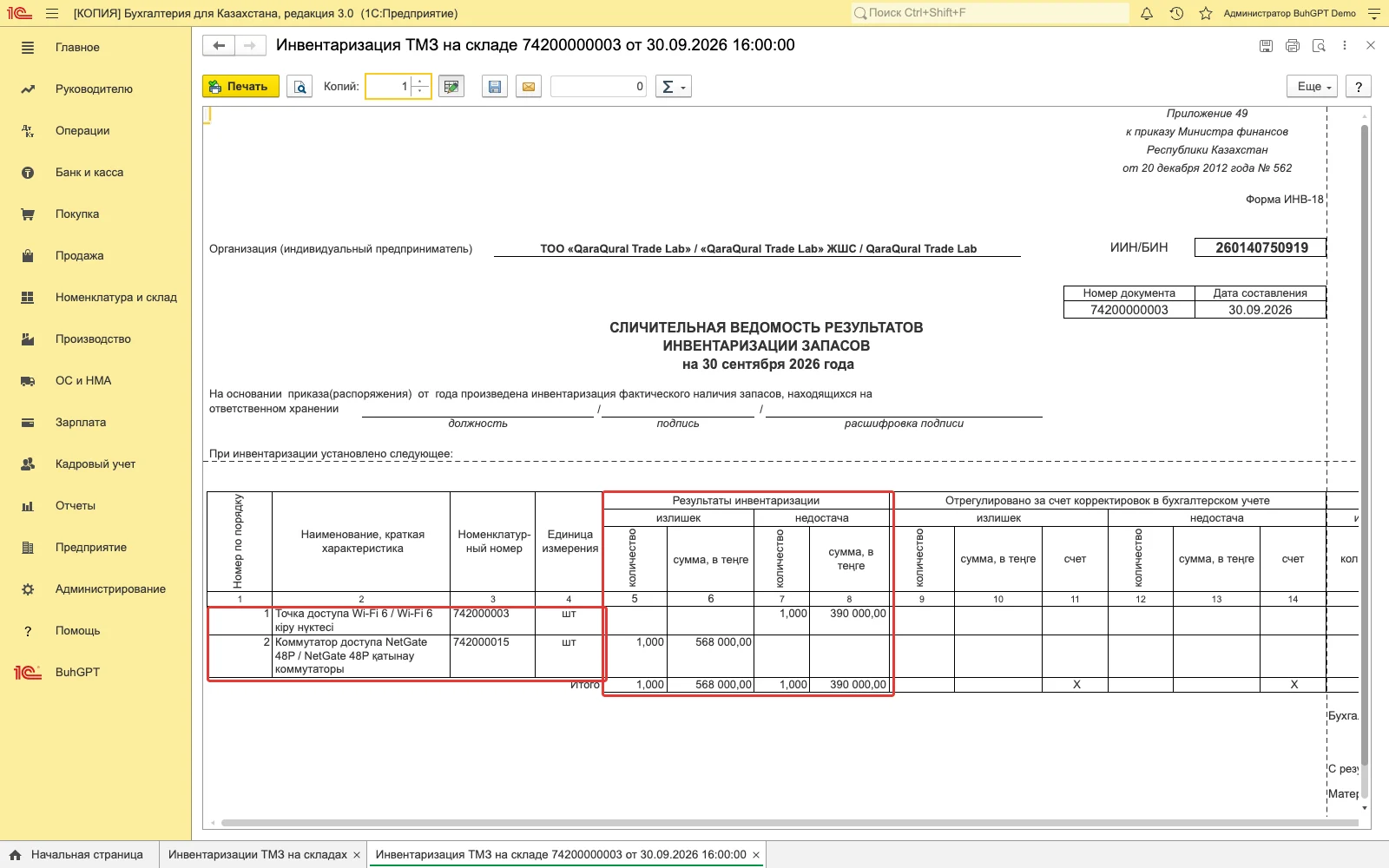
The stock count document cannot be posted and generates no journal entries. Use it to print forms and populate write-off and receipt documents.
How to record surpluses and shortages
Recognize surpluses as income and bring them into inventory. Recognize shortages as an expense or, if the person at fault is identified, as a receivable from that person (para. 71 of Rules No. 241). Apply natural shrinkage allowances only to actual shortages. The person at fault, if identified, reimburses shortages in excess of these allowances.
Shortages and surpluses caused by stock mix-ups may be offset only in exceptional cases. They must involve the same period, the same custodian, the same item designation and equal quantities. The custodian provides a detailed explanation to the committee (para. 71-1 of Rules No. 241).
Example: An LLP uses the general tax regime and is registered for VAT. It counts the “Main” warehouse as of 31.12.2026. Its accounts are kept in 1C 3.0.75.1 using the 2026 chart of accounts.
- Item A has a book quantity of 120 units at 2 500 tenge each and an actual count of 112 units. The shortage is 8 units × 2 500 = 20 000 tenge.
- The committee finds the warehouse keeper responsible for 5 units. Record 5 × 2 500 = 12 500 tenge as a receivable from the employee.
- No one is found responsible for 3 units. Record 3 × 2 500 = 7 500 tenge as other expenses. Check that 12 500 + 7 500 = 20 000.
- Reduce the input VAT previously claimed on the missing goods by 20 000 × 16% = 3 200 tenge (Articles 484 and 503 of the Tax Code of the Republic of Kazakhstan).
- Item B has a book quantity of 40 units and an actual count of 45 units. Recognize the surplus of 5 units at 1 800 each = 9 000 tenge as income.
- The effect on 2026 profit is +9 000 − 7 500 − 3 200 = −1 700 tenge.
| Transaction | Debit | Credit | Amount, tenge |
|---|---|---|---|
| Shortage with the person at fault identified (“Inventory Write-Off”) | 1254 | 1330 | 12 500 |
| Shortage with no person at fault identified (“Inventory Write-Off”) | 7480 | 1330 | 7 500 |
| Input VAT adjustment (“Adjust VAT” checkbox) | 7480 | 1421 | 3 200 |
| Surplus (“Inventory Receipt”) | 1330 | 6290 | 9 000 |
Profit for 2026 decreases by 1 700 tenge, and the warehouse keeper owes 12 500 tenge.
Account 1254 is a 1C subaccount of account 1250 “Short-Term Employee Receivables.” Account 1421 “Recoverable VAT” is likewise a 1C subaccount of 1420. The Standard Chart of Accounts lets organizations choose the fourth digit. Set the VAT expense account in the “VAT Expense Account (Financial Accounting)” field of “Inventory Write-Off.” The default is 7480 “Other Expenses.”
VAT and corporate income tax on shortages and surpluses
If goods are damaged or lost, reduce the input VAT previously claimed in the tax period in which the damage or loss occurred. Calculate the adjustment using the rate in effect on the adjustment date and the carrying amount before revaluation and impairment (Article 484 of the Tax Code of the Republic of Kazakhstan). Shortages within natural shrinkage allowances are excluded from the definition of loss.
Article 258 of the Tax Code of the Republic of Kazakhstan expressly allows losses within natural shrinkage allowances as deductions for corporate income tax. The cost of lost goods may also be deducted up to the amount of compensation received from the person at fault or the insurer.
For the simplified tax return, include surpluses identified during the inventory in income (subpara. 6 of para. 2 of Article 724 of the Tax Code of the Republic of Kazakhstan).
Important: The document date determines the tax period.
- For a write-off dated 31.12.2026, the VAT adjustment goes in the VAT return for Q4 2026.
- For a write-off dated January 2027, the adjustment goes in Q1 2027 and is posted to accounts in the new chart.
Inventory of fixed and intangible assets
- Open Fixed and Intangible Assets → Fixed Asset Accounting and create a “Fixed Asset Inventory” document.
- Fill in “Organization,” “Department,” “Custodian,” and the start and end dates.
- On the “Additional Information” tab, specify the reason, the order details, and the chair and members of the committee.
- On the “Fixed Assets” tab, click “From Balances,” then “Accounting Data.” The “Present per Books” and “Value per Books” columns are populated from the database.
- Print Inv-8 for the committee.
- After the count, mark the assets in “Actually Present.” To record any unrecorded assets you find, click “Add” and enter their actual value.
- Print Inv-16 (the discrepancy statement).
- For a missing asset, create a “Fixed Asset Write-Off” from the inventory document. For a surplus, create a “Fixed Asset Recognition” document with transaction type “Based on Inventory Results.”
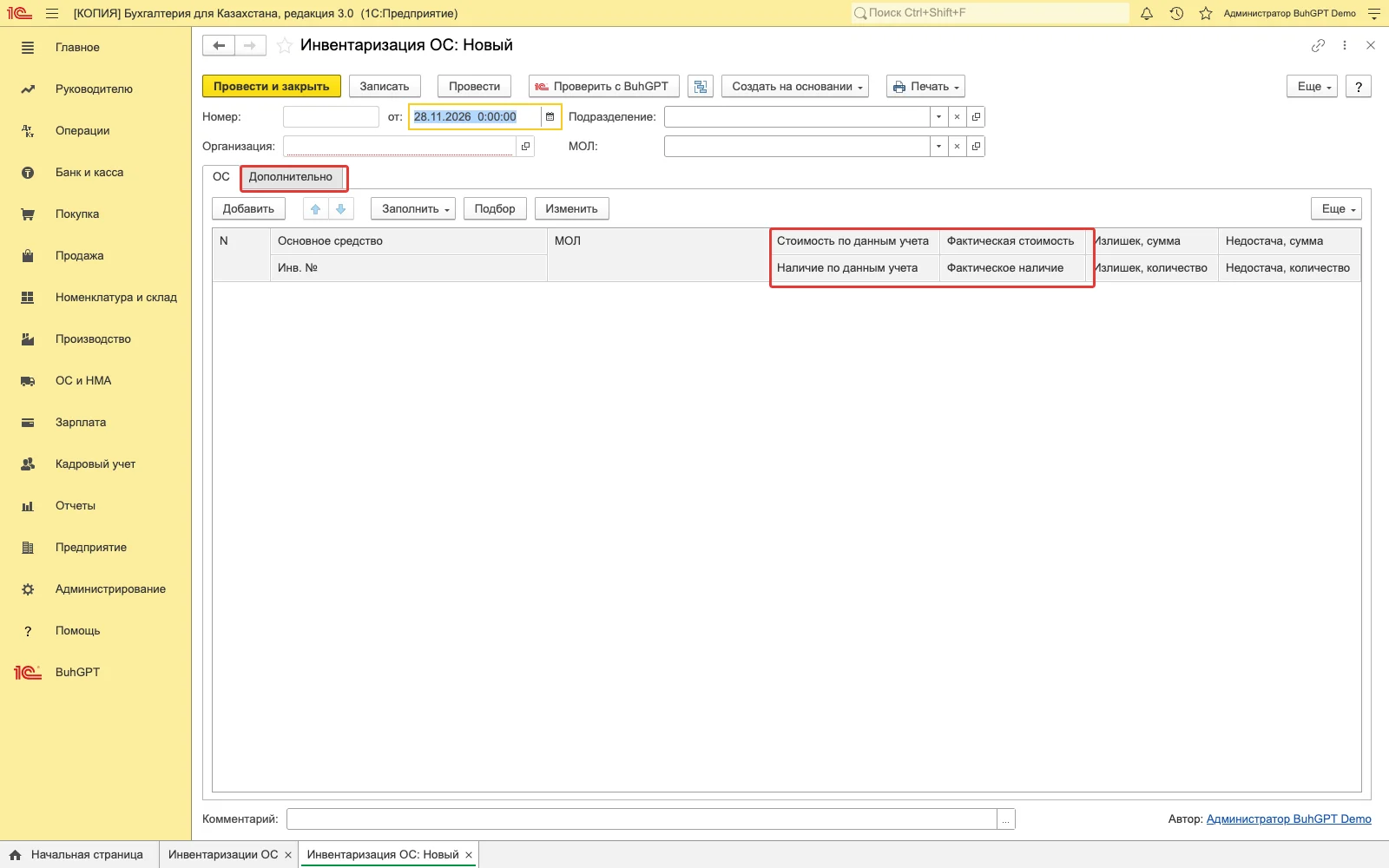
“Fixed Asset Inventory” generates no accounting entries. “Fixed Asset Write-Off” and “Fixed Asset Recognition” generate the journal entries. Follow the same procedure for intangible assets using “Intangible Asset Inventory” under Fixed and Intangible Assets → Intangible Assets.
When writing off a missing fixed asset, 1C clears its accumulated depreciation from account 2420 and charges the carrying amount to the expense account specified in the document. Under the 2026 chart of accounts, this is 7410 “Asset Disposal Expenses.” Check the expense account in “Fixed Asset Write-Off” before posting.
Cash on hand and at bank
Count all cash on hand, note by note. Management appoints a committee of at least three people. Prepare the report in two copies. Management sets the dates of surprise cash counts and keeps them confidential (para. 57 of Rules No. 241).
- Open Bank and Cash → Cash Desk and create a “Cash Inventory” document.
- For “Transaction Type,” select “Cash Desk.” In the “Cash Desk” field, select the cash desk to be checked.
- Click “Fill from Balances.” The “Book Amount” column is populated for each currency.
- Enter the amount counted in the “Amount” column.
- On the “Additional Information” tab, enter the committee details and the order number and date.
- Print and sign Inv-6.
- Record a surplus using a “Cash Receipt Voucher” with transaction type “Other Cash Receipt.” Record a shortage using a “Cash Payment Voucher” with transaction type “Other Cash Payment,” charging it to the cashier as a receivable or recording it as an expense.
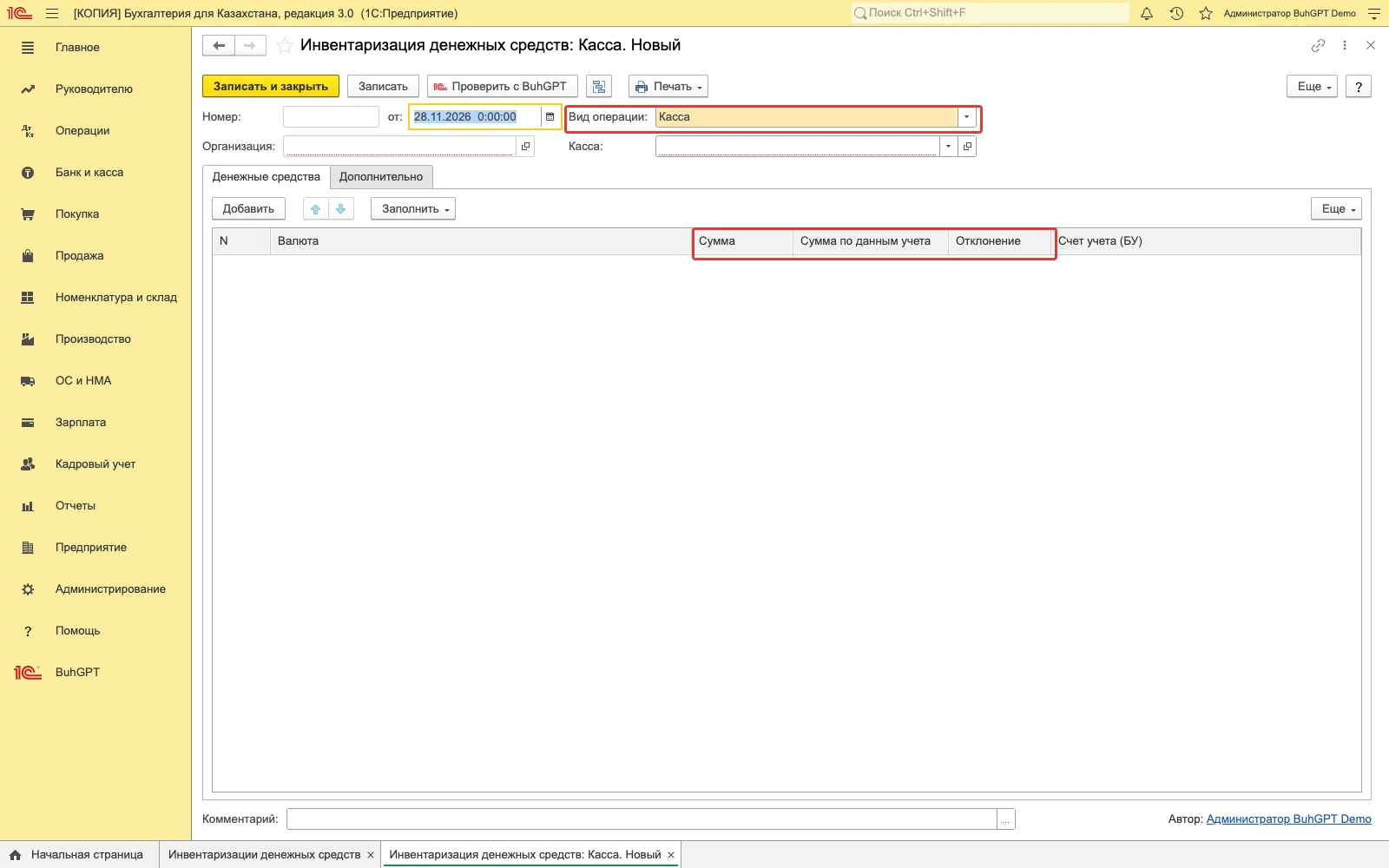
The “Cash Inventory” document cannot be posted. The discrepancy appears in the accounts only after the cash voucher is posted.
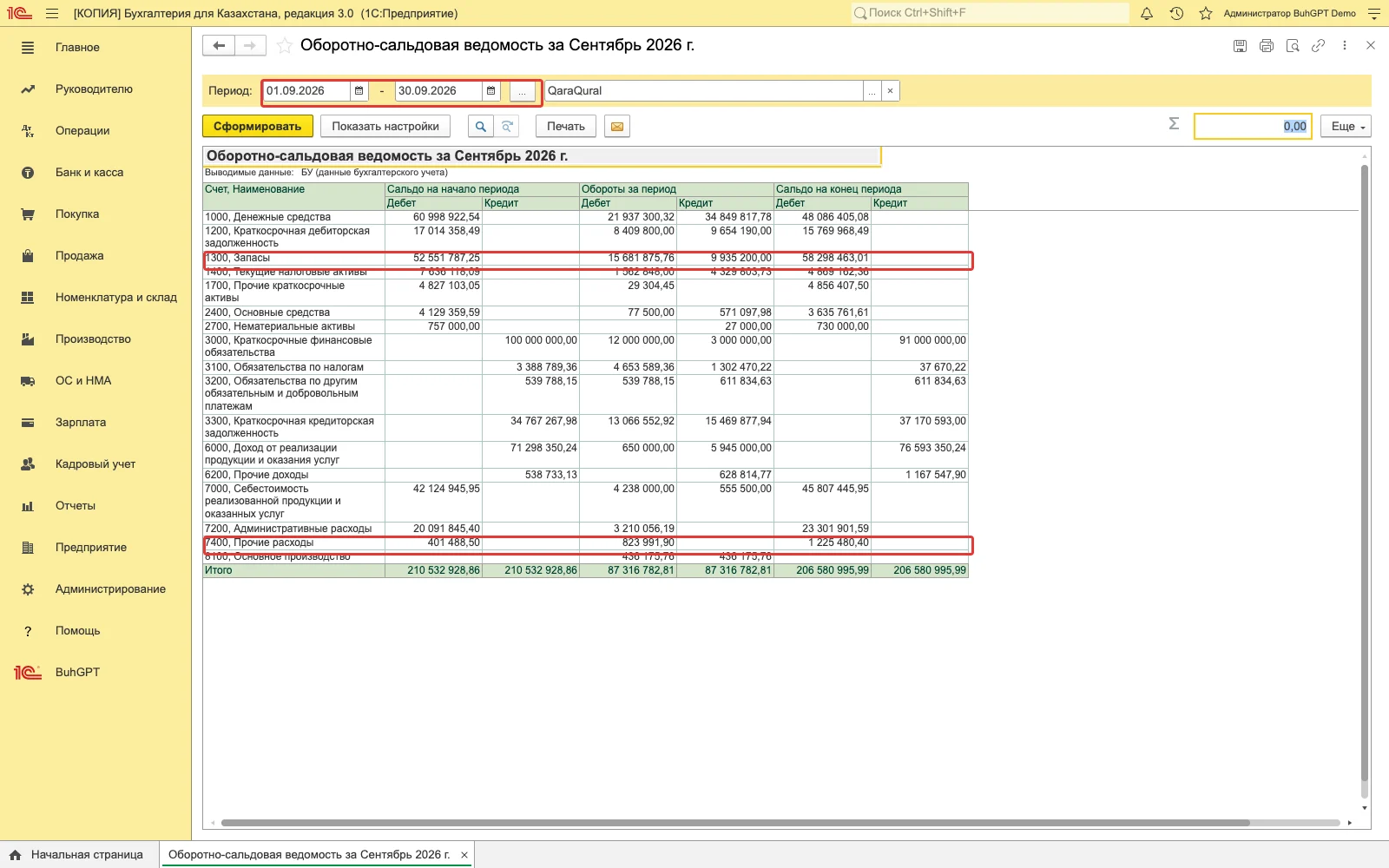
Reconcile bank account balances with bank statements as of 31.12.2026. In 1C, open Reports → Standard Reports → Trial Balance by Account (Financial Accounting) for account 1030, broken down by bank account. Form Inv-6 covers cash and cash equivalents.
Settlements with customers, suppliers and employees
Document the inventory of receivables and payables using the form approved by Order No. 562. Attach a reconciliation statement in any format (para. 72 of Rules No. 241).
- Run Management → Customer Settlements → Customer Receivables and the corresponding report for suppliers. Identify large and long-outstanding balances.
- Open Sales → Counterparty Settlements and create a “Reconciliation Statement.”
- Specify the “Counterparty,” “Contract” and the period from 01.01.2026 to 31.12.2026. For major counterparties, select “Break Down by Contract.”
- Populate the document from the accounting records, print it and send it to the counterparty.
- When the counterparty confirms the reconciliation, select the “Reconciliation Confirmed” checkbox. If there is a discrepancy, enter the counterparty’s figures and find the missing document.
- Transfer the final amounts to the receivables and payables inventory report (Inv-4).
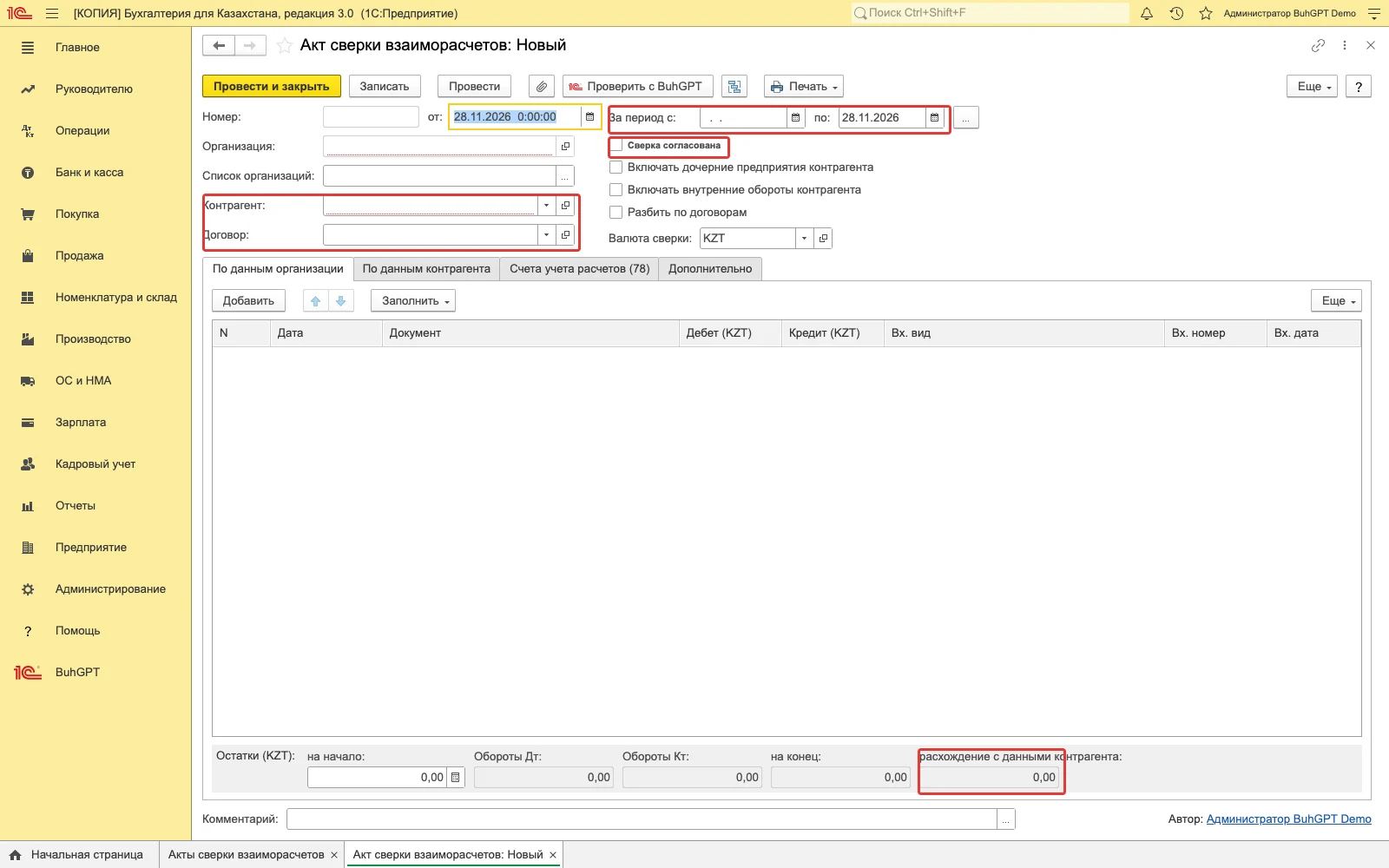
Check employee expense advances (1251), employee receivables (1254) and balances with the government separately. Clear unaccounted-for expense advances and overlooked advance payments before 31 December to avoid carrying them as outstanding balances on the balance sheet as of 01.01.2027.
How the new 2027 chart of accounts affects the inventory
In 2026, the version of the Standard Chart of Accounts under Order No. 185 applies. The new version under Order No. 533 of the Ministry of Finance of the Republic of Kazakhstan dated 6 August 2026 takes effect on 1 January 2027. The order expressly specifies 1 January 2027 as its effective date.
The accounts normally used for surpluses and shortages change numbers in 2027. For a detailed mapping, see “Switching to the New 2027 Chart of Accounts in 1C”.
| Purpose | Account in 2026 | Account from 01.01.2027 |
|---|---|---|
| Other income (surpluses) | 6290 “Other Income” | 6190 “Other Income” |
| Other expenses (shortages with no person at fault identified) | 7480 “Other Expenses” | 7170 “Other Expenses” |
| Asset disposal expenses (fixed asset write-offs) | 7410 | 7110 |
| Income from asset disposals | 6210 | 6110 |
| Employee receivables (damage and shortages) | 1250 | 1250, same purpose |
Important: Changes to account codes from 2027 (Order No. 533).
- 6290 changes from “Other Income” to “Income from Other Transactions with Investments and Financial Assets.”
- 7410 changes from asset disposal expenses to “Expenses Related to Discontinued Operations.”
- 6210 becomes “Interest Income.”
- The new chart omits account 7480.
If you use the familiar account codes 6290 or 7410 to record inventory results in January 2027, the amounts will be posted to accounts with different purposes. Post the receipts and write-offs as of 31.12.2026 using the accounts in the old chart.
Release 3.0.75.1 still uses the old chart of accounts. Wait for the 1C release with the revised Standard Chart of Accounts and leave the account names as they are. The more accurate the balances as of 31.12.2026, the easier they will be to transfer.
Frequently asked questions
Do we have to take inventory as of 31 December? — No. The Rules require an inventory at least once a year, and the accounting policy sets the dates (paras. 60 and 63 of Rules No. 241). The annual inventory results are reflected in the annual financial statements (para. 72), so a date close to year-end is the most convenient.
Our LLP has 6 employees. Can we skip the inventory? — A small business with up to 10 employees can choose its own inventory period (para. 60 of Rules No. 241). The inventory itself remains mandatory. An inventory as of 31.12.2026 is especially useful before switching to the new chart of accounts.
Why does “Warehouse Stock Count” generate no journal entries? — 1C 3.0.75.1 does not allow this document to be posted. The “Inventory Write-Off” and “Inventory Receipt” documents created from it generate the journal entries.
Can a shortage of one item be offset by a surplus of another? — Only as an exception for stock mix-ups involving the same period, the same custodian, the same item designation and identical quantities (para. 71-1 of Rules No. 241). In all other cases, record the shortage and surplus separately.
Do we have to adjust VAT if the person at fault reimbursed the shortage? — Under Article 484 of the Tax Code of the Republic of Kazakhstan, damage to or loss of goods triggers a reduction in input VAT regardless of who pays compensation. Shortages within natural shrinkage allowances are excluded from the definition of loss.
We finished the count on 10 January 2027. Which accounts should we post to? — The annual inventory is reflected in the 2026 financial statements (para. 72 of Rules No. 241). Post the entries in the 2026 period using the old chart of accounts before the annual financial statements are approved. Take into account the tax period for the VAT adjustment under Article 484 of the Tax Code of the Republic of Kazakhstan.
Sources
- Accounting Rules, Order No. 241 of the Ministry of Finance of the Republic of Kazakhstan dated 31.03.2015 (Chapter 4, paras. 57, 60–72)
- Law No. 234 of the Republic of Kazakhstan dated 28.02.2007 on Accounting and Financial Reporting (Articles 8, 18)
- Order No. 562 of the Ministry of Finance of the Republic of Kazakhstan dated 20.12.2012 on Approval of Source Accounting Document Forms (forms Inv-4, Inv-6, Inv-8, Inv-10, Inv-16, Inv-18)
- Standard Chart of Accounts, Order No. 185 of the Ministry of Finance of the Republic of Kazakhstan dated 23.05.2007 (version in force in 2026)
- Order No. 533 of the Ministry of Finance of the Republic of Kazakhstan dated 06.08.2026, introducing the revised Standard Chart of Accounts from 01.01.2027
- 2026 Tax Code of the Republic of Kazakhstan (Articles 258, 484, 503, 724)
- 1C:Accounting for Kazakhstan 3.0.75.1, including the “Warehouse Stock Count,” “Fixed Asset Inventory,” “Intangible Asset Inventory,” “Cash Inventory,” “Reconciliation Statement,” “Inventory Write-Off,” “Inventory Receipt,” “Fixed Asset Write-Off” and “Fixed Asset Recognition” documents