From 1 January 2027, the social benefit for job loss paid by the State Social Insurance Fund (SSIF) is capped at 45% of 7 times the minimum wage (MW), or 3,15 MW per month. The maximum payment period also falls from six to three months. Both changes were introduced by Law No. 306-VIII of the Republic of Kazakhstan dated 11 June 2026 (Law No. 306-VIII).
The exact cap in tenge is still unknown. The law on the republican budget will set the MW for 2027, and as of 28.11.2026 the law had yet to appear on Adilet.
At a glance
- From 2027, the benefit is capped at 45% of 7 times the MW in effect on the date entitlement begins.
- The benefit is paid for up to 3 months with at least 24 months of participation in social insurance (currently up to 6 months).
- A new benefit can be awarded only after 12 months have elapsed following the month in which the last payment was received.
- Anyone receiving the benefit on 31.12.2026 will continue to receive it for the approved period.
- The calculation formula, the 0,45 replacement coefficient and the participation coefficient remain the same.
- For accountants, the priority is to pay social contributions in full and on time for the last 24 months.
What was enacted and when it takes effect
Law No. 306-VIII was signed on 11 June 2026 and published in the Reference Control Bank of Regulatory Legal Acts on 15 June 2026. The law generally took effect on 1 July 2026, with some provisions scheduled to take effect later.
The amendments to the Social Code concerning the unemployment benefit are in subparagraphs 29)–33) of paragraph 9 of Article 1. The transitional provision is in subparagraph 60). Under Article 2 of the law, subparagraphs 29)–61) of paragraph 9 take effect from 1 January 2027.
To implement the law, the Minister of Labour and Social Protection of the Population issued Order No. 398 dated 9 October 2026. It makes the same changes to the Rules for Calculating and Awarding the Benefit (Order No. 237 dated 22.06.2023). These provisions also take effect from 1 January 2027 (Order No. 398).
| Item | Details |
|---|---|
| Law | No. 306-VIII dated 11.06.2026 |
| Amendments to the Social Code | Articles 113, 115 and 118 amended, and Articles 114 and 119 repealed |
| Effective date of these provisions | 1 January 2027 |
| Implementing regulation | Order No. 398 of the Ministry of Labour and Social Protection of the Population dated 09.10.2026 |
Previous and new rules
The formula stays the same. The changes affect the payment period, the maximum amount and eligibility for a new award (Article 118 of the Social Code).
| Condition | Through 31.12.2026 | From 01.01.2027 |
|---|---|---|
| Maximum amount | No separate cap | 45% of 7 times the MW on the date entitlement begins |
| Payment period with 24–36 months of social contributions | 3 months | 3 months |
| Payment period with 36 months or more of social contributions | 4, 5 or 6 months | 3 months |
| New award | 12 months are deducted from the participation period for each month of benefits received | The same deduction applies, and a new award is possible only after 12 months have elapsed following the month of the last payment |
The payment periods of 1 month (6 to 12 months of social contributions) and 2 months (12 to 24 months) still apply. In the provision on the three-month period, “up to thirty-six” is replaced with “or more,” and the provisions on payment periods of four, five and six months are repealed.
New provision in paragraph 2 of Article 118
The amendment reads, “The maximum amount of the social benefit for job loss shall not exceed forty-five percent of seven times the minimum wage established by the law on the republican budget as of the date on which entitlement to the social benefit for job loss arises.”
Entitlement begins on the date the person registers as unemployed at a career centre (paragraph 1 of Article 113 of the Social Code). The calculation therefore uses the minimum wage for the year of registration, even if the person was dismissed in a different year.
How the benefit is calculated
Paragraph 37 of the Rules gives the formula SB = AMI × IRC × PC. SB is the social benefit, AMI is the average monthly income on which social contributions were paid, IRC is the income replacement coefficient of 0,45, and PC is the participation coefficient (Rules, Order No. 237).
AMI is the total income on which social contributions were paid during the 24 calendar months preceding the month when entitlement begins, divided by 24. The divisor includes months without social contributions, so gaps reduce the benefit.
| Participation period (months of social contributions) | PC |
|---|---|
| 6–12 | 0,7 |
| 12–24 | 0,75 |
| 24–36 | 0,85 |
| 36–48 | 0,9 |
| 48–60 | 0,95 |
| 60–72 | 1,0 |
| 72 or more | 1,0 + 0,02 for every full 12 months beyond 60, up to 1,3 |
Who will be affected by the cap
The monthly social contribution base per employer cannot exceed 7 MW (Article 245 of the Social Code). An employee with one employer therefore almost always has an AMI of 7 MW or less.
The cap of 0,45 × 7 MW applies only when AMI × PC exceeds 7 MW. With one employer, this is possible only when the PC exceeds 1,0, meaning at least 72 months of participation and income close to the maximum social contribution base.
With two or more employers, income from each employer is counted up to 7 MW and the amounts are added together (paragraph 40 of the Rules). AMI can then exceed 7 MW, and the cap can apply even with a shorter participation period.
The reduction to three months affects many more people, including everyone with 36 months or more of social contributions.
Example for a high-income employee with one employer. The calculation uses multiples of the MW. The amounts in tenge use the 2026 MW of 85 000 tenge for illustration (Article 7 of Law No. 239-VIII). The figures are illustrative for 2027.
- The employee has 132 months of participation. Social contributions were paid each month on the maximum base of 7 MW, so 7 × 85 000 = 595 000 tenge. AMI = 595 000 tenge.
- PC = 1,0 + 0,02 × floor((132 − 60) / 12) = 1,0 + 0,02 × 6 = 1,12.
- The formula gives 595 000 × 0,45 × 1,12 = 267 750 × 1,12 = 299 880 tenge.
- The cap is 0,45 × 7 × 85 000 = 267 750 tenge. The award is 267 750 tenge.
- Mandatory pension contributions of 10%, or 26 775 tenge, are withheld from the benefit, leaving a net payment of 240 975 tenge (Article 117 of the Social Code).
- The payment period is 6 months under the 2026 rules and 3 months from 2027.
The total for the full period would be 6 × 299 880 = 1 799 280 tenge under the previous rules and 3 × 267 750 = 803 250 tenge under the 2027 rules.
If the 2027 MW is higher, the cap will rise accordingly. AMI is based on income from previous months, when the calculation used the MW for the respective years as the basis for the limit. A higher cap will therefore affect even fewer people.
Example for a typical employee whose benefit falls below the cap.
- AMI is 300 000 tenge, the participation period is 40 months, and PC = 0,9.
- The benefit is 300 000 × 0,45 × 0,9 = 135 000 × 0,9 = 121 500 tenge per month.
- At any MW of 38 572 tenge or more, the cap of 3,15 MW is above this amount, so the employee receives the full calculated benefit.
- Mandatory pension contributions of 10% amount to 12 150 tenge, leaving a net payment of 109 350 tenge.
- The payment period is 4 months in 2026 (36 to 48 months of social contributions) and 3 months from 2027.
The total for the full period would be 4 × 121 500 = 486 000 tenge under the previous rules and 3 × 121 500 = 364 500 tenge under the 2027 rules.
Who remains covered by the previous rules during the transition
Law No. 306-VIII adds paragraph 10 to the transitional provisions of the Social Code (Article 262). Anyone receiving the unemployment benefit on 31 December 2026 will continue to receive it for the approved period.
The date the benefit is awarded determines whether the transitional provision applies. If a person is dismissed in December 2026 and registers as unemployed in January 2027, entitlement begins in 2027.
Important — the law leaves it unclear which rules apply to someone who registers in December 2026 and receives a decision in January 2027.
- The transitional provision refers to “recipients as of 31 December 2026.”
- The new cap depends on when entitlement begins, which is the date the person registers as unemployed.
- Employees in this situation should check with an office of the State Corporation or a branch of the SSIF.
Other changes to how the benefit is awarded
Vocational training
People who undertake training through the Electronic Labour Exchange remain eligible (subparagraph 2 of paragraph 2 of Article 109 of the Social Code). A referral to an educational institution or training centre (subparagraph 1) becomes grounds for refusing to accept an application (new subparagraph 1-1 of paragraph 1 of Article 115).
Under the Rules as amended by Order No. 398, benefit payments stop in the month after the recipient takes up a subsidised job or is referred for such training.
Articles 114 and 119
The provisions of the Code on the award procedure (114) and on suspension and termination (119) have been repealed. Under new paragraph 6 of Article 113, the authorised body now sets the procedure through the Rules issued under Order No. 237, as amended by Order No. 398.
Applying again
Under new paragraph 38 of the Rules, a new benefit can be awarded once 12 calendar months have elapsed following the month in which the last payment was received. The rule deducting 12 months from the participation period for each month of prior benefits still applies.
Example for someone who received their last payment in March 2027.
- The 12 months following March 2027 run from April 2027 through March 2028.
- A new benefit can be awarded in April 2028 at the earliest.
- If the previous benefit was paid for 3 months, 3 × 12 = 36 months are deducted from the participation period.
What this means for employers and accountants
The SSIF awards and pays the benefit. Eligibility and the amount depend entirely on how the accountant calculated and paid social contributions.
Important — employees will discover errors in their social contributions when they apply, by which point it is too late to correct them retroactively.
- If no social contributions were paid in the last 24 months, the application will be refused (subparagraph 6 of paragraph 1 of Article 115 of the Social Code).
- The application will also be refused if the participation period is less than 6 months.
- Social contributions for the calculation period received after the application date do not trigger a recalculation (paragraph 5 of Article 113).
- Every missed month reduces AMI because the divisor is always 24.
The social contribution rate is 5% of the contribution base, or 4,5% under the unified payment (Article 244 of the Social Code). The monthly base per employer ranges from 1 MW to 7 MW.
Employer compensation for redundancies
Employers must pay redundancy compensation separately from the SSIF benefit. In the event of liquidation or a reduction in headcount or staffing, the employer pays compensation equal to one month's average pay (Article 131 of the Labour Code of the Republic of Kazakhstan). If the employee is dismissed because of a reduction in production, work or services, the employer pays two months' average pay.
An employment contract, collective agreement or employer act may provide for a higher amount.
Employees facing redundancy at the end of 2026 should be aware that the state benefit will be paid for a shorter period from 2027. They can discuss compensation and the timing of dismissal in advance, and they decide when to register as unemployed.
How to check social contributions and record a dismissal in 1C
The menu paths below were checked against 1C:Accounting for Kazakhstan 3.0.75.1. The new benefit rules require no changes in the software, which produces the underlying data for the SSIF benefit calculation.
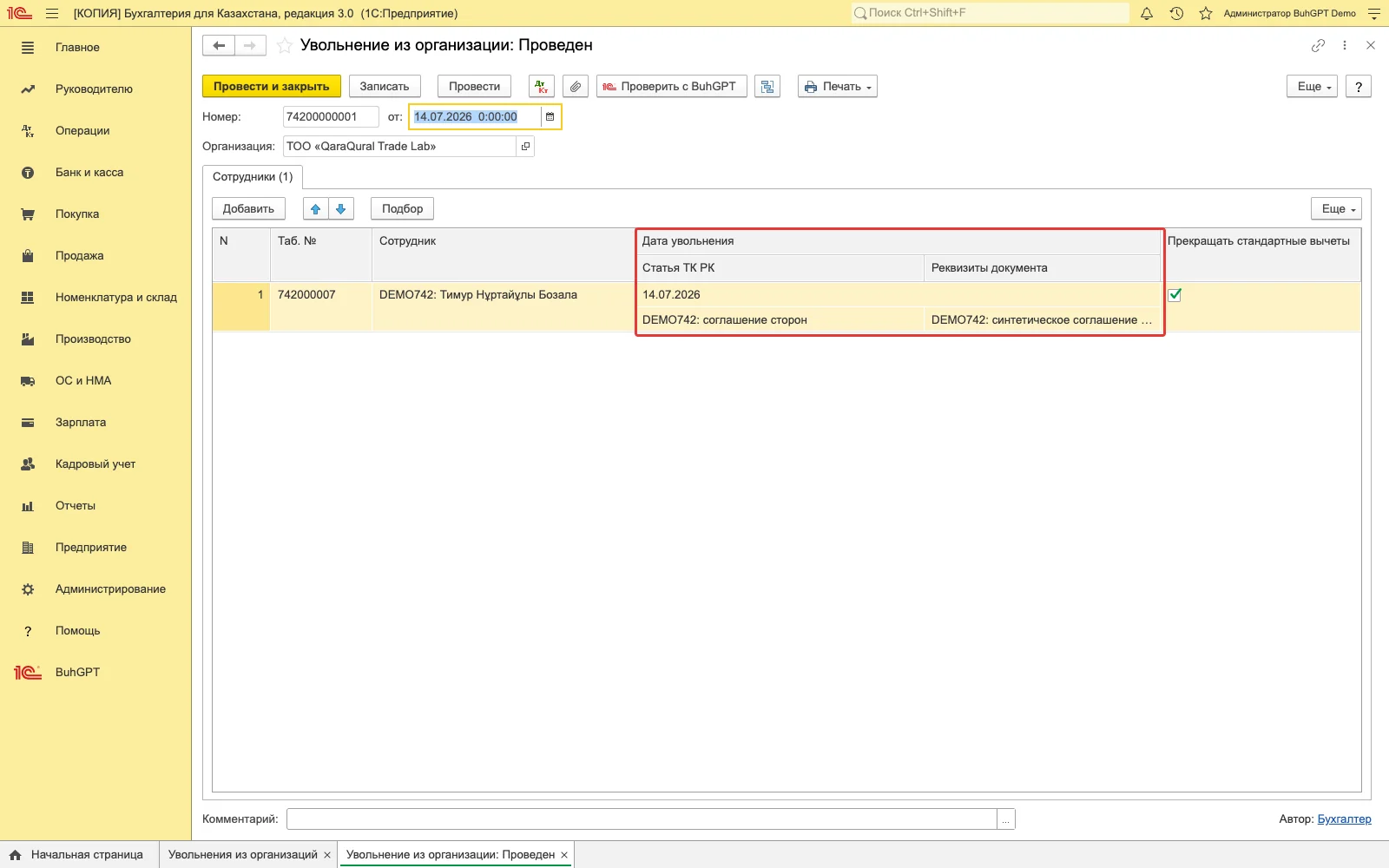
Record the dismissal
- Open Personnel Records → Dismissals from Organisations.
- Click “Create” and select the organisation and employee.
- Fill in “Dismissal Date.”
- In “Article of the RK Labour Code,” select the grounds for dismissal, such as a reduction in headcount or staffing.
- In “Document Details,” enter the number and date of the dismissal order.
- Post the document.
Calculate pay and compensation for the final month
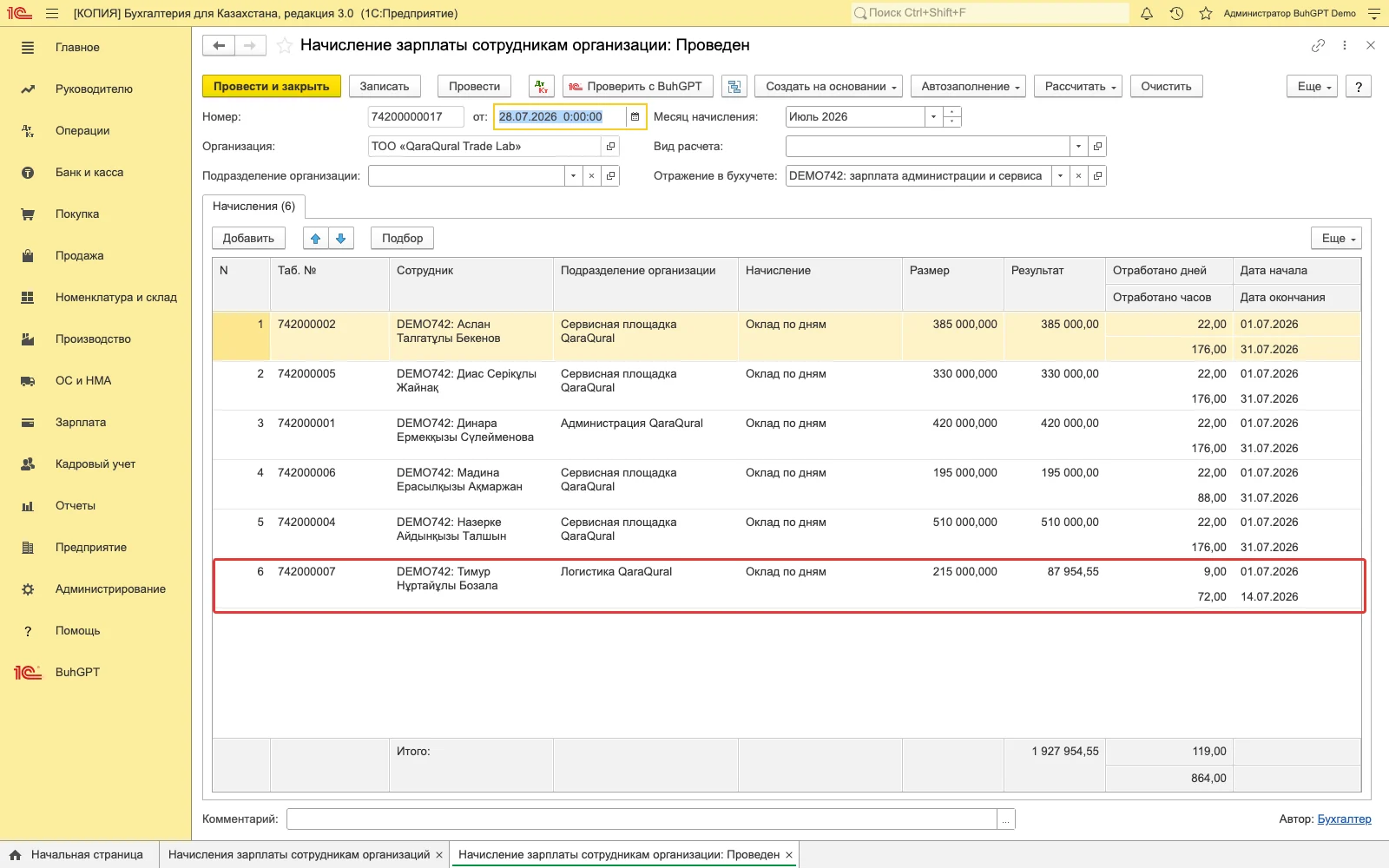
- Open Payroll → Statutory Payroll Calculation.
- Select the month of dismissal and run the payroll calculation for the organisation.
- Check the “Payroll Accruals for Organisation Employees” document. If the employee has unused leave, there should be a line for “Compensation for Unused Leave on Dismissal.”
- Calculate compensation under Article 131 of the RK Labour Code using the calculation type configured for this payment in the organisation (Payroll → Directories and Settings → Organisation Accruals).
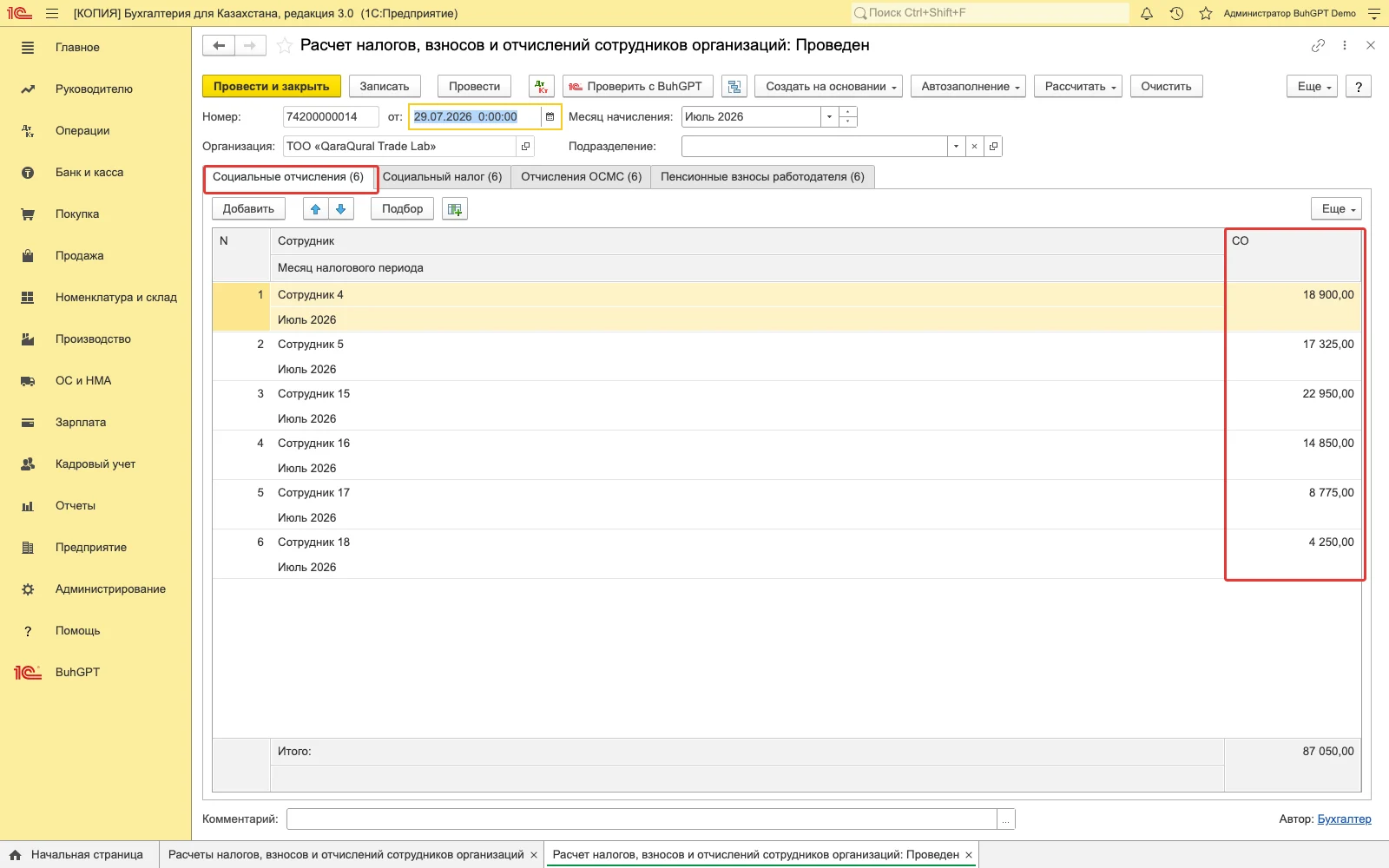
- Check that the “Calculation of Taxes and Contributions for Organisation Employees” document shows social contributions calculated for the employee.
Check that social contributions have been remitted
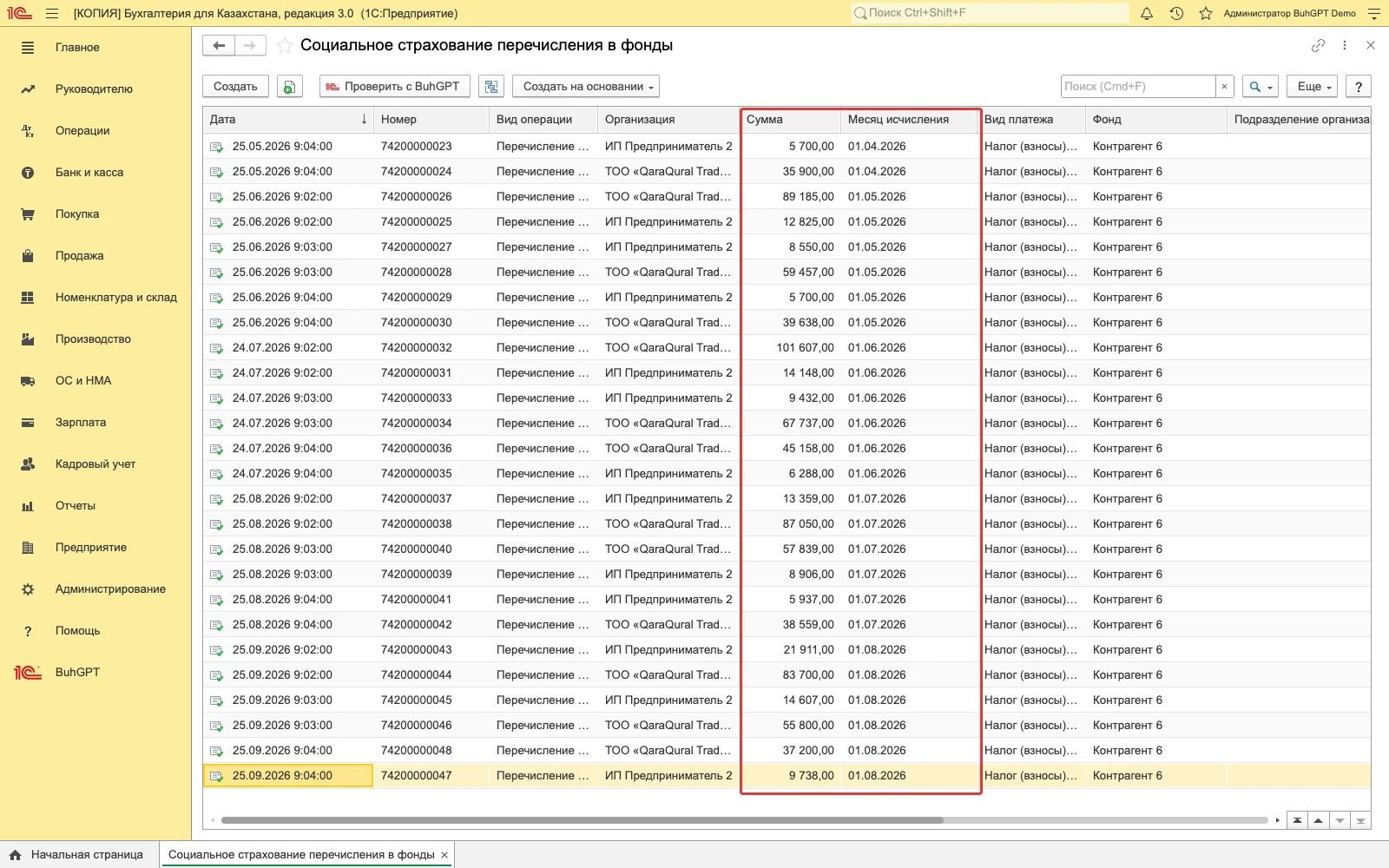
- Open Payroll → Contribution Records → Social Insurance Remittances to Funds.
- Check that a remittance document has been posted for each month of employment.
- If a month is missing, pay the outstanding social contributions before the employee applies. The calculation excludes contributions received after the application date.
Frequently asked questions
What will the maximum unemployment benefit be in tenge in 2027? — It will be 45% of 7 MW, or 3,15 MW. The law on the republican budget will set the 2027 MW. As of 28.11.2026, the law had yet to be published, so the amount in tenge is still unknown.
Can I receive the benefit for 6 months from 2027? — No, if your entitlement begins on or after 1 January 2027. The maximum payment period is 3 months with at least 24 months of social contributions (Law No. 306-VIII).
What happens to people already receiving the benefit? — Anyone receiving the benefit on 31 December 2026 will continue to receive it for the approved period, including approved periods of 4–6 months.
Has the calculation formula changed? — No. The calculation still uses AMI × 0,45 × PC. The new cap limits the amount payable.
Does the employer pay the benefit? — No. The SSIF awards and pays the benefit. The employer is responsible for paying social contributions in full and on time and pays separate redundancy compensation under Article 131 of the RK Labour Code.
When can I receive the benefit again after the first award? — Once 12 calendar months have elapsed following the month in which you received the last payment. For each month of prior benefits, 12 months are deducted from your participation period.
Do I need to update 1C because of these changes? — No. The SSIF benefit is calculated outside 1C. The relevant changes under Law No. 306-VIII apply only to how the benefit is awarded. Employers calculate social contributions as before.
Sources
- Law No. 306-VIII of the Republic of Kazakhstan dated 11.06.2026 (subparagraphs 29–33 and 60 of paragraph 9 of Article 1, and Article 2)
- Social Code of the Republic of Kazakhstan, Article 118
- Social Code of the Republic of Kazakhstan, Articles 113, 115 and 117
- Social Code of the Republic of Kazakhstan, Articles 244 and 245
- Rules for Calculating and Awarding the Unemployment Benefit (Order No. 237 dated 22.06.2023)
- Order No. 398 of the Ministry of Labour and Social Protection of the Population dated 09.10.2026
- Labour Code of the Republic of Kazakhstan, Article 131
- Law on the Republican Budget for 2026–2028, Article 7 (2026 MW)