The bill is still pending, and its provisions may change. For subsequent expenditure in 2026, apply the current Article 273 of the Tax Code of the Republic of Kazakhstan. For 2027, check the proposed treatment against the final version of the bill before recording the transaction for tax purposes.
How to account for subsequent expenditure under current rules
Under the current Article 273, subsequent expenditure includes the costs of operating, repairing, reconstructing, upgrading, maintaining and disposing of property, as well as other costs incurred in relation to the assets listed in that article (Article 273 of the Tax Code of the Republic of Kazakhstan). The name of the work alone, such as “repair” or “upgrade,” is therefore insufficient to determine its tax treatment. The accountant needs to identify the asset to which the costs relate, establish the nature of the work performed and determine how the costs were recorded in the accounts.
As a general rule, subsequent expenditure is deductible in the tax period in which it is incurred (paragraph 3 of Article 273 of the Tax Code of the Republic of Kazakhstan). The same provision sets out exceptions. In particular, subsequent expenditure on fixed assets subject to the special rules in the relevant subsection of the Tax Code of the Republic of Kazakhstan is excluded from the general rule allowing an immediate deduction (subparagraph 1 of paragraph 3 of Article 273 of the Tax Code of the Republic of Kazakhstan).
A separate exception applies to expenditure on non-depreciable assets. Where required by the chapter on fixed assets, the costs are included in the initial cost of those assets (subparagraph 2 of paragraph 3 of Article 273 of the Tax Code of the Republic of Kazakhstan). Special rules also apply to certain expenditure on leased property if the lessee recognises the property as a fixed asset (subparagraph 3 of paragraph 3 of Article 273 of the Tax Code of the Republic of Kazakhstan).
Article 273 does not apply to construction in progress. Its general rules also exclude the property, plant and equipment and intangible assets of a subsoil user specified in the provision, before extraction begins following a commercial discovery (paragraph 2 of Article 273 of the Tax Code of the Republic of Kazakhstan).
In practice, the accountant should start with the following questions, which go beyond classifying the work as routine or major repairs:
- which property the costs relate to;
- whether the asset is a fixed asset for tax purposes;
- whether any exception applies to the asset;
- whether the amount was expensed or added to the carrying amount in the accounts;
- whether any special tax rules apply to the asset.
Proposed changes from 2027
The draft amendments address the treatment of subsequent expenditure through the interaction between Article 273 and the proposed new Article 313-1. The materials provided contain neither the text of draft Article 313-1 nor an official link to it, so its conditions, exceptions and effective date cannot be confirmed. The draft provisions create no rights or obligations for taxpayers before the law is enacted.
In 2026, accountants should use Article 273 of the current Tax Code of the Republic of Kazakhstan as their starting point. For 2027, they will need to compare the final wording of that article with the enacted wording of Article 313-1. When closing a tax period, accountants must rely on the published text of the law itself.
Once the amendments are enacted, check the following four points:
- Whether the general rule allowing costs to be deducted in the period in which they are incurred has been retained.
- Which costs relating to fixed assets must be accounted for as part of the cost of those assets.
- Whether the tax treatment depends on how the costs are recorded in the accounts.
- Whether transitional rules apply to work that began before the amendments take effect.
It is especially important to determine the tax treatment separately from the accounting classification. Recording the amount as a current expense or adding it to the carrying amount helps explain the economic substance of the transaction. The tax treatment must comply with the version of the Tax Code of the Republic of Kazakhstan in force on the transaction date.
How to distinguish between expensing and capitalising costs
To document the decision, it helps to review the work in two stages. First, the committee or person responsible establishes what actually happened to the asset. The accountant then applies the tax rules to the facts established.
The documentation should describe both the nature and the outcome of the work. “Equipment repair” is too broad. Record the fault, the assemblies replaced, the work performed, the condition of the asset upon completion and the committee’s findings on the nature of the changes. Supporting documents may include the contract, cost estimate, defect report, certificate of completion, technical assessment and internal decision accepting the completed work.
Suppose an organisation carries out work on an item of property, plant and equipment in 2026. If the documentation and accounting rules support recognising the costs as expenses for the period, the accountant checks whether they qualify for a deduction under the general rule in Article 273. If the work is recorded as an increase in the asset’s carrying amount, the accountant must check the special rules for fixed assets separately. The title of the source document alone is insufficient grounds for claiming a deduction (Article 273 of the Tax Code of the Republic of Kazakhstan). The example omits a monetary amount because the source data contain no confirmed calculation parameters under draft Article 313-1.
For review purposes, prepare a tax accounting memorandum with the following fields:
- asset name and identifier;
- tax status of the asset;
- description of the work performed;
- date the costs were recognised;
- accounting treatment;
- version of the Tax Code of the Republic of Kazakhstan applied;
- basis for deducting the expenditure or including it in the asset’s cost;
- list of supporting documents.
How to prepare your accounts and 1C data
Until the tax accounting methodology is updated, avoid changing your accounting settings solely on the basis of the draft. First, separate transactions recognised as expenses for the period from those that increase the carrying amount of an item of property, plant and equipment. For expenses, use the appropriate account in Section 7 of the Standard Chart of Accounts. For example, account 7210 is used for administrative and general expenses unrelated to production (Chapter 10 of the Standard Chart of Accounts). Choose the account based on the purpose of the expenditure, taking into account the wording used by the contractor.
In 1C, the accounting details should let you link the costs to the item of property, plant and equipment, the contract, the contractor and the source document. For capitalised costs, retain the link to the asset whose carrying amount increases. For expenses recognised in the period, provide a breakdown of the amount in the tax register and evidence of the recognition date.
The exact menu path and document name depend on the 1C configuration and release. The source data do not specify the release, so a generic menu path could take an accountant to the wrong form. To prepare the screenshots, the consultant should use the working database and capture the two forms.
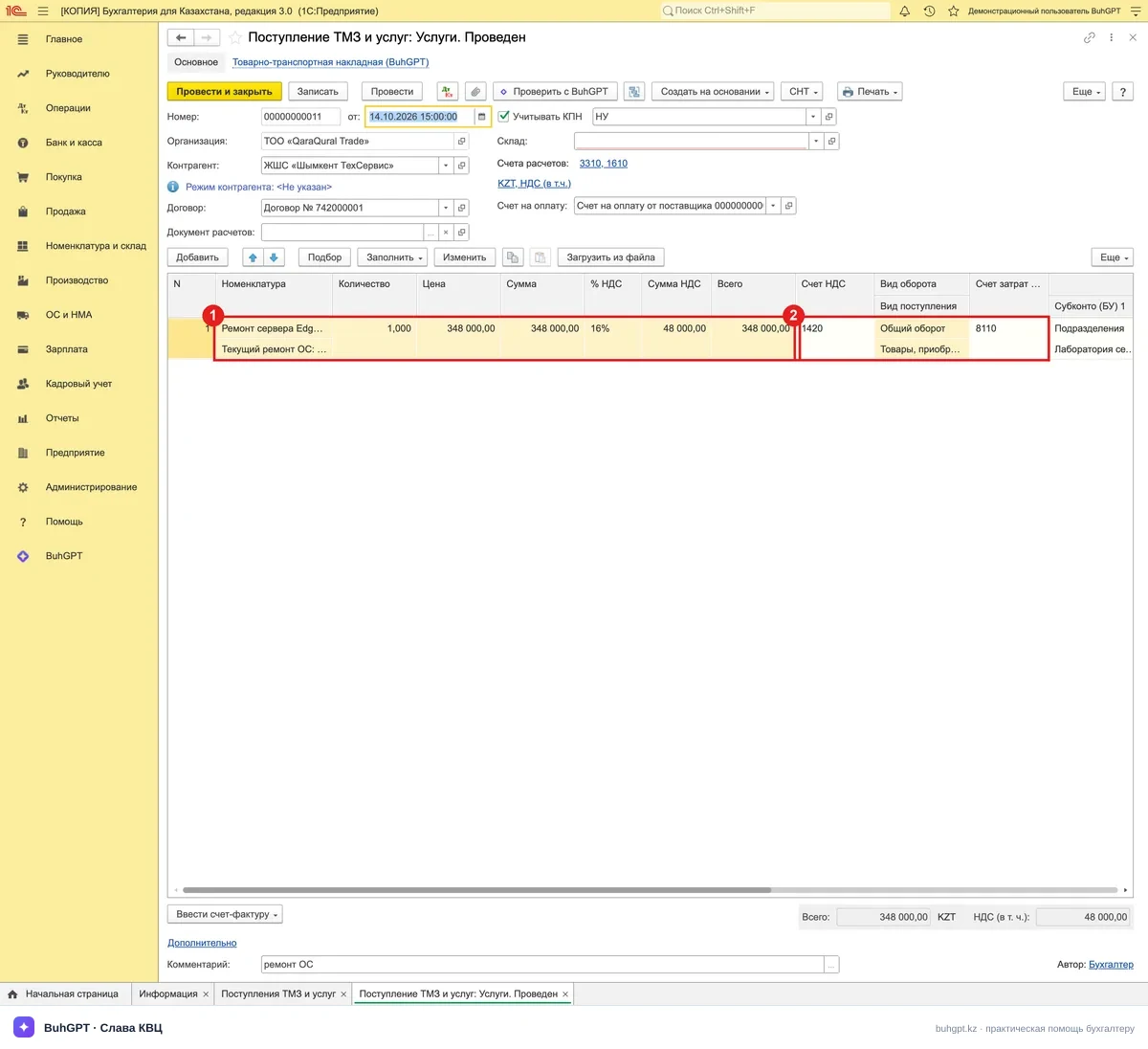
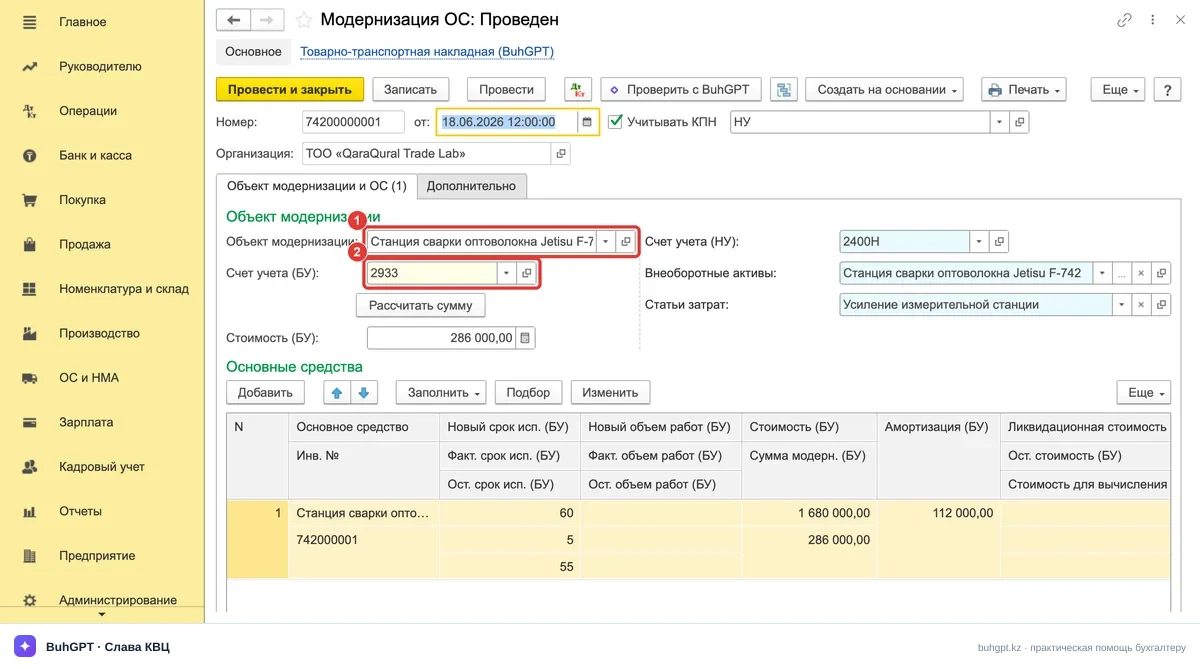
Before closing the period, prepare a reconciliation showing the following trail: source document → accounting entry → item of property, plant and equipment → tax register → basis under the Tax Code of the Republic of Kazakhstan. Once the final law is published, add a reference to the provision in force for the transaction concerned.
Frequently asked questions
Can draft Article 313-1 be applied now? — No. The bill is still pending, so tax accounting follows the current Tax Code of the Republic of Kazakhstan, including Article 273.
Are all routine repair costs immediately deductible? — The name of the work alone does not determine the tax treatment. Check the asset, the nature of the costs and the exceptions under Article 273 of the Tax Code of the Republic of Kazakhstan.
Does an upgrade always increase the cost of an asset for tax purposes? — The decision depends on the rules of the Tax Code of the Republic of Kazakhstan that apply to the specific asset and transaction. Capitalisation in the accounts is relevant and must be assessed against the special tax rules.
Which documents support the chosen accounting treatment? — The contract, cost estimate, defect report, certificate of completion, technical assessment and committee decision should together show what work was done and how it affected the asset.
What should be checked once the amendments are enacted? — Check the final wording of Articles 273 and 313-1, their effective date, the transitional provisions and the rules for expenditure that increases the cost of property, plant and equipment.