
What is a civil law contract (CLC)?
A CLC is an agreement between a customer and a contractor for the performance of specific work or the provision of services. These relationships are governed by the Civil Code, not the Labour Code.
Under paragraph 3 of Article 35 of the Entrepreneurial Code of the Republic of Kazakhstan, an individual who does not use employees’ labour on a permanent basis is entitled not to register as an individual entrepreneur (IE) when receiving the following types of income:
income subject to taxation at the source of payment;
property income.
How is such a person classified? The work and services performed by such persons are covered by the concepts of work under a work contract (Chapter 32 of the Civil Code of the Republic of Kazakhstan) and work under a fee-based service agreement (Chapter 33 of the Civil Code of the Republic of Kazakhstan). These types of agreements are civil law contracts (CLCs).
Main types of CLCs:
Work contract: Used when a specific tangible result is required (for example, office renovation, software development, or furniture production).
Fee-based service agreement: Used when the result of the service is intangible and is consumed as the service is provided (for example, legal advice, cleaning services, training, or an audit).
Commissioned work agreement: Concluded for the creation of works of art, literature, or science, software, or other intellectual products.
Agency contract / Agency agreement: The agent performs assignments in their own name or on behalf of the customer, but always at the customer’s expense (for example, searching for clients).
Mandate agreement: The authorised representative performs certain legal actions on behalf and at the expense of the principal.
Commission agreement: The commission agent undertakes, on the instructions of the principal, to execute one or more transactions in their own name but at the principal’s expense.
Carriage / Freight forwarding agreement: Used to transport cargo or arrange this process.
Storage agreement: One party undertakes to store an item transferred by the other party and return it intact.
In 2026, the duration of a civil law contract (CLC) in Kazakhstan remains unrestricted by law and is determined by agreement between the parties. However, starting in 2026, strict restrictions have been introduced on the use of such contracts, indirectly affecting their duration:
Prohibition on substituting employment relationships: If a CLC continues for a long time and has the characteristics of an employment contract (a schedule, workplace, and fixed monthly payment), it may be recognised as an employment contract by a court or following an inspection by the Ministry of Labour.
One-off nature: In 2026, it is recommended that a CLC be used only to perform specific one-off work or services with clearly stated start and completion dates.
Taxes and contributions: Starting in 2025–2026, contractors under CLCs are required to pay individual income tax (IIT), mandatory pension contributions (MPC), mandatory social health insurance contributions (MSHIC), and social contributions (SC), which effectively makes such contracts equivalent to employment contracts in terms of the tax burden.
Retention period: Original CLCs and certificates of completed work must be retained for at least 5 years.
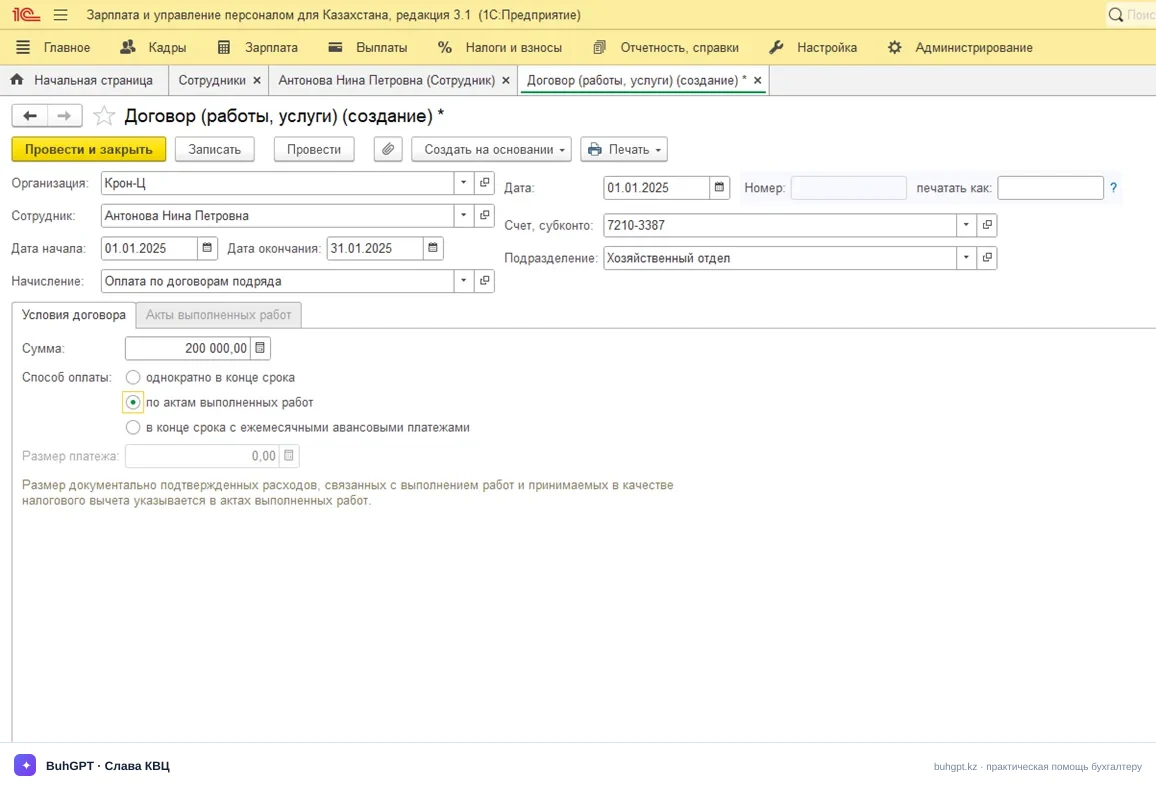
The screenshot shows the interface of 1C:Payroll and HR Management for Kazakhstan, Revision 3.1. The form for creating the primary document “Contract (Work, Services)”, used to register CLCs in the system, is open.
“Contract Terms” tab:
Amount: The total cost of the work is 200 000,00.
Payment method: The switch is set to “based on certificates of completed work”.
This is the main setting. Selecting payment “based on certificates” means that merely posting this contract will not cause the amount to be calculated automatically at the end of the month. An interim document confirming completion of the service must be created for the amount to be included in the calculation.
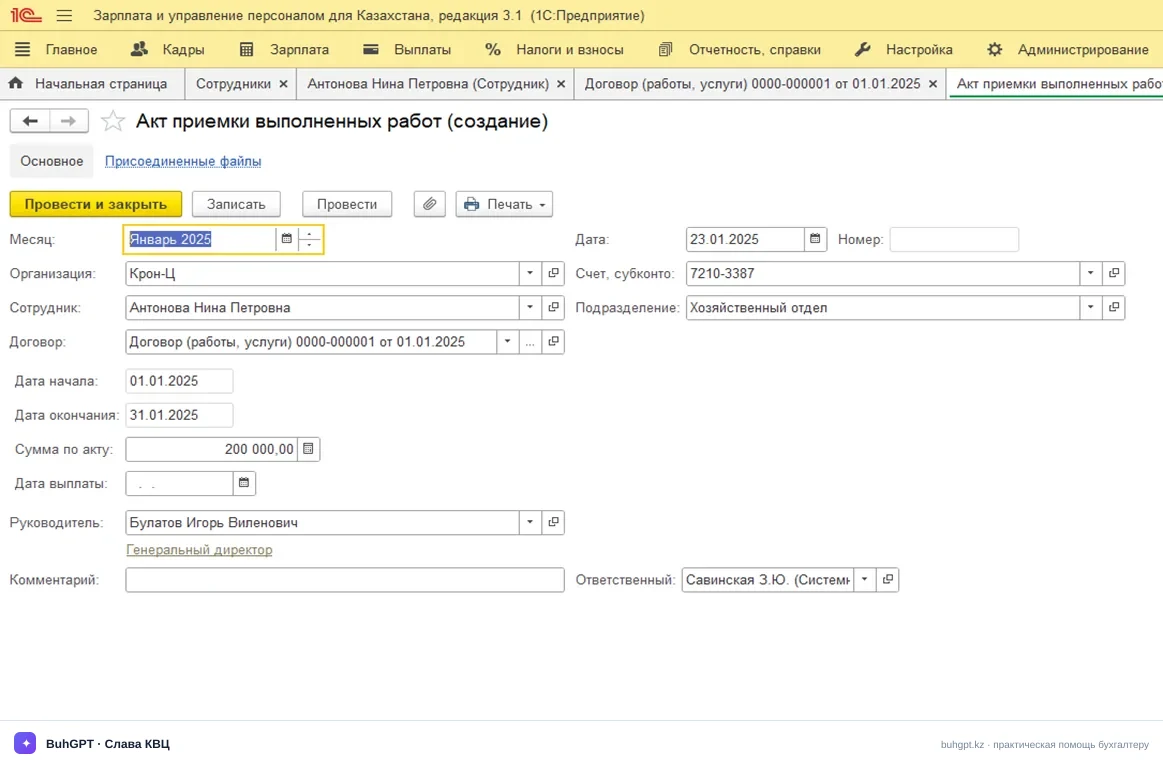
Since the contract itself (in the previous screenshot) specifies the payment term “based on certificates of completed work”, this document serves as the basis for making the payment. By posting this Certificate, you signal to the program that the service has been provided and that the remuneration may be calculated and taxes and contributions (IIT, MPC, MSHIC, and SC) may be withheld.
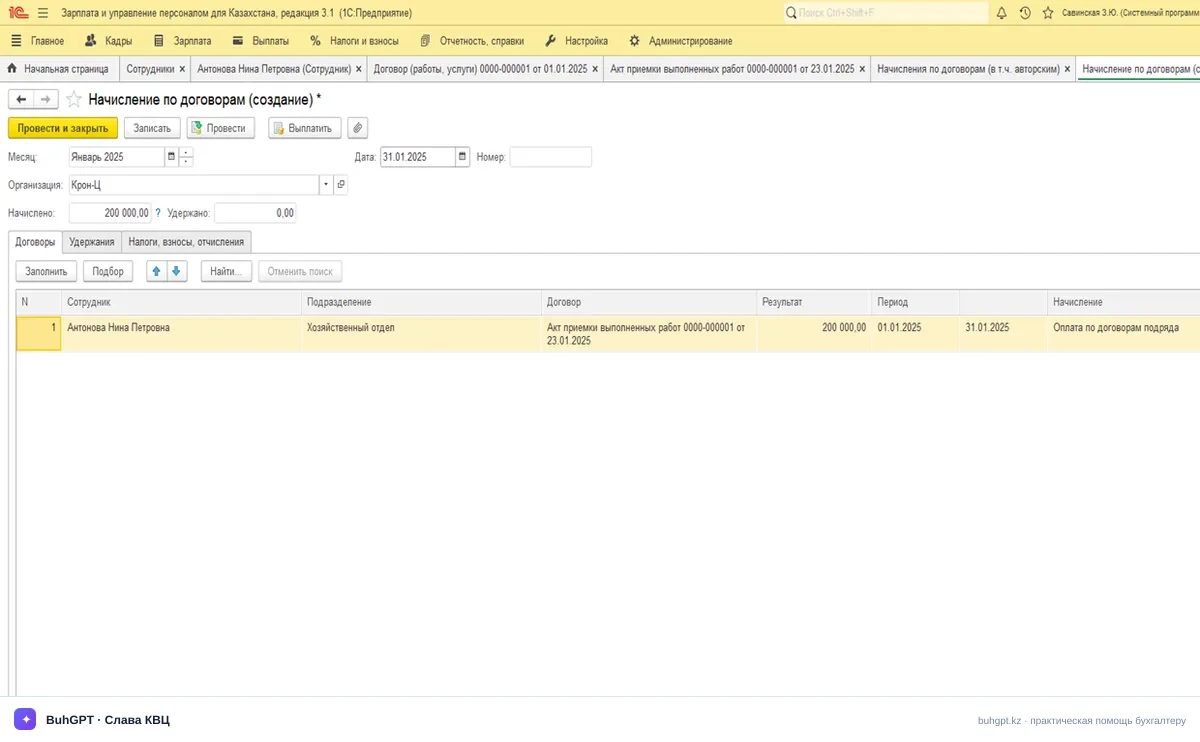
In the screenshot, you are using the special document “Calculation under Contracts...”. This document is generally used when the contractor must be paid separately and urgently (between payroll periods), without waiting until the end of the month. If you calculate everything together at the end of the month, these data would automatically be included in the general “Calculation of Payroll and Contributions” document.
Summary of the sequence:
The contract was concluded (terms).
The Certificate was created (confirmation of the work).
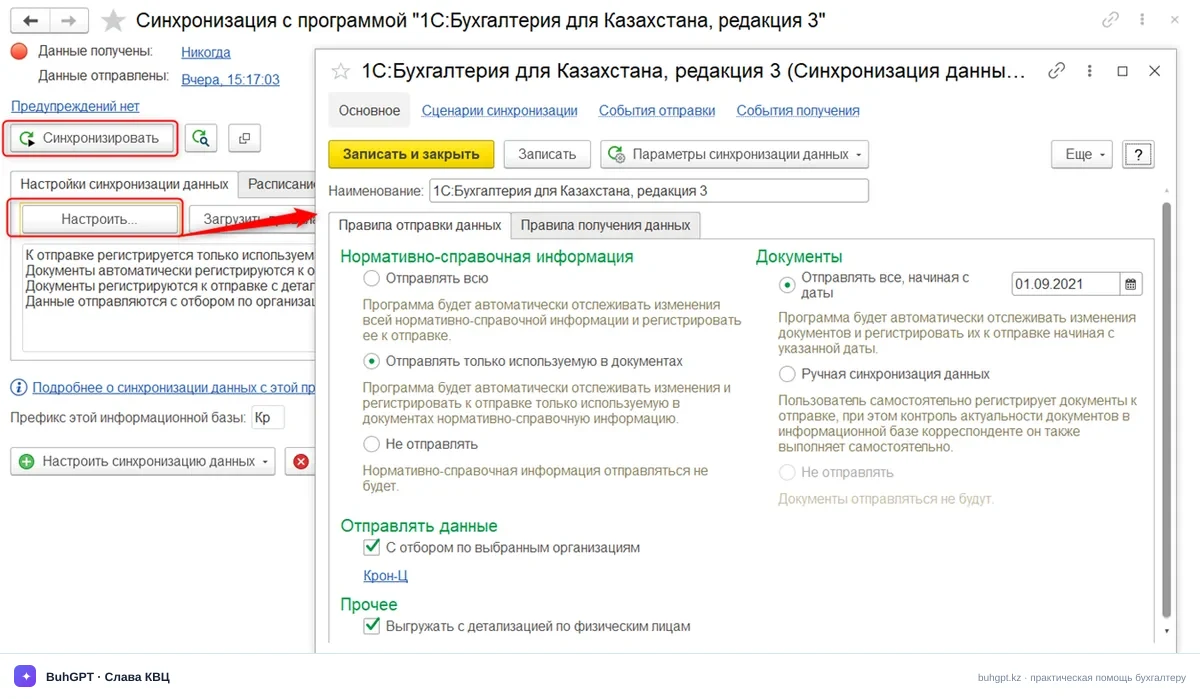
Figure 4. Synchronisation In this screenshot, we have opened the data synchronisation settings between “1C:Payroll and HR Management” and “1C:Accounting”. This tool physically transfers the “Recording Payroll in Accounting” document from the HR database to the accounting database.
What should be done now? To complete the cycle and generate accounting entries:
In the open window on the right, click “Save and Close” (Записать и закрыть) to save the settings.
In the window on the left, click the large “Synchronise” (Синхронизировать) button (with green arrows).
Wait for the process to finish.
What happens next: The “Recording Payroll in Accounting” document will disappear from the “to be sent” list in Payroll and HR Management and appear in the “1C:Accounting” database. The accountant will only need to open their program, find this document (in the “Payroll” section), and post it. At this point, the entries Dr 7210 — Cr 3387 will be generated in the balance sheet. This completes the entire CLC processing cycle, from the contract through to the accounting entries.
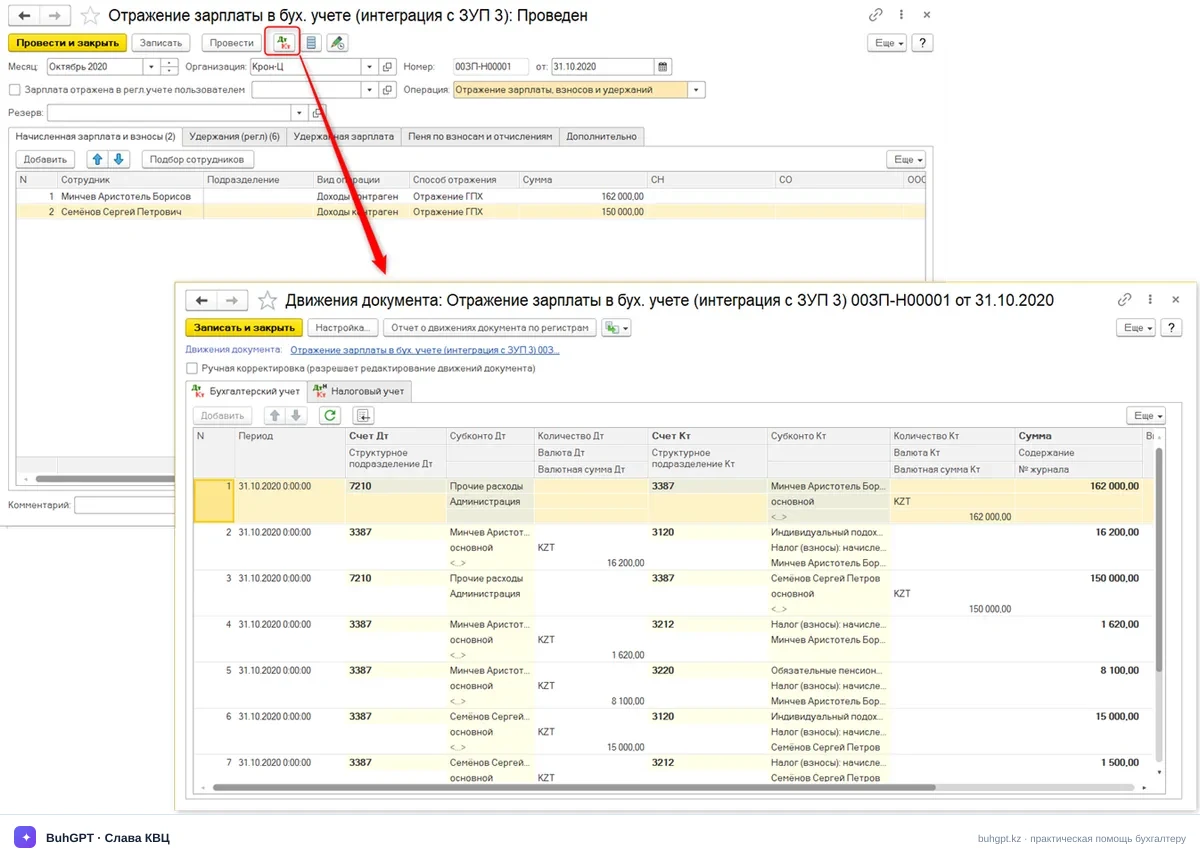
Figure 5. “Document Movements” window The screenshot shows the final result of all the work completed previously. This is the “Document Movements” window, which displays the accounting entries (Debit/Credit) generated through the “Recording Payroll in Accounting” document.
Popular question: If an employee works for the same organisation under both a CLC and an employment contract (EC), how is the basic deduction applied? When calculating the basic salary and income under the CLC (income received from a tax agent), is the basic deduction of 30 MCI applied to both types of income, meaning that the deduction is granted twice to one individual in the same organisation?
Answer: No, the basic deduction is not applied twice to one individual in the same organisation. Under the legislation of the Republic of Kazakhstan, where an individual receives both employment income and income under a CLC from the same tax agent (organisation) during one month, the basic tax deduction is applied in the following sequence: First: To the employee’s income (salary under the employment contract), within the amount of that income. Second: If the basic deduction has not been used in full, the remaining portion is applied to the income paid for work performed or services provided under the CLC. Example (based on calculations for 2026): If the employee’s salary under the employment contract exceeds the basic deduction amount (30 MCI), the deduction is applied in full to the salary, and no deduction is granted for the CLC income. If the salary is lower, only the remaining difference is applied to the CLC income.