
Retail accounting revolves around each sale. The accountant needs to link inventory balances, the cash register receipt, the payment method, revenue, VAT, and the cost of goods sold. In 2026, the standard VAT rate is 16% (Article 503 of the Tax Code of the Republic of Kazakhstan). The specific accounting procedures depend on the seller’s tax status, the 1C configuration in use, and how warehouses are organized.
How retail store accounting works
Retail accounting starts with accurately tracking the movement of each item. The revenue total comes later. In practice, the process works as follows:
- Goods are received from the supplier at a designated warehouse.
- The item, unit of measure, quantity, and inventory cost are recorded.
- The goods are transferred to the store if the storage location and the retail outlet are tracked separately.
- The sale is recorded on a cash register receipt that lists the items and payment methods.
- After the register shift closes, sales are summarized in the retail sales report.
- The accountant reconciles cash takings, non-cash payments, inventory deductions, and returns.
This process keeps three figures distinct: the quantity on the shelf, the carrying amount in the accounts, and the selling price. Discrepancies arise when goods are received into one warehouse and the sale is recorded against another, or when a return is processed without a link to the original receipt.
Cash, payment cards, loyalty points, and gift certificates each require separate tracking. Card payments may take time to reach the bank account. Until settlement, the amount can be tracked as a receivable from the acquiring bank or as cash in transit. The accounting records should allow the accountant to reconcile cash register data with the acquirer’s report and the bank statement.
Accounting entries for retail sales
In a typical setup, revenue is recorded separately from the cost of goods sold. The following account entries illustrate how the transactions can be recorded:
Cash sales proceeds received (Dr 1010 — Cr 6010, with the VAT portion credited to 3130)
Non-cash sales proceeds credited to the bank account (Dr 1030 — Cr 6010, with the VAT portion credited to 3130)
Cost of goods sold (Dr 7010 — Cr 1330)
Amounts owed by customers (account 1210)
Amounts owed to suppliers for goods purchased (account 3310)
These entries provide a guide for recording retail sales. The “Cash Register Receipt” document can generate transaction records for operational tracking. The final accounting entries depend on the configuration and the data exchange settings (technical description of the “Cash Register Receipt” document).
If the price includes VAT at the standard rate, calculate the VAT portion by multiplying the sale amount by 16 / 116. On a sale of 116 000 ₸, VAT is 16 000 ₸ and revenue excluding VAT is 100 000 ₸. Use this calculation only for transactions actually subject to VAT at 16% (Article 503 of the Tax Code of the Republic of Kazakhstan). Exempt transactions, sales without VAT, and transactions taxed at a different rate must be calculated in separate groups.
The accountant should check the following daily:
Total sales for the register shift
Cash in the register
Card payments and settlements from the acquiring bank
Customer refunds
Quantity and cost of goods deducted from inventory
VAT on taxable transactions
Retail accounting in 1C
In “Accounting for Kazakhstan,” edition 3.0, release 3.0.74.2, open the warehouse directory from Directories → Goods and Services → Warehouses. To add a storage location, click “Create,” enter a clear, distinct name, and select the warehouse type. Instructions for this release are available in the article on the “Warehouses” directory.
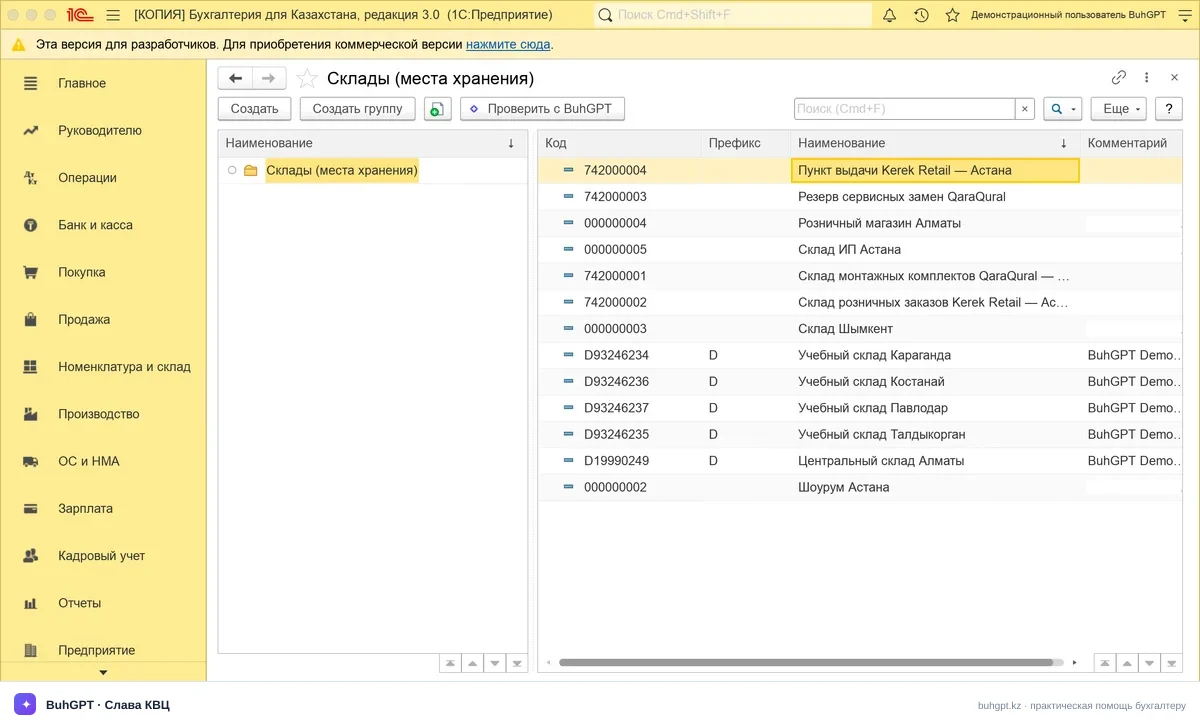
To check the configuration release, go to Main Menu → Help → About. Look for the line that shows the configuration version. The 1C platform version is listed separately.
Avoid creating warehouses with nearly identical names such as “Main” and “Main Warehouse.” The software treats them as separate storage locations, so stock for the same item will be split between them. Choose names that identify the actual location, such as “Store on Abay,” “Store Warehouse,” or “Distribution Warehouse.”
From a document with item lines, you can open the directory via Warehouse → Show All. Before posting a goods receipt, transfer, sale, or stocktake, check that the selected warehouse matches the actual storage location.
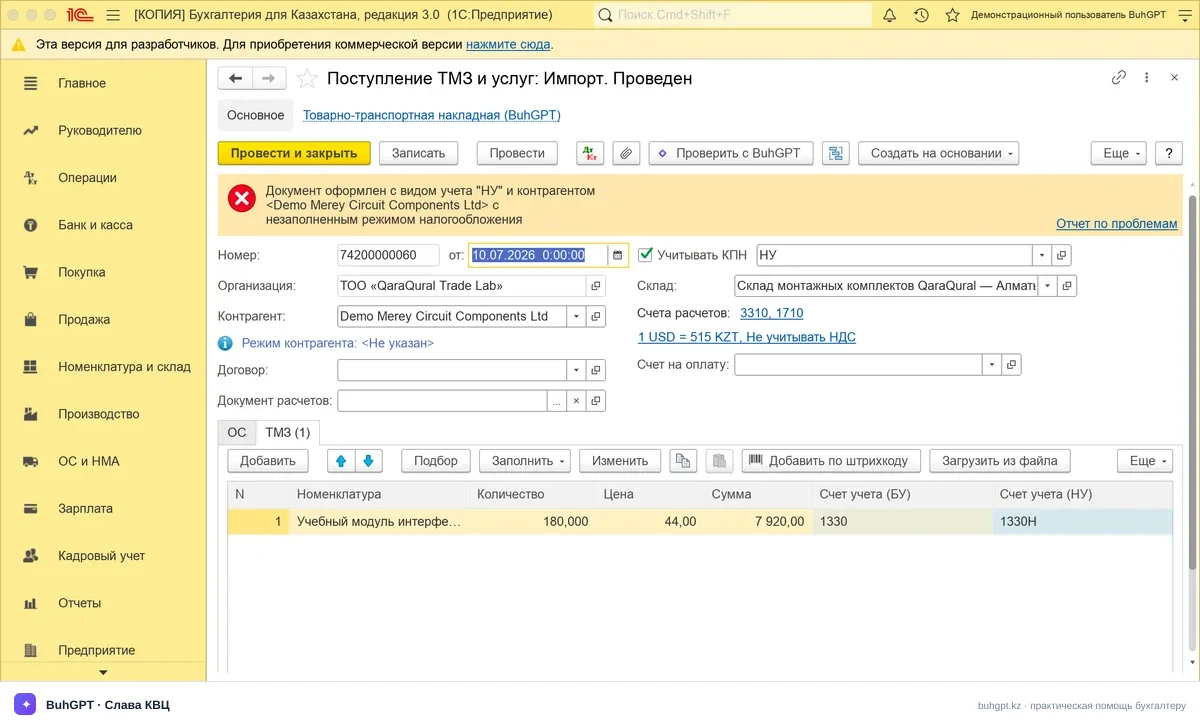
For sales accounting, the receipt must be linked to the register shift. Record each return as a separate transaction based on the original receipt and retain the posted fiscal receipt in the accounting records. After the shift closes, the accountant reconciles the sales summary with inventory movements, payments, and returns (description of the “Cash Register Receipt” document).
How to prevent discrepancies in retail accounting
At a minimum, internal procedures should specify who receives goods, sets prices, records transfers, closes the register shift, and checks card settlements. One employee can perform several of these duties, provided each transaction leaves a clear audit trail.
The accountant should establish regular checks:
Match sales by item against inventory deductions.
Compare cash register totals with the retail sales report.
Reconcile non-cash payments with the bank report and statement.
Check returns against the original receipts.
Compare physical inventory with recorded balances periodically.
Investigate negative inventory balances and sales recorded against the wrong warehouse before closing the period.
When working with electronic invoices, verify the documents directly in the Electronic Invoicing Information System. Even when there is a retail receipt, check whether the transaction requires an additional electronic document based on the status of the seller and buyer and the nature of the sale.
Frequently asked questions
What does retail store accounting cover? — Receiving and storing goods, setting prices, recording sales through the cash register, handling cash and non-cash payments and returns, recording the cost of goods sold, taking inventory, and accounting for transactions for tax purposes.
Can all retail outlets be tracked as a single warehouse? — The structure depends on how the accounting system is set up, but tracking each store separately makes it easier to verify stock on hand and identify discrepancies. Give each storage location a clear, distinct name.
Why do cash register sales totals differ from the amounts credited to the bank account? — Some sales may have been paid in cash, and card payments may have settled later. Also check refunds, any fees deducted by the bank, and the register shift’s start and end times.
How do you calculate the VAT included in a retail price? — If the price includes VAT at the standard rate of 16%, use the formula amount × 16 / 116 (Article 503 of the Tax Code of the Republic of Kazakhstan). Before calculating, verify that the sale is subject to VAT at that rate.
Does posting a cash register receipt complete the accounting for a sale? — The receipt records the sale and payment. The accountant also needs to check the final sales report, the cost of goods sold, card settlements, and returns.