The new Rules for marking clothing and textiles were approved by order of the Acting Minister of Industry and Construction of the Republic of Kazakhstan dated 10 September 2026, No. 450 (V2600039858). The order takes effect after 60 calendar days have elapsed following its official publication on 14.09.2026, which puts the effective date at 14 November 2026.
Some provisions on submitting information to the system take effect only on 1 October 2027. Existing stock must be marked no later than 1 January 2028.
At a glance
- Order No. 450 approved the Rules for marking and tracing light industry goods.
- The List under Order No. 199-НҚ sets the dates by product type: 1 December 2026, 1 March 2027, and 1 October 2027.
- The provisions on aggregation, transfers between companies, acceptance, and reintroduction into circulation take effect on 1 October 2027.
- Stock held in warehouses on the date marking becomes mandatory must be marked by 1 January 2028.
- Retailers need an online cash register, a DataMatrix scanner, and a contract with a fiscal data operator (FDO).
- 1C:Accounting for Kazakhstan 3.0.75.1 already includes the “Light Industry (Textiles)” product type.
What Order No. 450 approved
The order was adopted under subparagraph 2) of Article 7-2 of the Law on the Regulation of Trade Activities. It approves the Rules for Marking and Tracing Light Industry Goods Using Identification Means, referred to below as the Rules.
| Item | Details |
|---|---|
| Authority | Ministry of Industry and Construction of the Republic of Kazakhstan |
| Number and date | No. 450 dated 10.09.2026 |
| Registration with the Ministry of Justice | 10.09.2026, No. 39858 |
| Publication | Reference Control Bank of Regulatory Legal Acts, 14.09.2026 |
| Entry into force | 60 calendar days after first official publication |
| Deferred provisions | Paragraphs 29–32, 36–40, 43, 46 and 47 of the Rules take effect on 01.10.2027 |
By our calculation, the 60 days following 14.09.2026 expire on 13.11.2026, so the order takes effect on 14 November 2026. Check the note on the act’s page in Adilet to confirm the exact date (para. 4 of the order).
The Rules call it the “digital system for goods marking and traceability” (DS GMT). In 1C and in everyday usage, it is called the goods marking and traceability information system (IS GMT). Both names refer to the same system run by the Unified Marking Operator.
Which goods must be marked and when
The Rules list the EAEU Commodity Nomenclature for Foreign Economic Activity (EAEU CN FEA) codes in the “Light Industry” group. The dates for each code come from the List of Goods Subject to Marking under the Order of the Minister of Trade and Integration dated 26.05.2026, No. 199-НҚ (Order No. 199-НҚ). The List was revised twice, and the dates for light industry goods stayed the same.
Marking is mandatory regardless of style, size, intended use, production method, or material. The exceptions are the goods covered by Article 8 of the Agreement on the Marking of Goods in the EAEU (para. 2 of the Rules).
| Date | CN FEA codes | Goods covered |
|---|---|---|
| 01.12.2026 | 4203 10 000, 4304 00 000 0, 6113 00, 6210, 6211 20 000 0, 6211 32, 6211 39 000 0, 6211 42, 6211 49 000, 6302 | leather clothing, artificial fur, clothing made from rubberised and nonwoven materials, ski suits, other clothing, and bed, table, toilet, and kitchen linen |
| 01.03.2027 | 6106, 6110, 6201, 6202, 6205, 6206, 6211 33, 6211 43, 6214, 6215 | blouses, sweaters and cardigans, coats and jackets (other than knitted or crocheted), shirts, scarves and shawls, and ties |
| 01.10.2027 | 6101, 6102, 6103, 6104, 6105, 6112 11–6112 20, 6203, 6204 | knitted coats and jackets, suits, trousers, dresses, skirts, knitted shirts, and tracksuits |
The List applies to goods imported into or produced in Kazakhstan. Use the CN FEA code in the supplier’s documents or customs declaration to determine the group, rather than the product name in the price list.
Key dates and deadlines
The table brings the dates together in one place. The deadline for a particular product depends on its CN FEA code.
| Date | What takes effect | Legal basis |
|---|---|---|
| 14.11.2026 (calculated) | the Rules take effect, except for the deferred provisions | para. 4 of Order No. 450 |
| 01.12.2026 | marking begins for the first group, which includes leather, fur, linen, and other clothing | List No. 199-НҚ |
| 01.03.2027 | marking begins for the second group, which includes blouses, sweaters, jackets, and shirts | List No. 199-НҚ |
| 01.10.2027 | marking begins for the third group, and the deferred provisions of the Rules take effect | List No. 199-НҚ, para. 4 of Order No. 450 |
| 01.01.2028 | deadline for marking existing stock | para. 4 of the Rules |
What takes effect on 1 October 2027
The deferred provisions concern the movement of goods between companies. They apply from that date even if goods have already been marked beforehand.
- Aggregation into group and transport packaging, and repacking into different packaging (paras. 29–32).
- Circulation data for a sale or movement must be submitted no later than the day of the sale or movement (paras. 36–37).
- The buyer must confirm acceptance within 15 working days (para. 38).
- Paper-based procedures during system outages and changes in code ownership (paras. 39–40).
- Withdrawal from circulation outside retail sales must be reported within 3 working days (para. 43).
- Reintroduction into circulation must be reported within 3 working days (paras. 46–47).
Important: The provisions on retail sales through a cash register (paras. 41–42) are excluded from the list of deferred provisions.
- When a marked item is sold to a customer, its code is scanned at the checkout.
- The code is included on the receipt and sent to the system through the FDO.
- Under the order, these requirements apply from the date marking becomes mandatory for the relevant group of goods, even before October 2027. Confirm the retail procedure with the Operator.
Responsibilities by type of business
Under the Rules, a participant in circulation is an individual entrepreneur or legal entity resident in Kazakhstan that introduces marked goods into circulation, sells them, or withdraws them from circulation. All participants must register with the DS GMT before handling marked goods (paras. 7–9 of the Rules).
Manufacturer
The manufacturer marks goods before the first transfer to a new owner. The manufacturer registers the goods in the system using the individual identification number (IIN) or business identification number (BIN), GTIN, CN FEA code, brand, colour, size, model, material composition, and other information specified in para. 13 of the Rules.
The system issues a refusal to register goods within 3 working days if the GTIN is already registered, does not belong to the applicant, or does not exist according to GS1 records (para. 15).
Importer
The importer ensures that goods are marked before they are brought into Kazakhstan or released for domestic consumption. The identification mark is applied before the goods cross the border. Goods are deemed to have entered circulation once the import information is entered in the system (paras. 27, 33–34).
Wholesale
Wholesalers register in the system and set up their accounting software to exchange data. From 1 October 2027, they must submit shipment details no later than the day of sale and confirm acceptance of incoming deliveries within 15 working days.
Retail
Paragraph 9 of the Rules requires stores to have specific equipment.
- A cash register that records and transmits data.
- A scanner connected to the cash register that can read DataMatrix codes.
- A contract with an FDO to transmit information on each unit sold.
- A check to verify that the scanner can read the two-dimensional code.
When a customer returns an item, it is reintroduced into circulation. The store submits information on each returned unit through the FDO (paras. 44–45).
Consignment seller
The consignment seller marks goods accepted on consignment before or when displaying them on the sales floor. This applies both to samples and to goods offered at the point of sale (para. 4 of the Rules).
Ordering, applying, and paying for marking codes
Order codes from the Operator through the system. The Operator responds within 4 hours by issuing codes or rejecting the order (paras. 22–24). The order is rejected if the participant is unregistered or the GTIN is missing from the product register.
The code is applied as a GS1 DataMatrix to the consumer packaging, group packaging, or product label. It must be applied so that it cannot be removed without damage (paras. 16, 28).
Example: A garment workshop received codes for a batch of jackets on 10 March 2027.
- The deadline under para. 25 of the Rules is no later than 60 calendar days from the date of receipt.
- 11 to 31 March accounts for 21 days, and April adds 30 days, for a total of 51 days.
- The remaining 9 days fall in May.
- The deadline for applying the codes and reporting their application is 9 May 2027.
Codes are cancelled if their application is not reported within 60 days. The Operator must be paid for issuing the code under the contract before the application data is submitted (para. 26).
Existing stock must be marked by 1 January 2028
Existing stock is goods already owned by a company or individual entrepreneur engaged in production or trade on the date marking becomes mandatory. These goods must be marked no later than 1 January 2028 (paras. 3 and 4 of the Rules).
Four details are sufficient to register existing stock: the full product name, model or item number, product type, and colour (para. 14). This is simpler than completing a full record for a new product.
Example: A store sells sweaters (code 6110) and tracksuits (code 6112).
- Marking becomes mandatory for sweaters on 01.03.2027. Any stock held on that date must be marked by 01.01.2028.
- Marking becomes mandatory for tracksuits on 01.10.2027. Any stock held on that date must also be marked by 01.01.2028.
- That leaves three months to mark existing tracksuit stock and ten months to mark existing sweater stock.
- It is best to take inventory by CN FEA code for both groups at the same time before 1 March 2027.
Important: If a code is lost or damaged, it must be reapplied.
- This also applies to an item returned by a customer and offered for sale again.
- The same rule applies to goods on consignment.
How to handle marking in 1C:Accounting for Kazakhstan
Release 3.0.75.1 includes the “1C: Marking Service (IS GMT)” subsystem. The product type list includes “Light Industry (Textiles)”, and the code templates include “Light Industry”. The steps below apply to this release.
Step 1. Check the IS GMT settings
- Open Administration → General Settings.
- In the “Goods Marking and Traceability” group, click “Accounting and Integration Settings (IS GMT, Electronic Documentation Information System)”.
- Check which product groups are available in the section for tracking marked products. The visibility of textile settings depends on the release. In 3.0.75.1, this form shows no separate checkbox for light industry, so use the accounting option in the item record (step 2) and the product type in IS GMT documents.
- On the “Services” tab, check the server addresses, connection parameters, and settings for the Order Management Station (OMS).
- Check whether the cryptographic library is installed. Its status appears in the same form.
Step 2. Prepare item records
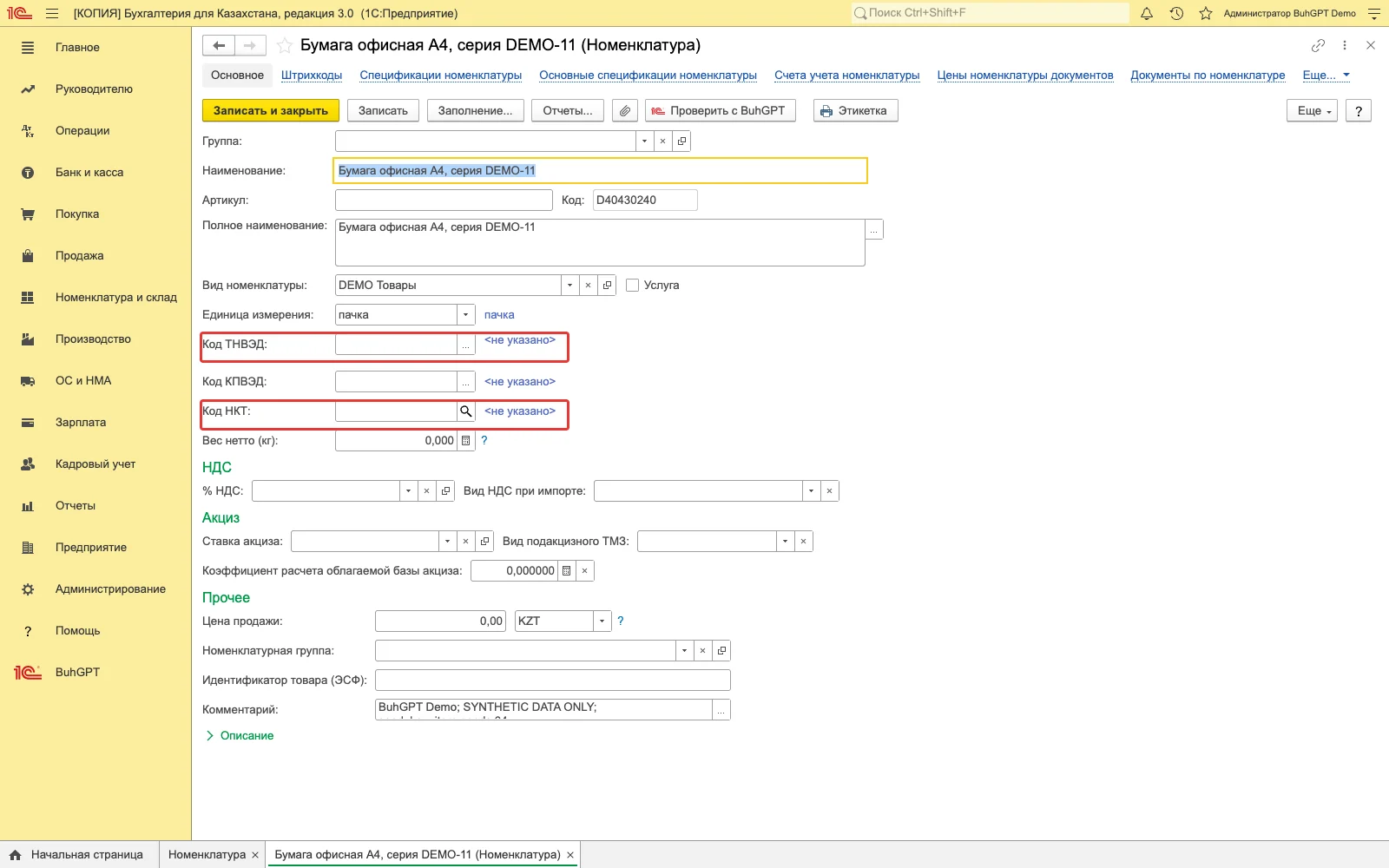
- Open Items and Warehouse → Items and open the product record.
- In the “Accounting Option” field, select “Light Industry Goods and Clothing”.
- Fill in the “CN FEA Code” field. This code determines when marking becomes mandatory for the product.
- In the “National Product Catalogue Code” field, select the product from the National Product Catalogue. The selection button opens the catalogue search and fills in the “National Product Catalogue Name” field.
Step 3. Ordering, applying, and aggregating codes in production
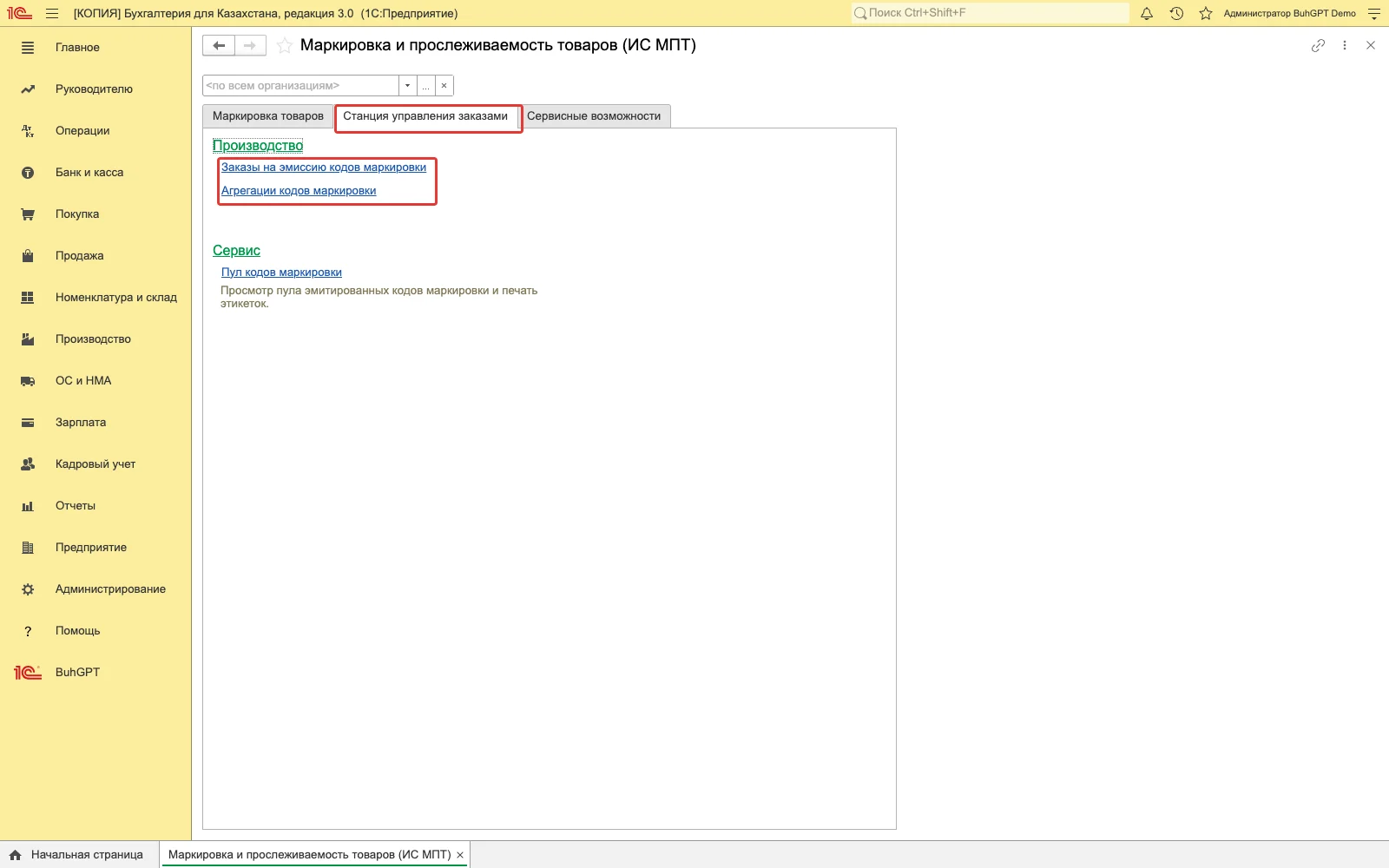
- Open Items and Warehouse → Goods Marking and Traceability → IS GMT → Goods Marking and Traceability (IS GMT).
- On the “Order Management Station” page, create an “Order for Issuance of Marking Codes (OMS)” document with the “Light Industry” product type.
- Print the codes you receive using “Marking Code Print Templates” and apply them to the labels.
- Complete “Application of Marking Codes (OMS)”. Submit the application report within 60 days.
- When packing goods into boxes, complete “Aggregation of Marking Codes (OMS)”. The provisions of the Rules on aggregation data (paras. 29–32) take effect on 01.10.2027.
- For goods introduced into circulation based on an “Inventory Receipt” or “Customer Return of Inventory” document, complete a “Notification of Introduction into Circulation (IS GMT)”.
Step 4. Imports
- Open Purchases → Goods Marking and Traceability → IS GMT.
- For goods from EAEU countries, create a “Notification of Import of Goods Subject to Marking (EAEU) (IS GMT)”.
- For imports from third countries, create a “Notification of Import of Goods Subject to Marking (Import) (IS GMT)”.
- Check the GTIN and codes against the packaging before submitting the notification.
Step 5. Wholesale transfers and acceptance
- Post a “Sale of Inventory and Services” or “Receipt of Inventory and Services” document.
- Open Sales → Goods Marking and Traceability → IS GMT or the corresponding menu item under “Purchases”.
- Create a “Transfer and Acceptance Record (IS GMT)” and specify the source document.
- Check incoming records against the codes actually received and confirm acceptance. After 01.10.2027, you have 15 working days to do this.
- If there are discrepancies, complete a “Discrepancy Notification (IS GMT)”.
Step 6. Retail sales and write-offs
- Open Sales → Retail Sales and create a “Retail Sale (Receipt)” document.
- Scan the DataMatrix code on the label. When marked goods tracking is enabled, the software processes it as a marking code rather than a standard barcode.
- For write-offs, defective items, or transfers for internal use, complete a “Notification of Withdrawal from Circulation (IS GMT)”. The source document can be an “Inventory Write-Off”, “Materials Requisition”, or “Sale of Inventory and Services”.
Important: Support for light industry goods in 3.0.75.1 predates Order No. 450.
- Whether the data exchange has been updated to comply with the new Rules remains officially unconfirmed.
- Before the first live shipment, test the workflow in a copy of the database, including the code order, application, transfer record, and receipt.
- Follow the release notes for new versions of “1C:Accounting for Kazakhstan”.
Frequently asked questions
When does Order No. 450 take effect? — 60 calendar days after first official publication. It was published on 14.09.2026, making 14.11.2026 the calculated effective date. Paragraphs 29–32, 36–40, 43, 46 and 47 of the Rules take effect on 01.10.2027 (para. 4 of the order).
Do jackets need to be marked as early as December 2026? — No, if they are coats or jackets under codes 6201 and 6202. The marking requirement for those goods starts on 01.03.2027. Knitted jackets under codes 6101 and 6102 must be marked from 01.10.2027 (List No. 199-НҚ).
What should I do with existing stock in the warehouse? — Register it in the system using the product name, model or item number, product type, and colour, and mark it no later than 01.01.2028 (paras. 4 and 14 of the Rules).
Can a store sell marked clothing without an online cash register? — The Rules require a cash register that can transmit data, a connected DataMatrix scanner, and a contract with an FDO. A retail sale withdraws goods from circulation only when it is processed through such a cash register (paras. 9 and 41 of the Rules).
How long do I have to apply the codes I receive? — No more than 60 calendar days from the date you receive the code. Codes left unused after that period are cancelled (para. 25 of the Rules).
Can I report sales to a wholesale buyer once a month? — No, after 01.10.2027, circulation data must be submitted no later than the day of the sale or movement, and the buyer must confirm acceptance within 15 working days (paras. 37–38 of the Rules).
Does 1C support textile marking? — Yes. Release 3.0.75.1 includes the “Light Industry (Textiles)” product type and the “Light Industry Goods and Clothing” accounting option in the item record.
Sources
- Order of the Acting Minister of Industry and Construction of the Republic of Kazakhstan dated 10.09.2026, No. 450 — Rules for Marking and Tracing Light Industry Goods
- Order of the Minister of Trade and Integration of the Republic of Kazakhstan dated 26.05.2026, No. 199-НҚ — List of Goods Subject to Marking and its effective dates
- Order of the Minister of Trade and Integration of the Republic of Kazakhstan dated 04.09.2026, No. 253-ОД — revised List (amendment to Order No. 215-НҚ)
- Order of the Minister of Finance of the Republic of Kazakhstan dated 24.10.2025, No. 626 on the use of cash registers
- Law of the Republic of Kazakhstan on the Regulation of Trade Activities
- “1C:Accounting for Kazakhstan” configuration 3.0.75.1, “1C: Marking Service (IS GMT)” subsystem and “Items” directory