Individual Income Tax and Social Payments (Mandatory Pension Contributions / Mandatory Social Medical Insurance): Key Considerations for 2026
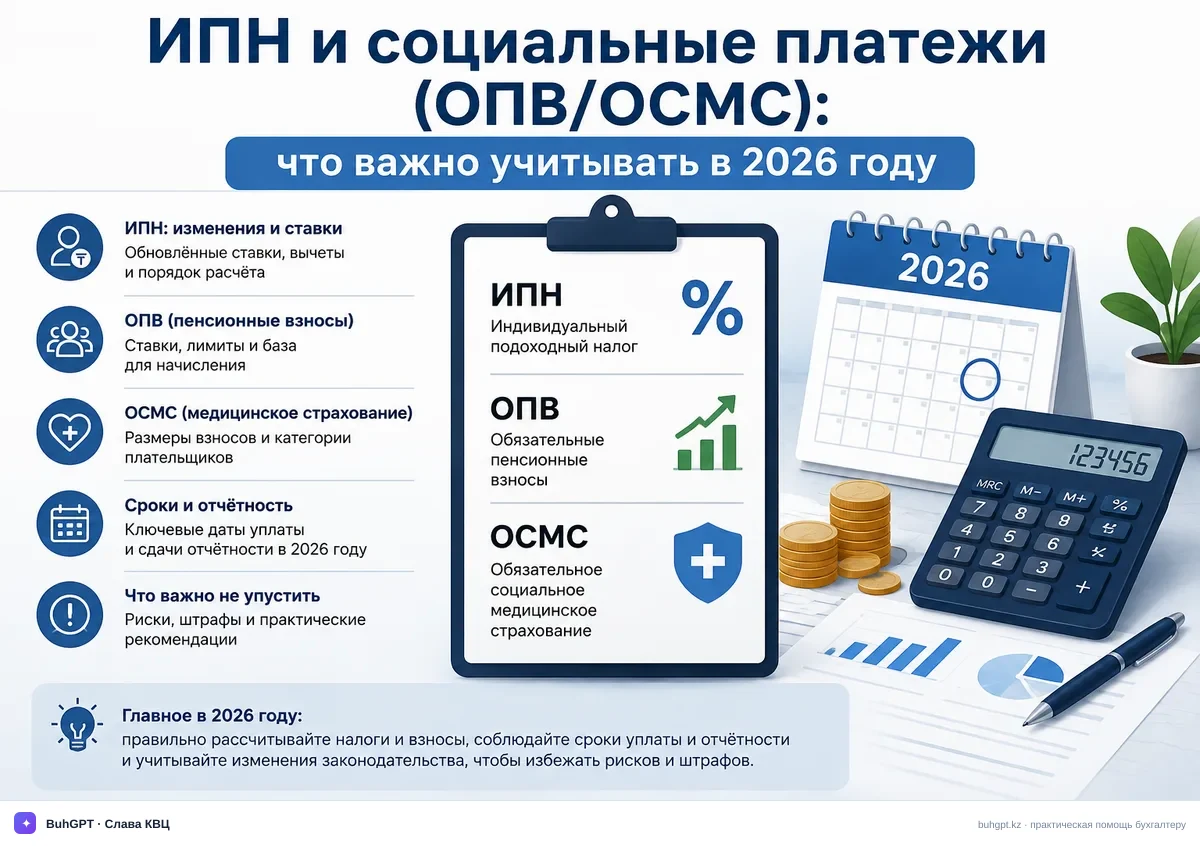
The issues of individual income tax and social payments are closely related: they are calculated from the same employee payment, but according to different rules, different bases, and different limits. In practice, errors often arise at the intersection of these calculations — from incorrectly applied deductions to exceeding the limit base. Below, I will discuss key points as an auditor would during a payroll audit: with examples, caveats, and based on current regulations.
General Logic of Calculation
The first thing to keep in mind is that individual income tax and social payments are different obligations, although they are interconnected. Mandatory pension contributions (MPC) and contributions for mandatory social medical insurance (MSMI) are withheld from the employee's income. Social deductions (SD), employer contributions for MSMI, and social tax are paid by the employer. When calculating individual income tax, the withheld MPC and MSMI reduce the taxable income of the employee — this is reflected in the official tax calculator of the State Revenue Committee, where the individual income tax formula directly accounts for MPC and MSMI.
Thus, the correct sequence is as follows: first, determine the income, then subtract MPC and MSMI as mandatory deductions, apply tax deductions (more on that below), and only to the remaining amount calculate individual income tax. Violating this order is a typical cause of tax overstatement.
Tax Deductions for Individual Income Tax
Starting from 2026, the key deduction remains the basic deduction of 30 MCI. This is applied by the employee at their primary place of work based on a statement. In addition to the basic deduction, social deductions are also in effect. Clarifications on their application have been provided by the capital's Department of State Revenues and the Project Office for the Implementation of the Tax Code — both sources emphasize that the basic and social deductions are applied cumulatively and affect the final amount of individual income tax.
I would like to highlight the situation with individuals engaged in private practice. According to clarifications, such individuals, when calculating individual income tax from January 1, 2026, will consider deductions for social payments (MPC, MSMI, social deductions) and the basic deduction. The practical conclusion is that even for self-employed professional categories, the logic of "first social payments as a deduction, then the basic deduction" remains, and this should be verified when preparing their declarations.
An important caveat: the right to a deduction does not arise automatically. The basic and social deductions are applied only with supporting documents and the employee's statement, and only from one source of payment. If the employee works in several places, the deduction cannot be applied simultaneously for each place — this is a classic risk area during desk audits.
Social Tax: A New Independent Rate
One of the most significant changes in 2026 concerns social tax. An independent rate of 6% has been established, and, importantly, the previous interconnection between social tax and social deductions — the reduction of social tax by the amount of social deductions is no longer applied. This has been clarified by the state revenue departments of several regions, including Kostanay and Pavlodar regions, as well as Astana.
In practice, this means that accountants need to revise the calculation settings: if previously social tax was effectively "offset" by social deductions, now these two payments are considered independently. Special rules and preferential approaches are provided for certain categories (in particular, agricultural (farm) enterprises and agricultural producers), so the calculations for such taxpayers need to be verified separately, not by the general rate.
MSMI: Previous Rates, Increased Bases
For MSMI, the key message for 2026 is as follows: the rates of contributions and deductions remain unchanged, but the limit bases for their calculation have been increased. The upper limit is 20 MCI for employee contributions (MSMI) and 40 MCI for employer deductions (OMSMI). The clarifications from the Social Medical Insurance Fund provide the limit amounts — approximately 34,000 tenge and 102,000 tenge, respectively.
What this means in practice: for employees with low and average salaries, the calculation will not change, but for high-paid employees, the amount of contributions and deductions will increase, as the "ceiling" of the base has been raised. When planning the payroll fund for 2026, this point should be considered in advance to avoid underpayment. The regulatory basis for the changes is Law No. 206-VIII dated July 14, 2025, on mandatory social medical insurance.
It is also useful to know about the mechanism for maintaining insured status. In case of a payment break, the status can be maintained for up to six months — this affects the employee's access to medical services but does not exempt the obligation to timely pay contributions. Employers should not perceive this norm as a "grace period": the obligation to withhold and remit MSMI remains.
Specific Situations to Watch Closely
Charitable and Sponsorship Assistance. According to clarifications, such payments are not included in the base for individual income tax and social payments (MPC, MSMI, social deductions). Here, the correct qualification of the payment and its documentary registration are important — if the assistance actually takes the form of remuneration for labor, applying the exemption is risky.
Non-residents. Starting from 2026, changes have been made to the Tax Code regarding the taxation of non-residents, including the application of a progressive scale for individual income tax. For such employees, the rules applicable to residents cannot be mechanically transferred: it is necessary to separately verify both the calculation of individual income tax and the obligations for MSMI/OSMI and social deductions, taking into account the status of the individual (for example, the presence of a residence permit, retirement age).
Sole Proprietors on a Simplified Declaration. Form 910.00 in 2026 requires careful reflection of MSMI contributions — usually monthly — and alignment with the calculation of individual income tax. Errors in the distribution of social payments by month lead to discrepancies during reconciliation, so this block of the form should be checked especially carefully.
Conclusion
Before closing the period, it makes sense to go through a short checklist. Check that MPC and MSMI are deducted before calculating individual income tax and that the basic deduction of 30 MCI is applied only from one source. Ensure that social tax is calculated at the independent rate of 6% without reduction for social deductions. Verify that the limit bases for MSMI (20 MCI for employees and 40 MCI for employers) are not exceeded for high-paid employees. For non-residents and preferential categories, plan a separate check.
I also recommend verifying the settings of the accounting system: the changes in 2026 regarding social tax, MSMI, and social deductions affect the calculation algorithms, and the correctness depends on the relevance of updates. There are methodological materials on configuring these calculations in 1C considering the changes in 2026 — these should be relied upon when initially setting up for the new year.