Legislation Consultations — ITS
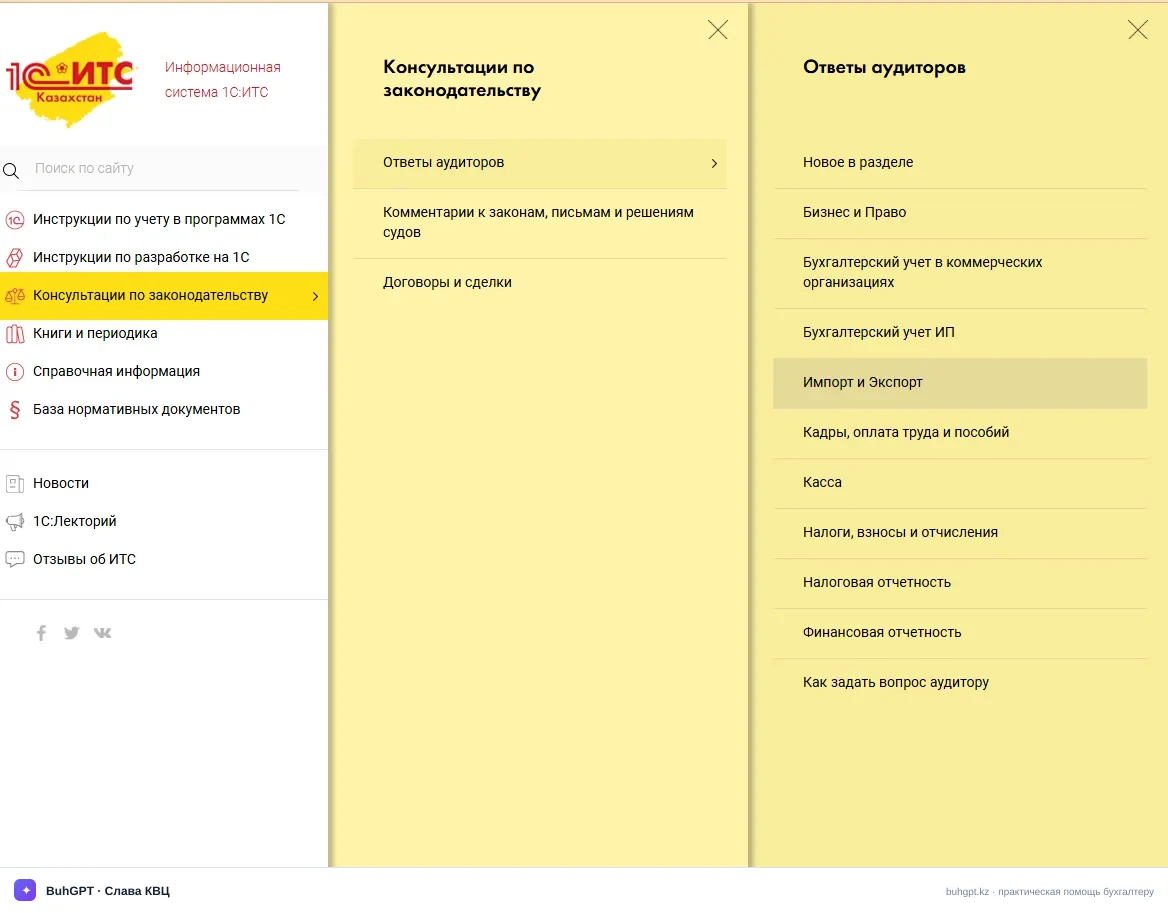
The work of an accountant and HR specialist in Kazakhstan increasingly requires not only knowledge of the Labor Code provisions, but also the ability to quickly navigate the clarifications on their application. The "Legislation Consultations" section in the information technology support (ITS) is designed precisely for this: it gathers consultations and practical commentaries from auditors that help understand how a particular provision works in real-life situations. Below we will examine how this section is useful and how to structure your work with it so that HR and payroll decisions are well-grounded.
Why prompt consultations are needed
Labor legislation regulates a wide range of relations between employer and employee: hiring and dismissal, working time and rest time, remuneration, leave, guarantees and compensations, disciplinary and material liability. In practice, each of these topics gives rise to dozens of specific questions, the answers to which are not always obvious from the text of the code itself. The "Legislation Consultations" section in ITS closes precisely this gap: it contains consultations and clarifications on the application of the labor legislation of the RK, oriented toward specific work situations.
A particular value of this format lies in its relevance. The materials are updated and supplemented, reflecting the latest publications and changes. This means that a specialist receives not an outdated reference book, but a living tool that takes into account the current practice of applying the provisions.
Who benefits from this
First and foremost, the section is oriented toward accountants and HR specialists — those who daily make decisions at the intersection of labor and tax accounting. It is important for an accountant to understand how remuneration, vacation pay, and compensations are documented and calculated, and how to record payments upon dismissal. An HR specialist needs to correctly maintain document flow: employment contracts, orders, schedules, local acts. An error in any of these areas can lead to disputes with employees and claims from inspecting authorities, which is why relying on verified consultations reduces risks.
The section is also useful for managers of small companies, where the functions of HR specialist and accountant are often combined, and there is not enough time for an in-depth study of the regulatory base. Ready-made clarifications help to quickly make a balanced decision and properly document it.
How to work with the section effectively
For consultations to bring maximum benefit, it is worth building a systematic approach.
1. Formulate the question specifically. The more precisely the situation is described — the category of employee, the type of contract, the circumstances — the easier it is to find a relevant clarification and apply it without distortions.
2. Check the relevance of the material. Pay attention to the date of the consultation's publication: labor legislation periodically changes, and it is important to rely on a clarification that corresponds to the current edition of the provisions.
3. Compare the clarification with the primary source. A consultation helps to understand the logic of applying a provision, but the final decision must always rely on the text of the law itself. A clarification is a reference point and an analysis tool, not a replacement for the regulatory act.
4. Record the justification for the decision. If you have made an HR or payroll decision based on a consultation, it is useful to keep a link to it and a brief justification. This simplifies internal control and the defense of the company's position in the event of possible disputes.
5. Track changes regularly. A one-time reference to the section solves a specific task, but systematic work involves periodically reviewing new publications so as not to miss significant changes in the application of the Labor Code.
Practical value
The main advantage of the "Legislation Consultations" section is saving time and reducing uncertainty. Instead of independently interpreting complex wordings and searching for answers across scattered resources, a specialist receives structured clarifications on practical questions. This is especially important during periods of change, when the cost of an error in documenting labor relations or in calculations increases.
At the same time, it is important to remember reasonable caution: consultations reflect an approach to applying provisions, but do not eliminate the need to take into account the specifics of a particular situation and, on contentious issues, to refer to the text of the current legislation. Such a balanced approach — using prompt clarifications as a working tool while relying on the primary source — allows an accountant and HR specialist to make decisions confidently and with justification.
Conclusion
The "Legislation Consultations" section in ITS is a convenient way to keep a finger on the pulse of the RK's labor legislation. It helps to understand practical questions of applying the Labor Code, saves time, and reduces the risk of errors. To get the most out of it, it is worth working systematically: formulate questions specifically, check the relevance of materials, compare them with the provisions, and regularly track updates.
Sources
— Legislation Consultations — ITS, Search for recent publications, 19.08.2026.